
The Social Backbone: Why Influencers, Not Elites, Rule Player Retention
Influencers in Multiplayer Online Shooters
This study utilizes Social Network Analysis (SNA) to identify "influencers" within the multiplayer shooter Tom Clancy’s The Division. By intersecting six centrality measures, the authors identify a core group of players whose presence in a network significantly drives increases in playtime and social engagement among their peers, achieving a staggering 26% influencer conversion rate within their social circles.
TL;DR
In the world of Tom Clancy’s The Division, "Power Users" might have the best gear and the most kills, but they aren't the ones keeping the community alive. This research proves that a specific class of "Influencers"—defined by their central position in social networks rather than raw skill—acts as a catalyst for social contagion. Joining an influencer's squad increases a player’s group play by 18% and has a 26% chance of turning that player into an influencer themselves within a year.
Background: The Shift to Games-as-a-Service
As games transition from one-time purchases to long-term services, retention is the new North Star. Developers no longer just care if you buy the game; they care if you play it daily. While we've known that social ties foster longevity, the industry has historically struggled to identify who exactly drives these ties. Are the best players the most influential? Or is there a "hidden" class of social catalysts?
The Anatomy of an Influencer
The researchers didn't look at "Influencers" in the Instagram sense. Instead, they used Social Network Analysis (SNA). They identified influencers by finding the tiny intersection of players who dominated six different mathematical measures of centrality.
Unlike Power Users (the "Elites"), these Influencers:
- Proactively create groups: They initiate play rather than just joining it.
- Bridge Communities: They play with a vast rotation of strangers and friends alike.
- Are Performance-Average: Academically speaking, their "kill counts" and "gear scores" are often no better than the average player.
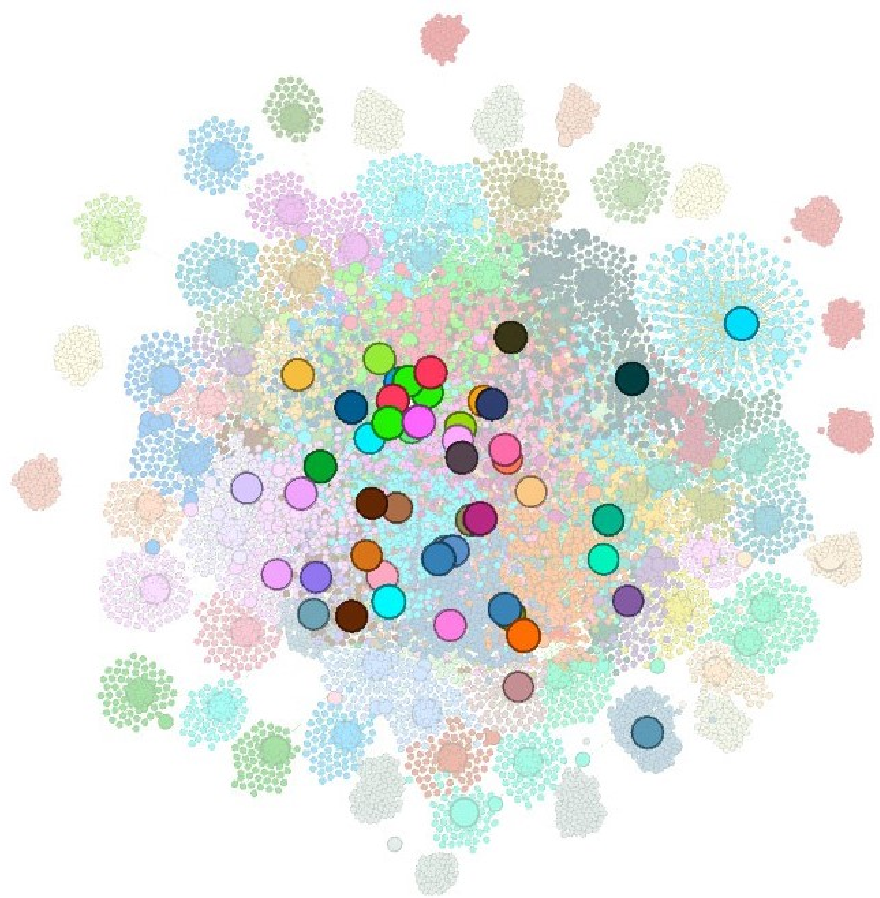 Figure 1: The 49 identified influencers mapped on the supergraph. Note how they occupy the 'connective tissue' of the various sub-communities.
Methodology: Proving Contagion
To prove that influencers cause behavior changes (rather than just attracting active players), the team used a quasi-experimental pre/post design. They tracked players for two weeks before and two weeks after they joined an influencer’s network.
The DVs (Dependent Variables) were:
- Daily Playtime: A proxy for engagement.
- Social Play Ratio: The percentage of time spent in groups vs. solo.
Key Findings: The "Elite" Fallacy
The results were striking. While Power Users (the top 5% of earners/killers) play the most, they have almost zero impact on the behavior of those around them. They tend to stick to their own small, elite circles.
| Metric | Impact of Influencer | Impact of Power User |
|---|---|---|
| Daily Playtime | Significant Increase (+24%) | No Significant Change |
| Group Play Ratio | Reversed (41% → 59%) | Minor Increase |
| 1-Year Conversion | 26% become Influencers | 6% become Influencers |
 Figure 2: Behavioral shift before and after joining an influencer's circle.
Deep Insight: The Viral Nature of Social Play
The most profound takeaway is the conversion rate. Influencers don't just make people play more; they teach them how to be influencers. This creates a "social backbone" for the game. Even if the original influencer leaves, the "seed" they planted has already converted 1/4 of their circle into new social hubs.
Conclusion & Industry Impact
For game designers and community managers, the message is clear: Stop only rewarding the 'Star Players' for their skill.
The real value lies in the "Social Butterflies"—the players who may have average skill but possess the "connective" personality to unite disparate groups. By using SNA to identify these nodes, developers can foster healthier, more resilient communities that survive long after the initial hype-cycle of a game dies down.
Limitations: The study is limited to a one-degree tie analysis within a 4-player squad context (TCTD). Future work remains to see if these "social butterflies" carry the same weight in massive 100-player Battle Royales or highly competitive 5v5 tactical shooters.