
The Architecture of Persuasion: How Facebook’s Interface Shapes Your Social Behavior
A influência das estratégias persuasivas no comportamento dos usuários no Facebook
This paper explores the implementation of persuasive strategies within Facebook's user interface and their effects on user behavior and attitudes. Utilizing B.J. Fogg's "Captology" framework, the study identifies specific design patterns like "Reduction" and "Conditioning" that steer users toward quantifiable interactions such as "Likes" and "Shares."
TL;DR
Is your social media behavior a choice, or a design outcome? This study analyzes Facebook through the lens of Captology (Persuasive Technology), revealing how simple UI elements like the "Like" button leverage psychological triggers to increase engagement while suppressing dissent. The research proves that the platform's architecture is meticulously designed to make agreement effortless and disagreement cognitively expensive.
Background: The Illusion of Neutral Technology
Digital platforms are often viewed as neutral stages for human interaction. However, in the field of Human-Computer Interaction (HCI), scholars argue that the "architecture" of the tool determines the "form" of the conversation. Borrowing from B.J. Fogg’s seminal work, the authors of this study position Facebook not just as a medium, but as an active Persuasive Tool and Social Actor.
The "Easy Path" to Agreement: Reduction Strategy
One of the most profound insights of this paper is the application of the Reduction Strategy. The goal of reduction is to break complex activities into simple tasks to increase the likelihood of the behavior.
- The Math of Interaction: Using the Keystroke Level Model, the authors calculated that "Liking" a post takes approximately 0.35 seconds. In contrast, typing a meaningful comment takes roughly 70 seconds.
- The Behavioral Cost: Because there is no "Dislike" or "Disagree" button, a user who wants to express a contrary opinion must perform a high-effort task (typing).
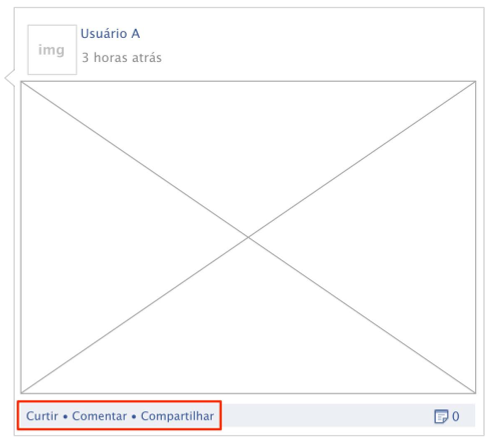 Caption: The primary interaction trio—Like, Comment, Share—where 'Like' represents the path of least resistance.
Methodology: Mapping the Captology Framework
The authors mapped Facebook’s features to Fogg’s seven persuasive strategies. Key findings include:
- Conditioning: The "Like" count acts as a social reward. 54% of survey respondents admit to pre-evaluating their content based on whether it will receive likes.
- Tunneling: The account deletion process is a "tunnel" filled with emotional blocks, such as showing photos of friends with the text "X will miss you."
- Surveillance/Monitoring: The News Feed allows users to monitor others, which in turn motivates them to self-censor or curate their own behavior to fit social norms.
Experimental Results: The Rise of Indifference
The heart of the study lies in its survey of 296 users. The data reveals a stark contrast in behavior based on the software's affordances:
- When users agree: 77% use the "Like" button—it is fast, rewarding, and socially safe.
- When users disagree: In the absence of a "Dislike" button, 47% become indifferent.
This suggests that Facebook’s design doesn't just encourage positivity; it actively erodes the expression of critical thought by making it "too much work."
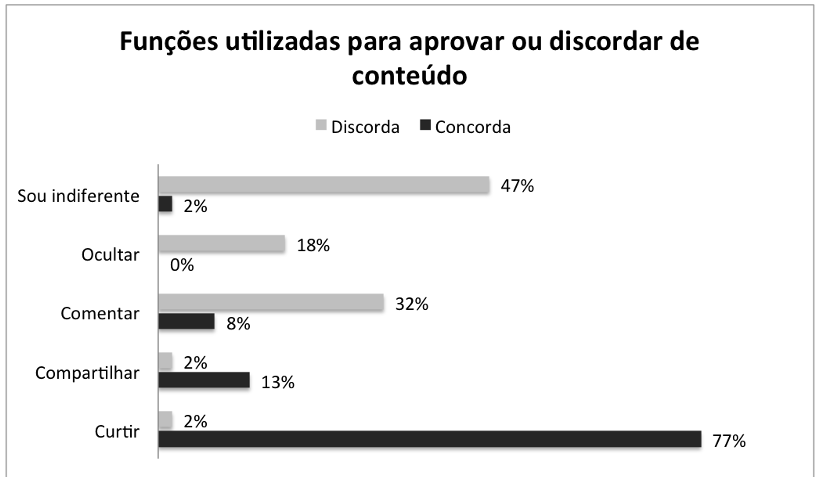 Caption: Comparative analysis of user actions when agreeing vs. disagreeing with content.
Facebook as a "Social Actor"
The study highlights that Facebook has become a "Social Actor" that can socially exclude those who do not use it. With 73% of participants attending events created exclusively on the platform, the machine itself dictates the boundaries of a user's physical social life.
Critical Analysis & Conclusion
This paper serves as a vital reminder of the Inductive Bias inherent in UI design. By making positive reinforcement "cheap" (one click) and critical feedback "expensive" (typing), Facebook successfully conditioned a generation of users toward a culture of consensus and "spectator" behavior.
Takeaways for Designers and Researchers:
- Affordances Shape Values: If you only provide a "Like" button, you value engagement over authenticity.
- The Cost of Friction: Increasing friction for dissent doesn't remove the dissent; it merely turns it into "latent indifference," which can lead to echo chambers.
Limitations: While the study is robust for its time (2014), the landscape has evolved with AI algorithms and multi-emotional reactions. However, the core psychological principle—that we are "users" being "used" by persuasive loops—remains more relevant than ever.