
Copter: Leveraging AI and Choice Theory to Influence Sustainable Urban Mobility
On Influencing Individual Behavior for Reducing Transportation Energy Expenditure in a Large Population
The paper introduces Copter, an intelligent travel assistant designed to reduce urban energy consumption by influencing individual commuter behavior. It integrates AI multi-modal planning with economic choice theory and machine learning to recommend energy-efficient routes that users are likely to accept, achieving a 4.6% reduction in fuel consumption and a 20% reduction in congestion delay in Los Angeles simulations.
TL;DR
Researchers have developed Copter, an AI-driven travel assistant that doesn't just find the fastest route, but the most acceptable sustainable route. By combining machine learning with economic choice theory, the system accurately predicts which energy-saving alternatives a driver is likely to adopt. In a simulated Los Angeles deployment, it cut fuel use by nearly 5% and slashed traffic delays by a staggering 20%.
The "Influence Problem" in Transportation
Urban transportation accounts for roughly 29% of US energy consumption. While we have mastered the "how" of multi-modal routing (getting from A to B via bus, bike, and rail), we have struggled with the "why"—why don't people switch?
The core obstacle isn't a lack of options; it's the Influence Problem. Most AI planners treat humans as rational agents who only care about travel time. In reality, personal context—like household income, vehicle ownership, and past habits—creates a "switching cost" that makes an energy-efficient bus route feel "unacceptable" to a daily driver.
Methodology: Bridging AI Planning and Economics
Copter bridges this gap by redefining what makes a plan "optimal." It uses a two-step process:
- Predicting Preferences: Using a Random Forest model trained on the California Household Travel Survey (CHTS), Copter estimates the likelihood of a person choosing a specific mode (e.g., walking vs. driving) based on their demographics and trip context.
- Calculating Switching Gain: Borrowing from Rational Choice Theory, Copter calculates the "Switching Gain"—the utility difference between a user's status quo and the green alternative.
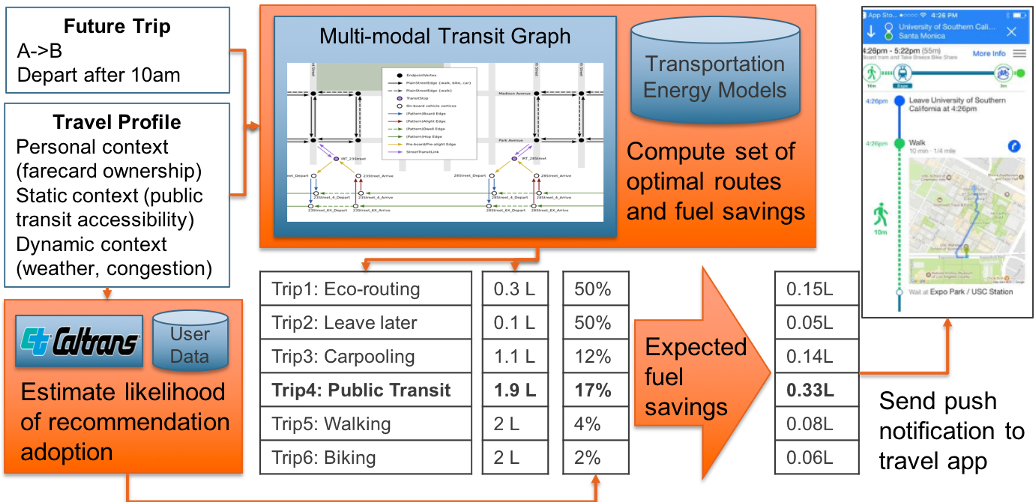
The system doesn't just suggest the greenest path; it selects the path that maximizes:
Putting Humans to the Test
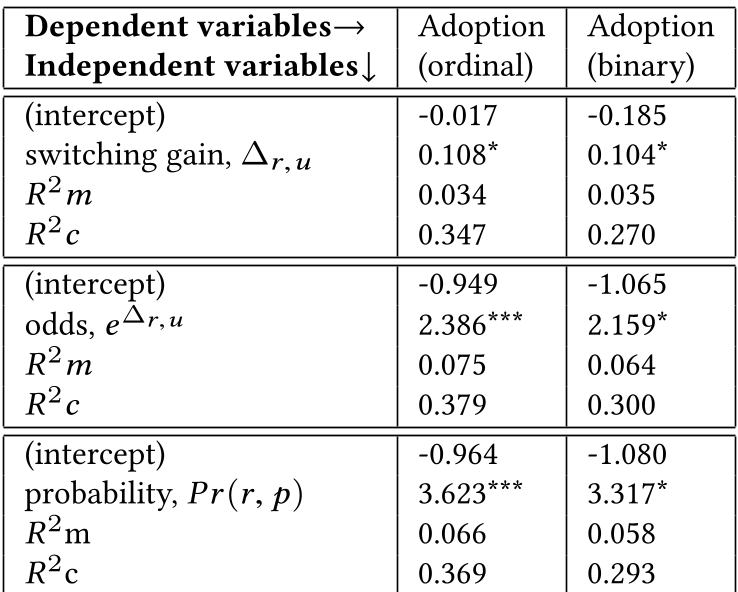
To validate the model, the team conducted a mode adoption study with drivers in Los Angeles. Participants were presented with alternative routes (like taking a bus for a usual commute) and asked to rate their likelihood of switching.
The results, shown in the table below, confirmed that the Odds (derived from their ML model) were the strongest predictor of whether a human would actually follow the AI's advice.
Impact: A Greener Los Angeles
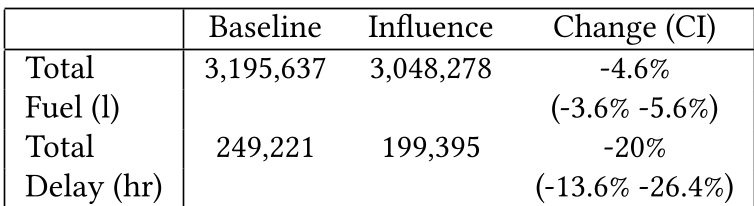
The most compelling evidence comes from high-fidelity simulations of LA traffic. By influencing just 10% of peak-period drivers, Copter generated system-wide benefits that far exceeded the size of the influenced population.
- Fuel Savings: Up to 4.6% reduction in total liters consumed.
- Delay Reduction: A massive 20% drop in hours wasted in congestion.
Critical Insight & Conclusion
Copter proves that Social Good in AI doesn't always require "sticks" like congestion pricing or "carrots" like monetary rewards. By simply understanding the contextual acceptability of a route, AI can nudge populations toward sustainability.
Limitations & Future Work: The current model assumes a fixed "acceptability" baseline. Future iterations could explore compelling messaging (e.g., "This walk will save 5kg of CO2") or Departure Time Optimization to further smoothen the traffic peaks.
Copter represents a shift from "Systems-Centric" to "Human-Aware" AI, proving that the best way to save the planet might just be to understand the person behind the wheel.