
Beyond the Election Surge: Timing Influence in Heterogeneous Societies
Influencing Opinions of Heterogeneous Populations over Finite Time Horizons
This paper introduces a generalized Voter Model to analyze opinion dynamics in heterogeneous populations consisting of conformists, rebels, and strong-willed individuals. Utilizing constant step-size stochastic approximation and ODE analysis, the authors characterize optimal external influence strategies (e.g., advertising) over finite time horizons, challenging the conventional wisdom of back-loading campaigns.
TL;DR
Is it always better to spend your advertising budget in a final "blitz" before the deadline? This paper demonstrates that "Influencing Early" can be mathematically superior to the traditional "Last-Minute Surge" if your audience is prone to conformity. By modeling a heterogeneous population of conformists and rebels, the authors show that early intervention can trigger a "cascading effect" that peer interactions amplify over time.
Problem & Motivation: The Fallacy of the Final Blitz
In election campaigns, we often see a massive ramp-up in advertising in the final weeks. The intuition is simple: influence people close to the voting date so they don't have time to change their minds.
However, this assumes that peer interaction is a "leak" in the system—something that only erodes the influence you've bought. The authors of this paper argue that in a Conformist society, peer interaction is actually a force multiplier. If you influence enough people early on, they will convince their peers, creating a self-sustaining wave of opinion shift. The challenge lies in determining the tipping point where this early cascade outweighs the decay of influence over time.
Methodology: Strong-Willed, Conformists, and Rebels
The researchers generalized the classic Voter Model by introducing three distinct behavioral types:
- Strong-willed (Type S): Immune to peer pressure.
- Conformist (Type C): Likely to adopt the majority opinion.
- Rebel (Type R): Likely to adopt the minority opinion.
Crucially, they allowed individuals to switch between types over time. To make this analytically tractable, they used a Stochastic Approximation Scheme, which allows a complex, discrete-time random process (individuals changing minds) to be analyzed as a continuous Ordinary Differential Equation (ODE).
Model Architecture and Dynamics
The state of the system is tracked by , the fraction of individuals with a "No" opinion. The evolution follows: Where and represent the probabilities of flipping opinions based on the individual's current type and external influence.
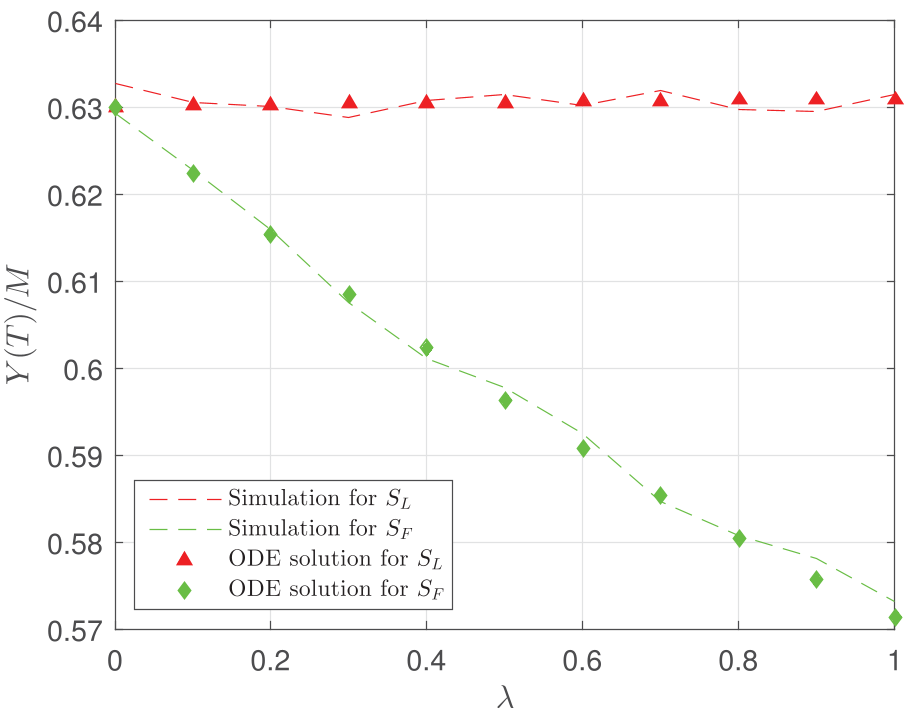 Figure 1: The ODE solution (solid lines) accurately tracks the simulated discrete-time opinion evolution.
Experiments & Results: When to Start the Campaign?
The authors compared two primary strategies:
- (Strategy First): Spend the budget at the very beginning of the time horizon.
- (Strategy Last): Spend the budget at the very end.
Key Findings:
- The Stickiness Factor: If the "Yes" opinion is more "sticky" (harder to flip) than "No," and the population is mostly conformist, is optimal. The early boost in "Yes" opinions creates a majority that pulls the remaining conformists in.
- Rebel Influence: In populations where people tend to rebel (Type R), the "Influence Early" strategy fails miserably. Rebels will see the early majority and move in the opposite direction, making the surge the only viable option.
- The Cross-over Point: For Hybrid populations (S/C), there exists a threshold (fraction of strong-willed individuals). Below this threshold (many conformists), wins. Above it, wins.
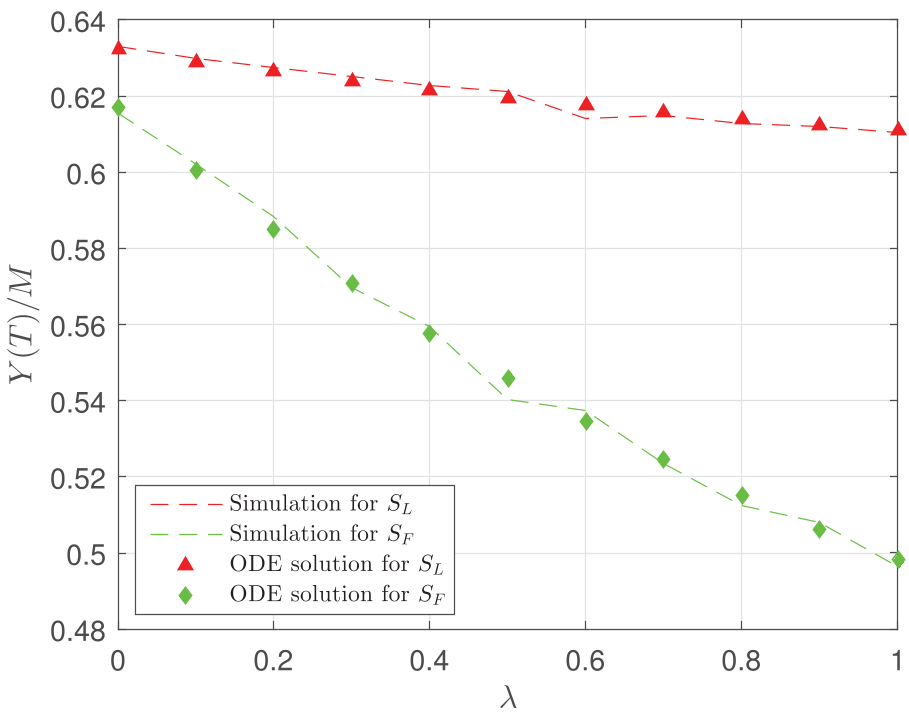 Figure 2: Comparison of the final "Yes" fraction for vs across varying levels of λ (strong-willedness).
Critical Analysis & Conclusion
Takeaway
The research mathematically proves that social context determines optimal timing. Advertisers should front-load campaigns in "trend-following" markets but back-load them in "contrarian" or highly individualistic markets.
Limitations
- Complete Connectivity: The model assumes a "well-connected" society where everyone talks to everyone. In reality, social networks are sparse and modular (echo chambers), which might slow down the cascading effect.
- Binary Opinions: The model uses a 1/0 (Yes/No) opinion set; real-world opinions are often a spectrum.
Future Work
The authors suggest that extending this to complex graph topologies (like Barabási-Albert graphs) and multi-agent competition (two agencies fighting for opinion) are the next frontiers for this framework.