
Scaling Influence Maximization: The Power of Community-Aware Embedding
Identifying Influential Individuals on Large-Scale Social Networks: A Community Based Approach
This paper introduces BCRIM and ICRIM, two community-based approximation algorithms for Influence Maximization (IM) on large-scale social networks. By leveraging network embedding (LINE) and k-means for community detection, the authors restrict the influence search space while specifically accounting for "hub" nodes to maintain high influence spread.
TL;DR
To solve the Influence Maximization (IM) problem on large-scale networks, this research moves beyond the binary choice of "slow but accurate greedy algorithms" vs "fast but unstable heuristics." By combining Network Embedding (LINE) with a community-based search strategy, the proposed ICRIM algorithm achieves a speedup of up to 1,000x over traditional greedy methods while retaining a provable theoretical performance guarantee.
Background: The Social Reach Dilemma
In social network analysis, Influence Maximization is the task of finding a "seed set" of nodes that triggers the largest possible cascade of information or adoption. This is critical for viral marketing and opinion monitoring. However, as networks grow to millions of nodes (like Facebook or WeChat), calculating the expected spread becomes an NP-hard nightmare.
The Core Insight: Communities and Hubs
The authors observe that social networks are not random; they are highly modular. Most influence flows within dense "communities."
- Restricted Scope: Instead of simulating spread across the whole graph, we can estimate a node's power within its own community.
- The Hub Problem: A simple community-only approach misses "bridge" nodes that connect different groups.
- The Solution: BCRIM/ICRIM identifies these influential "hubs" and allows their influence scope to expand into neighboring communities, ensuring that critical bridges are not overlooked.
Methodology
The framework consists of two main phases:
1. Network Embedding Based Community Detection (NECD)
Instead of using traditional modularity optimization, the authors use LINE (Large-scale Information Network Embedding). This converts nodes into low-dimensional vectors that capture both direct (first-order) and structural (second-order) similarities. K-means then clusters these vectors into high-quality communities.
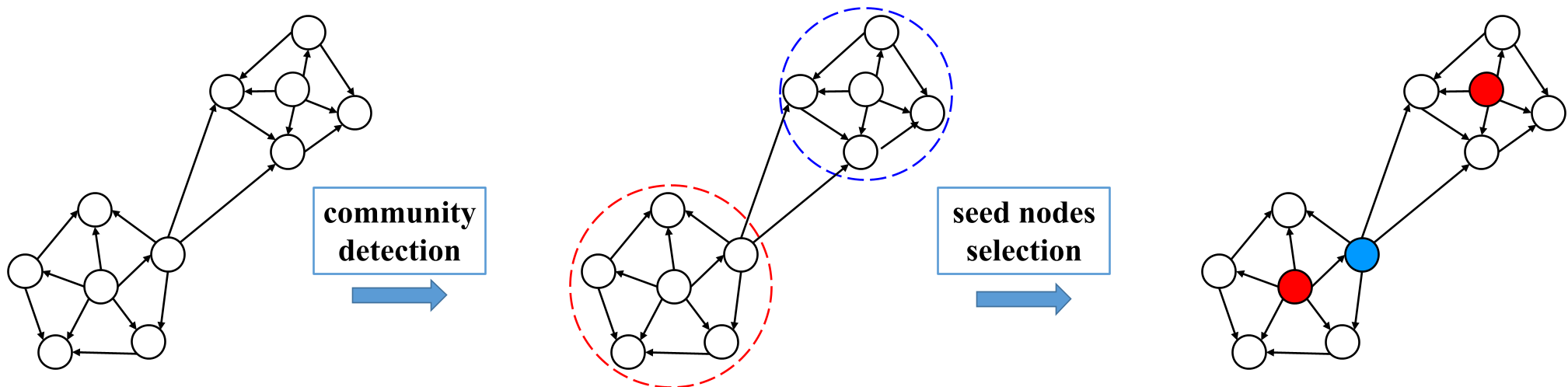
2. High-Efficiency Seed Selection (ICRIM)
The Improved Community-Based Robust Influence Maximization (ICRIM) uses "lazy operations." Since the marginal gain of a node is submodular (it only decreases as the seed set grows), the algorithm maintains a priority queue. It only re-calculates a node's influence spread if its community has been "affected" by a new seed node since its last update.
Experimental Validation
The paper benchmarks the algorithm against five real-world datasets, from the small Wikivote to the million-node Lastfm.
Speed Performance
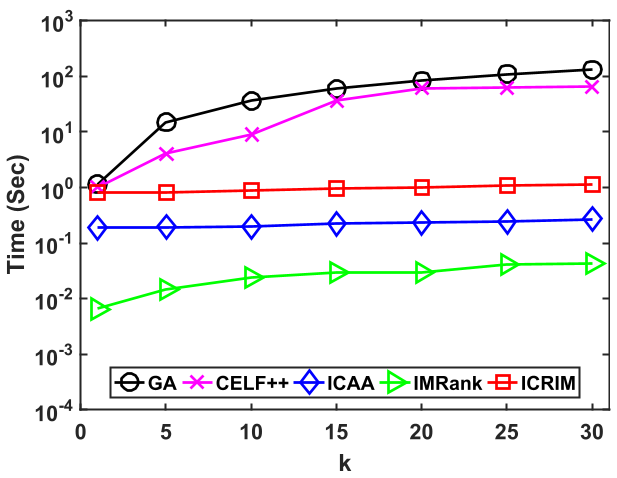
In terms of running time, ICRIM stays nearly flat while traditional greedy algorithms (GA and CELF++) scale exponentially. For small networks like Facebook, the difference is minutes versus days.
Effectiveness
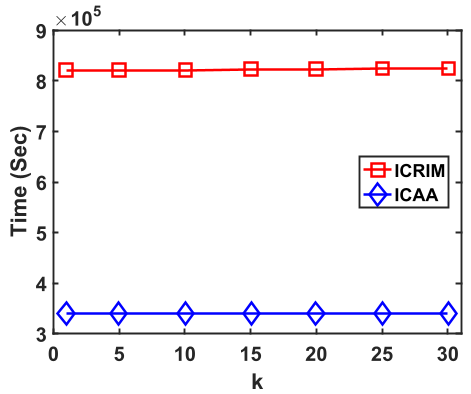
Despite the massive reduction in search space, the influence spread remains competitive with the optimal greedy results. In the Independent Cascade (IC) model, ICRIM captures hub nodes that a standard community-exclusive approach (ICAA) misses, consistently yielding higher reach.
Deep Insight & Conclusion
The mathematical beauty of this paper lies in Theorem 4, which proves that the approximation ratio of these community-based methods is . This ensures that even though we are cutting corners for speed, we are doing so with a safety net.
Takeaway: If you are dealing with real-world graphs, don't treat them as a flat structure. Use embedding-based communities to "localize" your simulations, but always keep an eye on the "hubs" that traverse the boundaries.
Limitations: The Linear Threshold (LT) model still remains computationally expensive compared to the IC model, and the authors aim to further optimize the LT diffusion simulations in future work.