
Leveraging Influence: The Future of Data Dissemination in Mobile Social Networks
Influential nodes selection to enhance data dissemination in mobile social networks: A survey
This survey provides a comprehensive analysis of influential node selection techniques within Mobile Social Networks (MSNs) to enhance data dissemination and offload cellular traffic via Device-to-Device (D2D) communications. It categorizes existing methodologies into protocol-based, collaboration-based, and community-based schemes, positioning MSN as a vital component for high-capacity 5G and future 6G networks.
TL;DR
As mobile data traffic threatens to overwhelm cellular infrastructure, Mobile Social Networks (MSNs) offer a solution by offloading traffic to local device-to-device (D2D) links. This survey explores the "Influential Node" problem—identifying the optimal users to serve as data anchors—and maps out the transition from simple connectivity to social-aware 5G networks.
The Core Challenge: The Redundancy Paradox
A staggering portion of mobile traffic is composed of highly popular content—ranked lists, viral videos, and breaking news. In a traditional centralized architecture, every user pulls the same content from the Base Station (BS), leading to massive backhaul redundancy.
The insight behind MSNs is simple: if User A has already downloaded a video, why should User B (standing five meters away) use cellular bandwidth to get it? The challenge, however, lies in seed selection. If we push content to the "wrong" nodes, the opportunistic "store-carry-forward" mechanism fails to reach the rest of the crowd.
Taxonomy of Influence
The paper categorizes the selection of these "digital influencers" into four distinct technical schools:
- Protocol-based (e.g., iWander): Highlighting the "friendship paradox" (your friends likely have more friends than you do), using random walks to find high-centrality nodes.
- Multidimensional Collaboration: Systems like TOSS and TASA that weigh offline mobility (how often you move and meet people) against online influence (your social media reach and tags).
- Community-based Logic: Using modularity and edge-betweenness to partition the network into clusters. By finding the "bridge nodes" between communities, dissemination speed is maximized.
- Influence Maximization: Viewing the network as a probabilistic graph where "infecting" a seed node spreads the "content virus" across the network using submodular optimization.
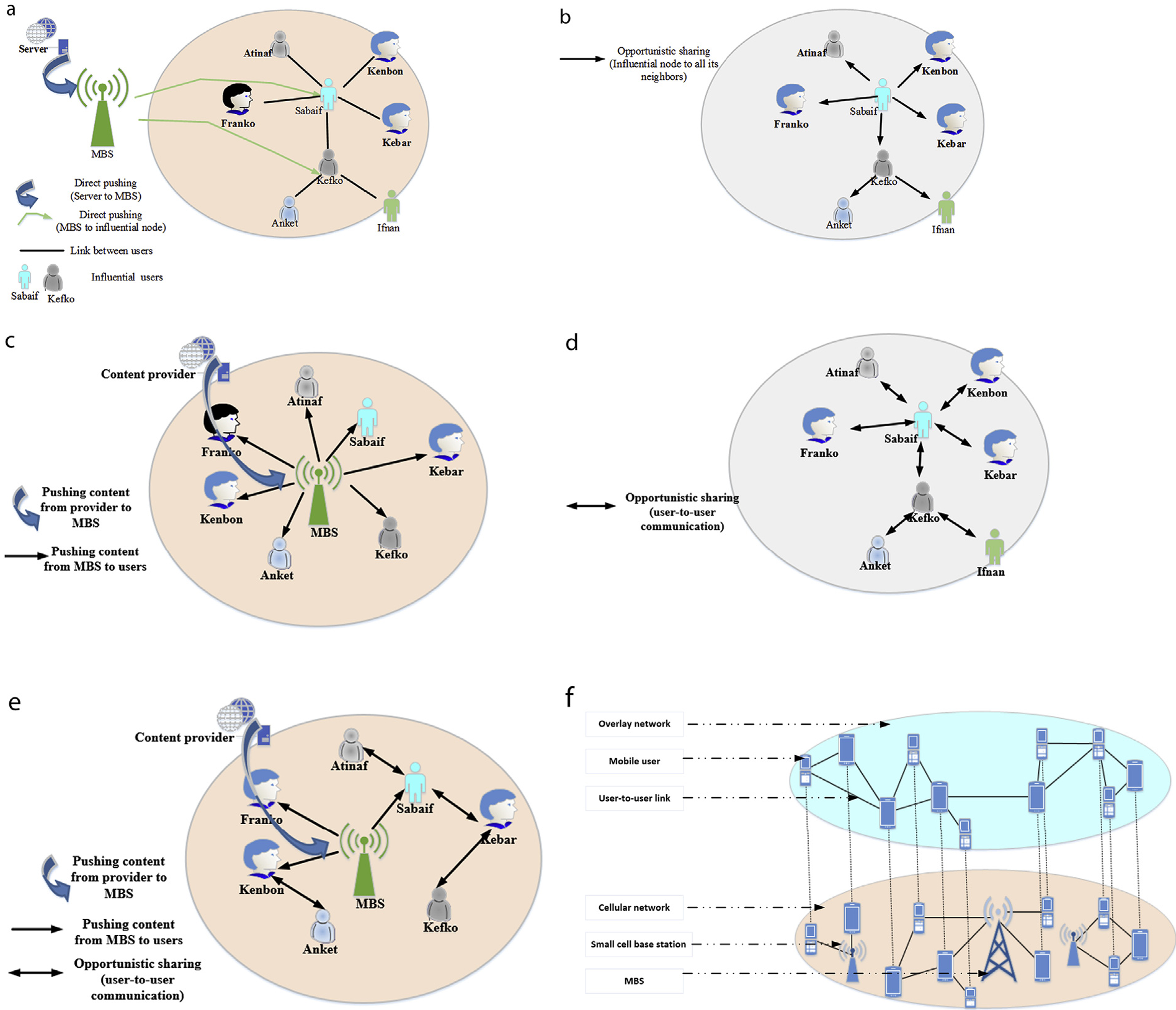 Figure 1: Comparison of Centralized, Distributed, and Hybrid MSN Architectures for traffic offloading.
Methodology: From Topology to Physical Reality
The survey bridges the gap between graph theory and physical constraints. It notes that nodes in an MSN are not just vertices; they are humans with:
- Mobility Patterns: Human movement is rarely random (often following Levy-walk patterns), making contact history a strong predictor of future dissemination.
- Social Selfishness: Users may refuse to help others to save their own battery. The paper reviews incentive schemes that treat data forwarding as a "game" where cooperation must be rewarded.
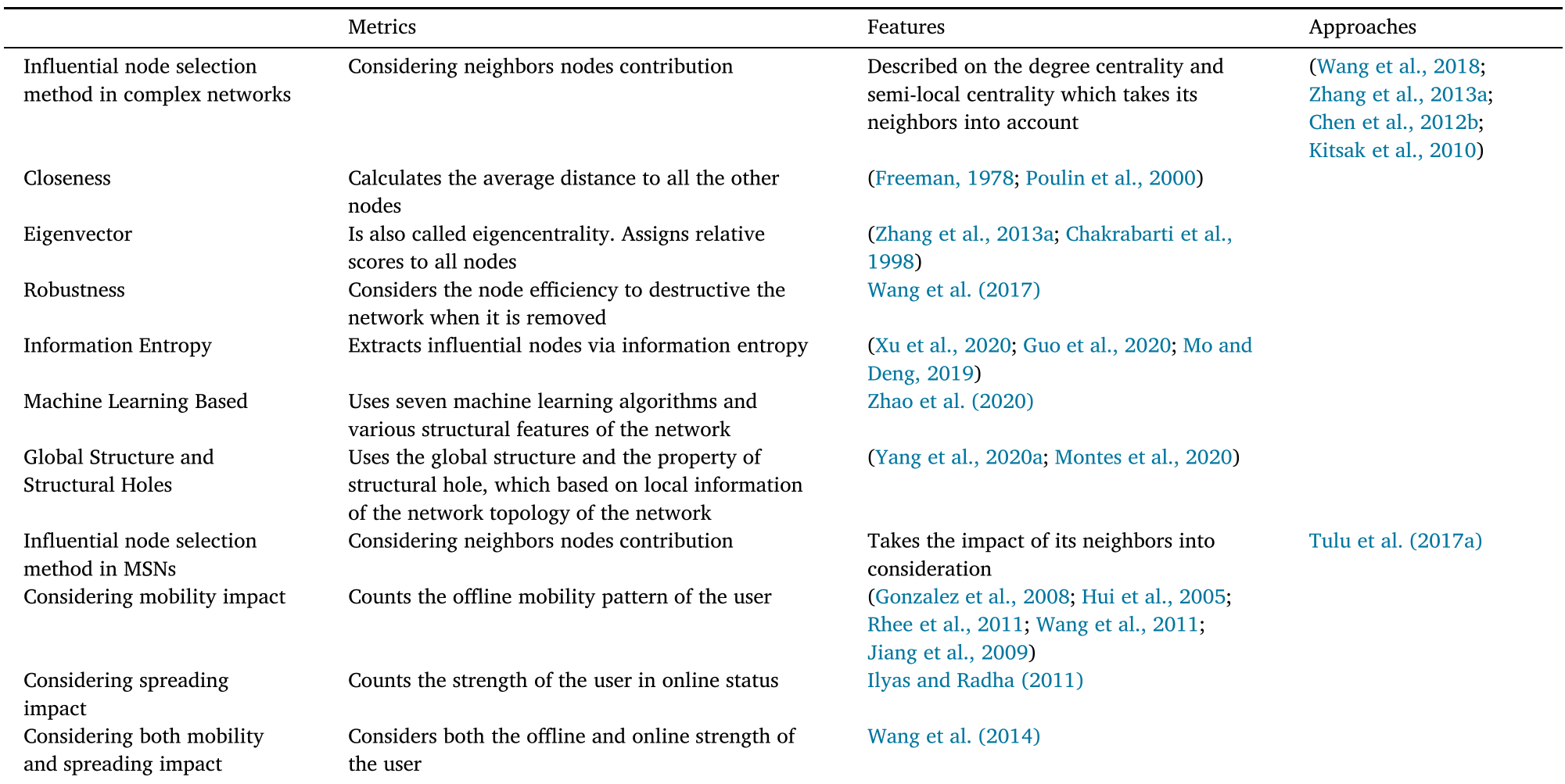 Table 1: Summary of metrics used to identify influential nodes, from degree centrality to information entropy.
The 5G/6G Perspective: AI and Deep Learning
As we move toward 2026 and beyond, the complexity of MSNs scales exponentially with the Mobile Internet of Things (mIoT). The authors identify three "Frontier Technologies" for the next generation:
- Game Theory: Modeling the interaction between rational, selfish nodes to ensure network stability.
- Artificial Intelligence: Using AI for link prediction—predicting who will meet whom before it happens.
- Deep Learning: Specifically using Natural Language Processing (NLP) on social feeds to predict content popularity and optimize cache hit rates at the edge.
Critical Analysis & Conclusion
While MSNs promise to "unclog" our airwaves, the survey acknowledges a significant hurdle: Privacy. Identifying influential nodes requires tracking user locations and social ties, creating a natural tension between network efficiency and individual data sovereignty.
The Takeaway: The success of future mobile networks depends less on "more hardware" and more on "smarter selection." Influential node selection isn't just an optimization problem; it is the fundamental bridge between the social digital layers and the physical wireless layers of our world.