
Designing for Resilience: Finding Influential Successors in Social Networks
Finding influential seed successors in social networks
This paper introduces the "Influential Successors Problem," focusing on identifying replacement nodes (successors) for removed seeds in a social network to maintain influence spread. The authors propose and evaluate five neighborhood-based heuristics, with the "Community Degree" method consistently achieving SOTA-level recovery of influence propagation.
TL;DR
In the volatile world of social networks, influencers and "seeds" are not permanent. Whether a salesperson leaves a company or a key researcher retires, their departure creates a vacuum in information flow. This paper tackles the Influential Successors Problem: how to automatically select a neighbor to inherit the "influence duty" and prevent the collapse of information spread. The winner? Community-aware heuristics that prioritize bridging power over mere popularity.
Problem & Motivation: The "Retiring Seed" Dilemma
Most research in Influence Maximization (IM) targets the "static start" problem—how to pick the initial nodes to start a viral campaign. However, real networks are dynamic. Nodes vanish.
The authors argue that when a seed is removed, we cannot simply re-run a global greedy algorithm (which is computationally expensive). Instead, we need a local "successor" strategy. Their core insight is that a successor should ideally be a neighbor of the removed node, reflecting real-world transitions where duties are handed to close associates.
Methodology: Five Strategies for Handover
The researchers tested five distinct philosophies for choosing a successor () from the neighborhood of the removed seed ():
- Degree: Hire the most popular neighbor.
- Degree Discount: Hire the neighbor with the most untapped potential (discounting connections to existing seeds).
- Overlapping: Hire the "closest friend" (maximal common neighbors). Surprisingly, this performed poorly.
- Community Bridge: Hire the neighbor who connects to the most diverse "cliques," acting as a structural bottleneck.
- Community Degree: a hybrid approach combining raw popularity and bridging potential.

Experimental Insights: Community is King
The authors used the DBLP co-authorship network (22k nodes, 49k edges) to simulate real academic influence. They measured the Normalized Decay—how much of the original influence was lost after the seeds were replaced.
Key Findings:
- The "Best Friend" Paradox: The "Overlapping" heuristic—selecting the person with the most common friends—consistently performed the worst. This suggests that "redundancy" is the enemy of influence; if you and I share all the same friends, you aren't helping me reaching new audiences.
- The Power of Bridges: The Community Degree method proved most resilient. By selecting successors who bridge different clusters, the network maintains its "reach" across disciplinary boundaries.
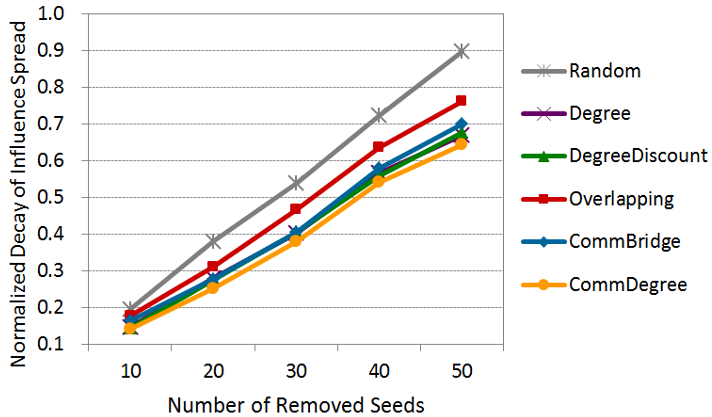 Figure 1: Performance under random removal. Notice how the Community-based methods stay higher on the Influence Spread axis.
Critical Analysis & Conclusion
This work highlights a critical but often ignored aspect of network theory: Robustness.
Pros: The heuristics are computationally "cheap" because they only require looking at 1-step or 2-step neighborhoods, making them viable for massive, real-time social platforms.
Limitations: The study focuses only on local successors. In some cases, a node from a completely different part of the graph might be a better replacement, though it might lack the "contextual authority" of a neighbor.
Future Outlook: As we move toward AI-driven marketing, algorithms that can predict "influence churn" and pre-identify successors will be vital for maintaining long-term brand presence in decentralized networks.