
Beyond Follower Counts: Decoding Social Influence through Starters and Connecters
Identifying Influential Users by Their Postings in Social Networks
The paper proposes a dual-layer graph framework to identify influential social network users based on topical interactions rather than static follower counts. It introduces a Post Graph to User Graph conversion methodology and defines two unique influence roles: Starters (conversation initiators) and Connecters (bridges between disparate discussion hubs).
TL;DR
In the world of social media, having a million followers doesn't necessarily make you an "influencer" on specific topics. This paper moves beyond static network analysis to propose a dynamic, topical graph model. By distinguishing between Starters (those who trigger discussions) and Connecters (those who bridge different discussion clusters), the authors provide a mathematically rigorous way to identify who actually drives the conversation.
The Problem: The Follower Count Paradox
Most influence metrics, including the famous Klout score or early versions of TwitterRank, suffer from a "static bias." They assume that influence is a permanent trait of a user link. However, actual influence is topical and interdependent. Existing methods often overlook the specific interactions within a thread and fail to account for implicit relationships—where a user is inspired by a post without directly replying to it.
Methodology: From Posts to People
The authors argue that to find influential users, you must first find influential content. They propose a dual-graph architecture:
1. The Post Graph Model (The "What")
Posts are modeled as nodes in a Directed Acyclic Graph (DAG). Edges are defined by:
- Explicit Relationships: Direct replies, retweets, or citations.
- Implicit Relationships: Determined by content similarity and temporal proximity.
To measure influence within this graph, the paper leverages three sophisticated metrics:
- Degree Measure: Identifying "Starters" who have high in-degree (many responses) but low out-degree (they aren't just replying to others).
- Shortest-Path Cost Measure (SCM): Measuring how the "connectivity" of the graph collapses if a specific post is removed.
- Graph Entropy Measure (GEM): Using information theory to find nodes that contribute most to the structural complexity of the conversation.
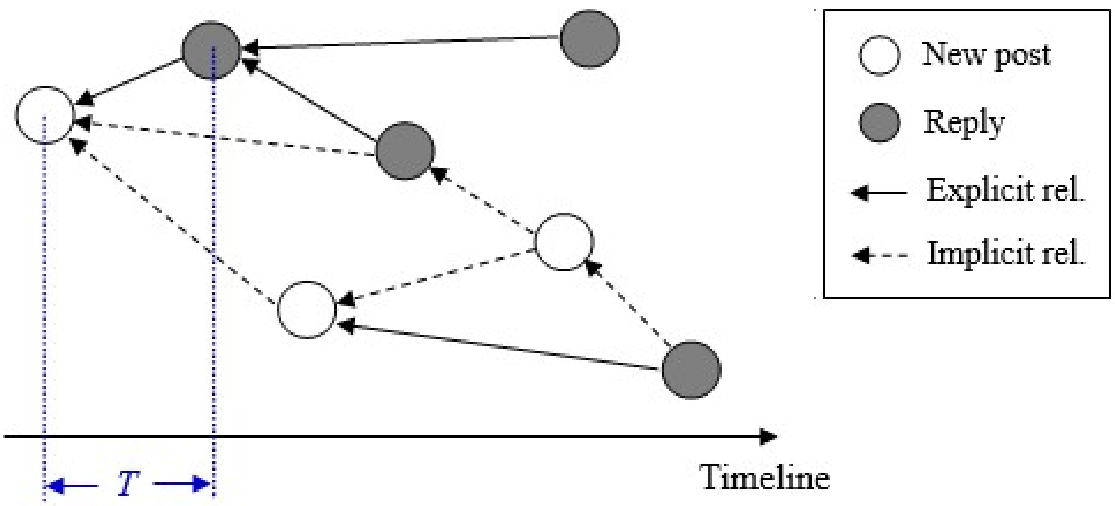
2. The User Graph Model (The "Who")
The post graph is then collapsed into a user graph. This isn't a simple one-to-one mapping. The authors use m-reach graphs to consolidate the influence of a user who might have made multiple starter posts. This prevents "double-counting" and accounts for the density of the community the user influences.
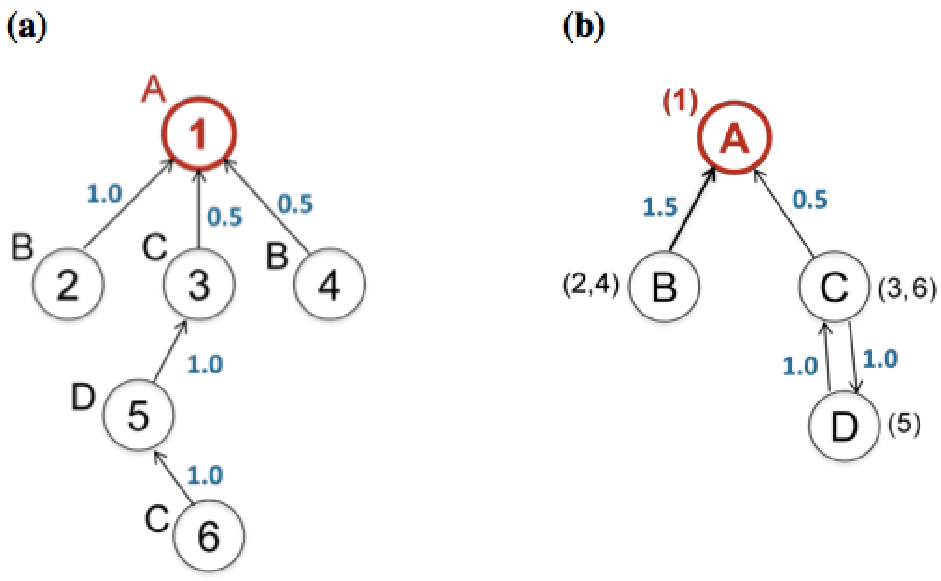
Starters vs. Connecters: A Critical Distinction
The paper’s most vital insight is the role of the Connecter.
- Starters are the "Hubs." They are essential for beginning the wave.
- Connecters are the "Bridges." Without them, a topic stays trapped within a single sub-group. A connecter might not have the most followers, but they are the reason a discussion jumps from "Tech Twitter" to "Finance Twitter."
Experimental Insights
Testing against real-world data (Twitter data concerning Steve Jobs and the Lushan Earthquake), the researchers found that:
- Graph Entropy (GEM) is significantly more effective than traditional degree measures at finding the true "Starters" of a viral trend.
- Identifying Connecters requires looking at "Virtual Edges"—paths between distant hubs that only become apparent when you analyze the flow of information across different threads.
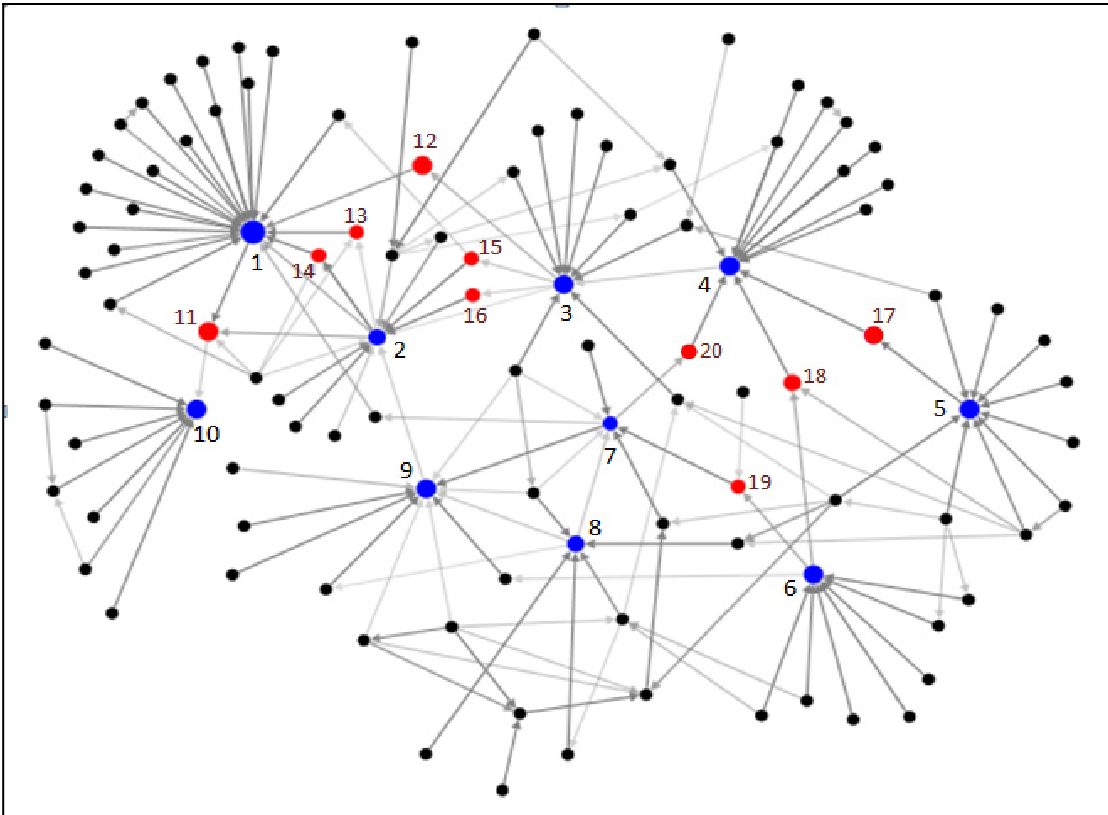
Deep Insight & Conclusion
This work shifts the paradigm of influence from "who you know" to "how you participate." By focusing on the functional role of a user (Starter vs. Connecter), the model provides a more granular view of social dynamics.
Future Outlook: As we combat the spread of misinformation, the "Connecter" identification becomes crucial. Identifying the bridge nodes that link echo chambers could be the key to designing more effective social interventions. While this model relies on text similarity for implicit links, integrating modern LLM-based embeddings could further refine its accuracy.
Takeaway: Don't just look for the loud voices (Starters); look for the bridges (Connecters) that carry the message across the network.