
Info-Cluster: Unlocking the Power of Geography in Social Influence Analysis
Info-Cluster Based Regional Influence Analysis in Social Networks
The paper introduces "Info-Cluster," a novel concept and framework for regional influence analysis in social networks. By integrating K-Means for spatial clustering and modularity-based community detection, the authors developed the Influence Propagation Based Info-Cluster Detection (IPBICD) algorithm to identify how information spreads from specific geographical regions across social structures.
TL;DR
Information doesn't just spread through "who you know"—it spreads through "where you are." This paper introduces Info-Cluster, a framework that merges spatial K-Means clustering with social community detection to quantify regional influence. By testing on Renren (China's Facebook equivalent), the authors prove that geographic "capitals" have vastly different powers to trigger information cascades across the network.
Background & Motivation: The Missing Link in Influence
Traditional influence analysis treats social networks as abstract graphs of nodes and edges. While community detection (finding "who hangs out with whom") is a mature field, it often ignores the physical reality of the users.
The authors argue that location information implies abundant metadata about individuals. A "regional influence" perspective is vital for viral marketing—if a brand wants to launch a product in a specific city, they need to know not just who the influencers are, but which geographical clusters can effectively bridge information into diverse social communities.
Methodology: The Info-Cluster Framework
The core contribution is the IPBICD (Influence Propagation Based Info-Cluster Detection) algorithm. The process operates in three distinct phases:
- Spatial Layer: K-Means clustering groups individuals based on their physical coordinates (GPS/trajectories).
- Social Layer: Modularity-based algorithms (maximizing ) partition the network into community structures.
- Propagation Layer: This is where the magic happens. The authors define a unique activation threshold and a probability function that considers:
- : Probabilities for intra-community influence (high trust).
- : Probabilities for inter-community influence (weak ties).
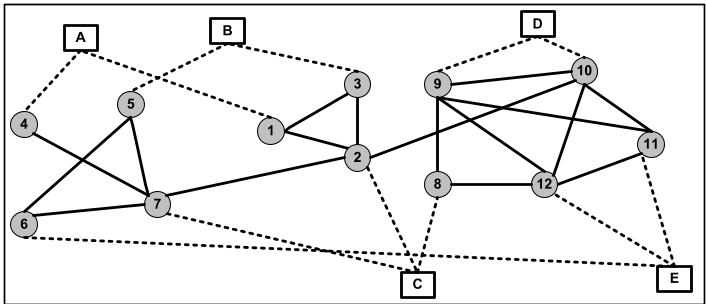 Figure 1: The hybrid data model connecting Individuals (V), Locations (L), and their social/spatial interactions.
The Activation Logic
An individual is "activated" (joins the Info-Cluster) if their cumulative neighborhood influence exceeds the threshold . The model separates nodes into:
- Capital Nodes: The original influencers in a location cluster.
- Influence Nodes: Those successfully activated by the capital.
- Know Nodes: Those who heard the info but did not "buy-in" (inactive).
Experimental Insights from Renren Data
Using a real-world dataset from Renren, the authors analyzed how influence spreads across China.
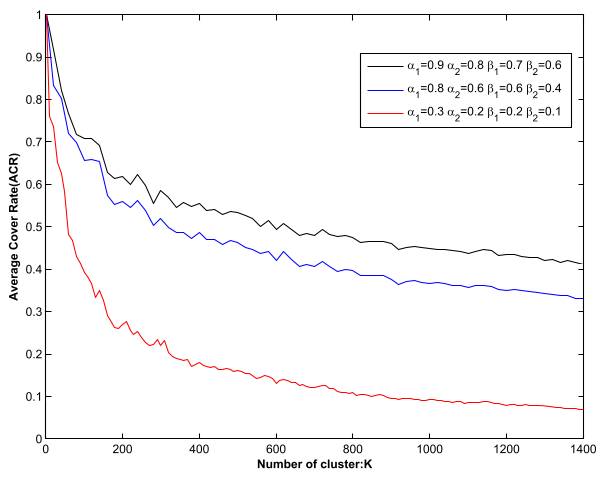 Figure 2: The Average Covering Rate (ACR) generally decreases as the number of clusters (K) increases, as source clusters become smaller and more localized.
Key Findings:
- Density Matters: The Beijing region showed the highest Covering Rate (CR), suggesting that high population density and high social connectivity in urban hubs act as a "super-spreader" for information.
- Non-Linear Influence: Having more people in a "Capital" set doesn't always lead to higher influence. The experiment showed that 30 highly connected individuals in one region could outperform 100 individuals in a less "central" geographic cluster.
- East vs. West: Visual mapping on the Chinese map revealed that information from eastern Info-Clusters (more developed, higher social density) spreads significantly wider than western ones.
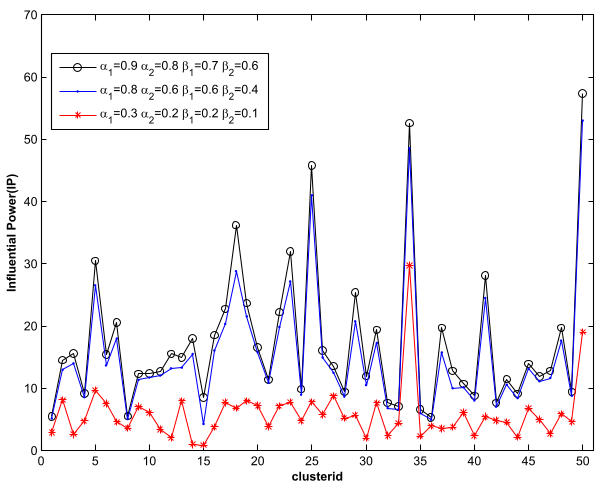 Figure 3: Influence Power (IP) for various capital sets, identifying "influential regions" versus "weak regions."
Critical Analysis & Conclusion
The Info-Cluster concept successfully bridges the gap between spatial data mining and social network analysis. By moving beyond a "flat" graph and into a "geo-social" model, it provides a practical tool for regional strategy.
Limitations: The current model uses a static K-Means approach for location. In reality, users move (trajectories). A dynamic Info-Cluster model that accounts for temporal-spatial shifts would be the logical next step.
Future Outlook: This framework is a precursor to modern Location-Based Social Network (LBSN) analysis. For practitioners in digital marketing or urban planning, the takeaway is clear: Targeting a community is good; targeting a geo-social cluster is better.