
Information Adoption: Decoding the Tug-of-War Between Repetition and Diversity on Twitter
8021_Information Adoption via Repeated or Diversified Social Influence on Twitter.
This paper investigates information adoption on Twitter by quantifying user susceptibility and adoption thresholds across multiple aggregation levels (item, user, and topic). Utilizing a large-scale dataset of 1.2 million users during the 2019 European Elections, it reveals that social contagion is driven by both repeated exposure and diversified social influence, with retweets being significantly easier to adopt than hashtags.
TL;DR
Why do we retweet some news instantly but wait for five different friends to use a hashtag before joining the trend? This study analyzes 1.1 billion tweets to quantify Susceptibility and Adoption Thresholds. The verdict: while hearing the same thing repeatedly helps, the most powerful trigger for adoption is a new person entering the conversation—a classic hallmark of complex contagion.
The Core Conflict: Frequency vs. Diversity
In the world of social dynamics, two theories compete to explain how we adopt new behaviors:
- Simple Contagion: Information spreads like a virus; a single exposure from one person might be enough, and more exposures simply increase the probability.
- Complex Contagion: Adoption requires a "threshold" of social validation from multiple different sources.
The authors of this paper argue that existing research struggles to distinguish these because they don't look at the right "levels" of data. By tracking 8,527 "seed" users and their entire followee networks during the 2019 European Elections, the researchers sought to find where the "tipping point" actually lies.
Methodology: The Three Levels of Influence
The researchers didn't just look at one hashtag. They broke down influence into three granularities:
- Item Level: Analyzing the adoption of a specific retweet or hashtag.
- User Level: Measuring a specific person's general tendency to be influenced (their "innate" susceptibility).
- Topic Level: Using Word2Vec and K-means clustering to see if we adopt "Politics" differently than "Entertainment."
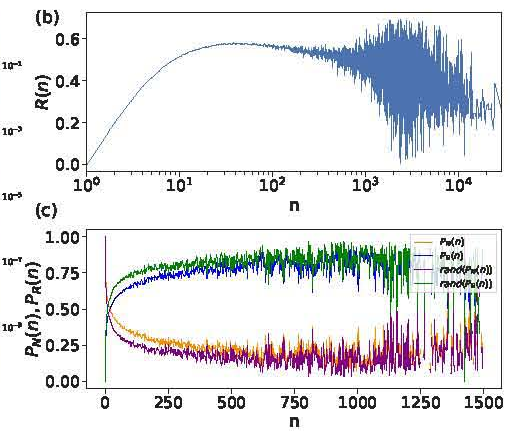 Figure: Analysis of sequence influence—distinguishing between reinforced (R) and new (N) influences.
Key Insights: Retweets vs. Hashtags
The study discovered a massive rift between how we handle different types of content:
- The Low Barrier of Retweets: Retweets are adopted easily. The average susceptibility is high (0.618), and users typically need only 2.6 introductions before hitting "retweet."
- The High Wall of Hashtags: Hashtags represent a deeper commitment. Users need an average of 40.8 introductions before adopting a hashtag, and their susceptibility is much lower (0.095).
Topic-Specific Behavior
Interestingly, topics like Tourism and Entertainment have the highest susceptibility (they are "catchy"), whereas Social Movements (Gilets Jaunes) and Politics have much higher adoption thresholds. This implies that serious or controversial topics require more social "backing" before an individual is willing to participate publicly.
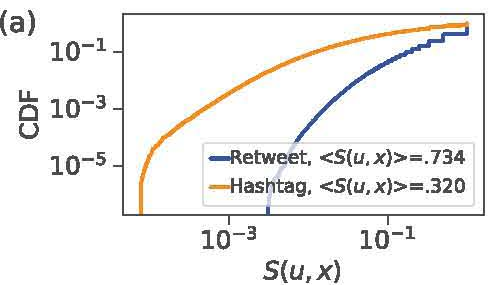 Figure: Cumulative distributions for susceptibility across different hashtag topics.
Why New Voices Matter More Than Repetition
One of the most striking parts of the paper is the "Sequence Analysis." The authors tracked the stream of influence events leading up to an adoption. They labeled influences as:
- N (New): A friend who hasn't posted it before.
- R (Reinforcement): A friend who has already posted it, doing so again.
The results (shown in Figure 3c) indicate that PN(n)—the probability that the last influence before adoption was a new neighbor—is significantly higher than chance. Even after thousands of repeated influences (R) from early adopters, the arrival of a single new voice (N) is often the final trigger that causes a user to adopt.
Critical Analysis & Future Outlook
Takeaway: Diversity of influence is the engine of social spreading. If you want a message to stick, having one "mega-influencer" shout it ten times is less effective than having five "micro-influencers" mention it once each.
Limitations: The study correctly identifies that it cannot see the Twitter "Algorithm" (the feed ranking). Since Twitter doesn't show every tweet to every follower, some "exposures" might never have been seen by the user.
Future Directions: This framework opens the door to better predictive modeling of "tipping points" in social movements. If we can calculate a community's average topic-level threshold, we can predict whether a social movement will remain a niche echo chamber or cascade into a global trend.