
Efficient 5G Caching: Leveraging the Two-Layer Social Cyberspace
Information Caching Strategy for Cyber Social Computing Based Wireless Networks XING ZHANG, (Senior Member, IEEE), YONGJING LI, YAN ZHANG, (Senior Member, IEEE), JIAXIN ZHANG, HAILING LI, SHUO WANG, AND DANYANG WANG
This paper proposes a novel information caching strategy for 5G wireless networks by constructing a two-layer social cyberspace. The framework integrates a Base Station Social Network (BSSN) for traffic correlation and the Indian Buffet Model (IBM) for user interest modeling, successfully achieving up to a 60% network throughput gain through optimized D2D communication and dynamic edge caching.
TL;DR
To combat the exponential growth of mobile traffic, this paper introduces a two-layer social computing framework for wireless networks. By modeling social ties between Base Stations (BSs) and the collective interests of users via the Indian Buffet Model, the authors achieve a 60% gain in throughput and significant backhaul offloading through an intelligent D2D/Cellular hybrid caching strategy.
Background & Motivation: Beyond Static Caching
As 5G matures, the bottleneck often lies in the "backhaul" — the link between local towers and the core network. Localized caching at the mobile edge is the standard solution, but static caching is dead. User interests fluctuate based on social trends, and traffic at one base station is often correlated with another nearby.
The authors argue that existing methods overlook two critical dimensions:
- Traffic Correlation: Base stations aren't islands; they exhibit social-like relationship patterns in traffic spikes.
- Social Influence: User "A" requesting a video often influences User "B" to do the same, a phenomenon perfectly captured by the Indian Buffet Model (IBM).
Methodology: The Two-Layer Architecture
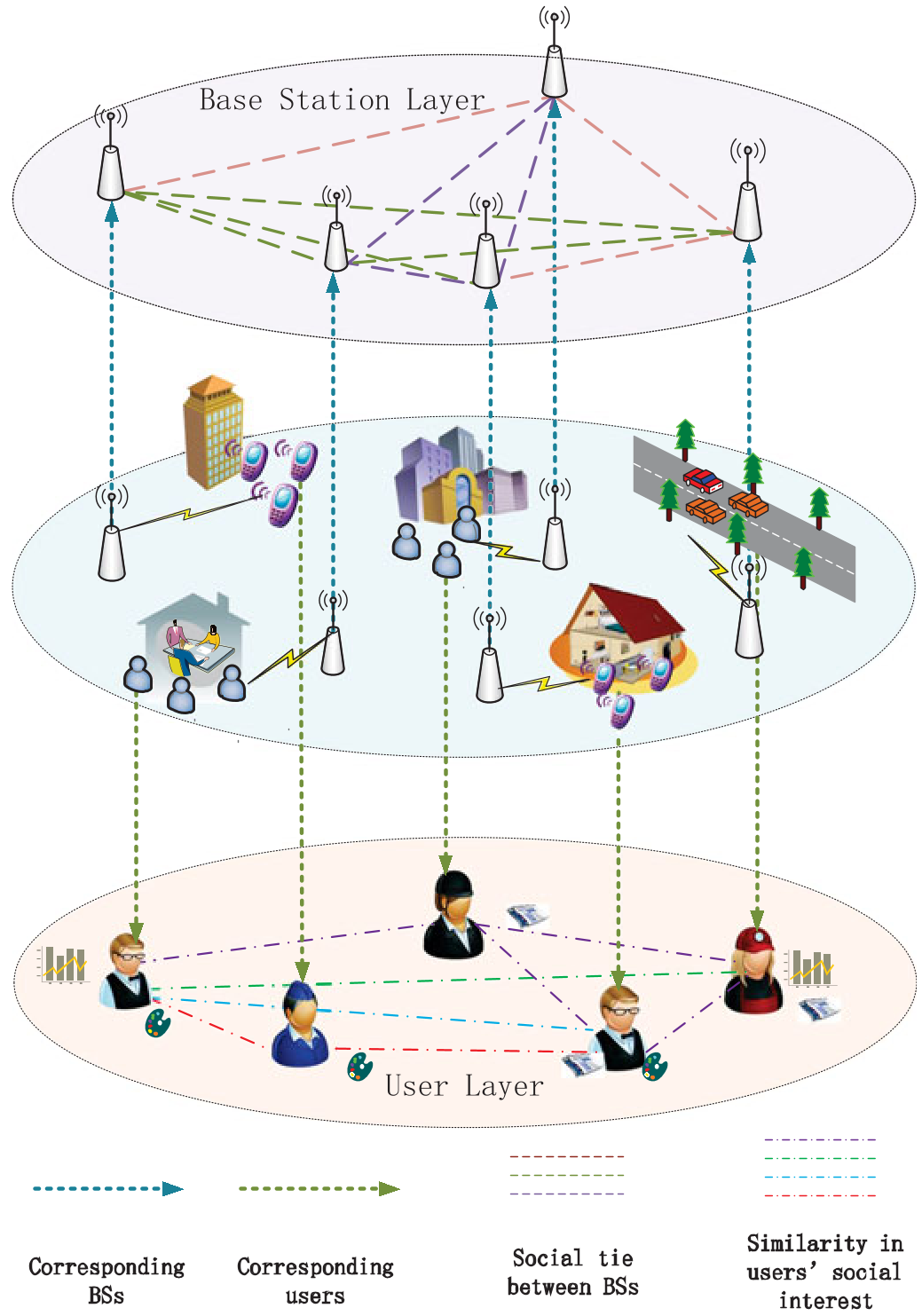
The proposed system decomposes the wireless environment into two distinct social layers:
1. The Base Station Social Network (BSSN)
Using a metric called the Social-Tie Factor (STF) based on traffic volume series correlation, the network categorizes BSs into:
- VIBS (Very Important BSs): High STF; they serve as central hubs for caching and backhaul.
- NSC (Normal Small Cells): These offload their backhaul needs to nearby VIBSs.
- USC (Unique Small Cells): Low correlation BSs that connect directly to the core network.
2. The User Social Layer (Indian Buffet Model)
The user layer mimics a buffet restaurant. The first user chooses "dishes" (content) randomly, but subsequent users are more likely to choose popular dishes while occasionally trying something new.
- D2D Underlay: If a user needs "old content" (already requested by someone else), the system prioritizes Device-to-Device (D2D) communication to fetch it from a nearby pear, saving base station resources.
Core Insights: When Does D2D Work?
The methodology focuses on a "Triple-Condition" check for D2D success:
- Similarity of Interest: Proven by the IBM model history.
- Encounter Duration: Modeled via a Gamma Distribution to ensure the users stay close long enough to finish the transfer.
- Physical Proximity: Users must be within a calculated radius.
Experimental Performance
The researchers used stochastic geometry to derive key performance indicators (KPIs). The findings are striking:
- Throughput Gains: By optimizing the STF threshold () and the VIBS cover radius, throughput can be boosted by 44%. In some D2D scenarios, this gain reaches 60%.
- Energy Efficiency (EE): Since D2D consumes significantly less power than cellular transmission, the total network energy efficiency improves as the D2D communication radius increases.
- Delay Reduction: By fetching content from local D2D partners or VIBS caches, the "retrieval delay" is slashed compared to fetching from the core network.
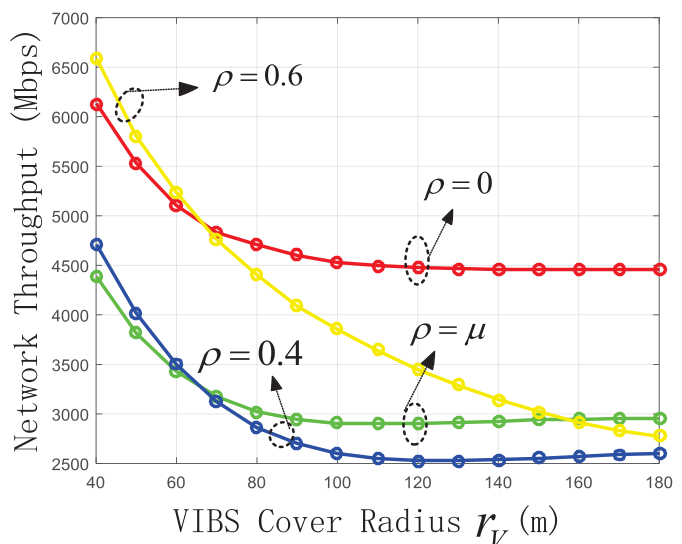 The figure above illustrates that network throughput is highly sensitive to the VIBS coverage radius and the social-tie threshold.
Conclusion & Future Outlook
This paper presents a masterclass in combining high-level social behavior models with low-level physical networking constraints. The Indian Buffet Model provides a mathematically rigorous way to handle content popularity, while the BSSN structuralizes the chaos of base station traffic.
Limitations: The model assumes Rayleigh fading and a specific Gaussian distribution for STF. Future work could benefit from applying these principles to non-terrestrial networks (NTN) or high-mobility scenarios (like V2X), where encounter durations are significantly more volatile.
Final Takeaway: Social computing isn't just for apps like Facebook; it's the next frontier for optimizing the very hardware and protocols that keep us connected.