
Decoding the Viral Loop: A Degree-Aware Propagation Model for Social Networks
The Method of Information Communication of Online Social Network Based on Communication Algorithm
This paper presents a mathematical propagation model for Online Social Networks (OSNs) based on epidemiological principles (SIR/SNS models). Using a communication algorithm, it tracks the transition of network nodes between uninfected, propagating, and immune states, establishing a framework to predict information flow dynamics.
TL;DR
The digital age has transformed every user into a potential broadcaster. This paper introduces an enhanced propagation algorithm for Online Social Networks (OSNs) that classifies nodes into Uninfected, Propagating, and Immune states. By leveraging the mathematical backbone of infectious disease models (SIR) and tailoring it to network topology, the research demonstrates how node connectivity (degree) dictates the speed and saturation of information spread.
Background & Motivation: Beyond the "Balanced" Network
Most early communication models treated social networks as "balanced," assuming every user had a roughly equal chance of seeing and sharing data. In reality, OSNs are Scale-Free. A single "KOL" (Key Opinion Leader) can reach millions, while an average user reaches dozens.
The author argues that to accurately predict how a piece of news goes viral, we must move past simple averages and look at the local topology—the specific connections and "authority" of individual nodes.
Methodology: The Mechanics of Infection
The paper formalizes the information flow using a state-transition system. A node 's probability of being "infected" (receiving information) at time depends on its degree and the state of its neighbors.
The Core Formulas
The probability that a node remains uninfected is calculated as: Where represents the number of already "infected" neighboring nodes. This highlights a physical intuition: the more people around you talking about a topic, the harder it is for you to remain "uninfected" by that information.
Structural Insight
The model integrates a Degree Correlation Function , which represents the probability that a node of degree is connected to a node of degree . This is crucial for modeling "hubs" in a network.
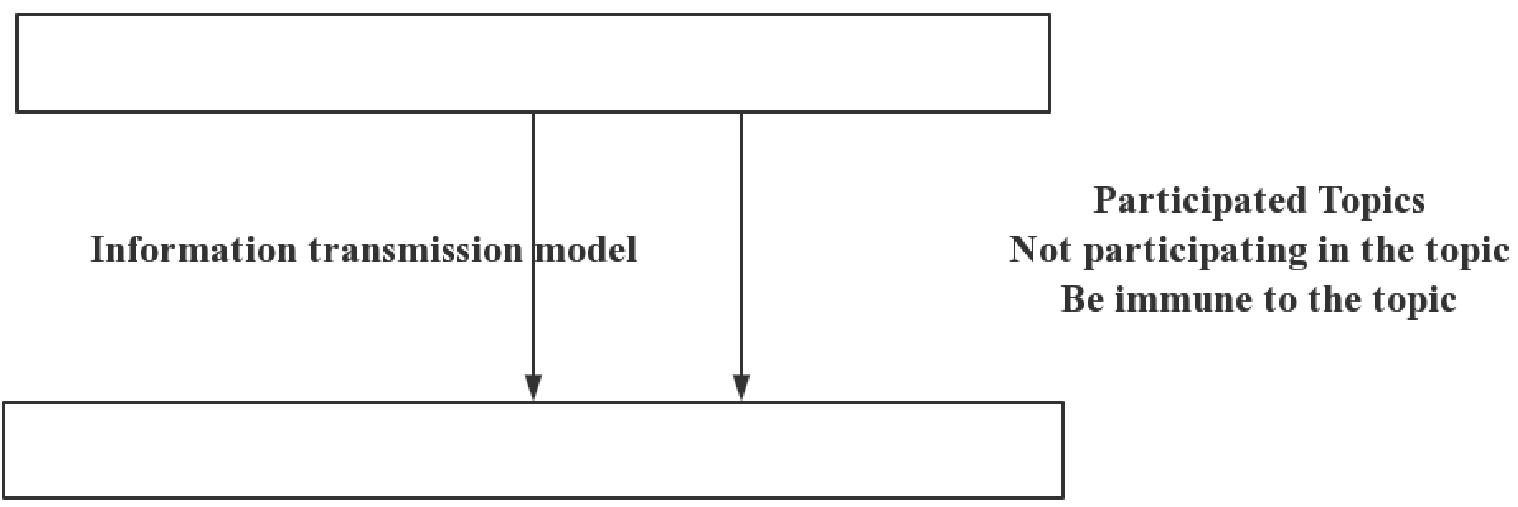 Fig 1. The classic SIR-based infectious disease framework adapted for information flow.
Experiments: What the Data Shows
To validate the model, the author simulated a network of 10,000 nodes with an average degree of 14.85.
- Phase Transition: Information initially spikes as it hits well-connected hubs, then tapers off as the majority of the network becomes "immune" (either loses interest or has already seen the info).
- Degree Sensitivity: The study compared nodes of different degrees ( through ). The results were clear: nodes with higher degrees (more neighbors) are infected much earlier and serve as the primary conduits for viral spread.
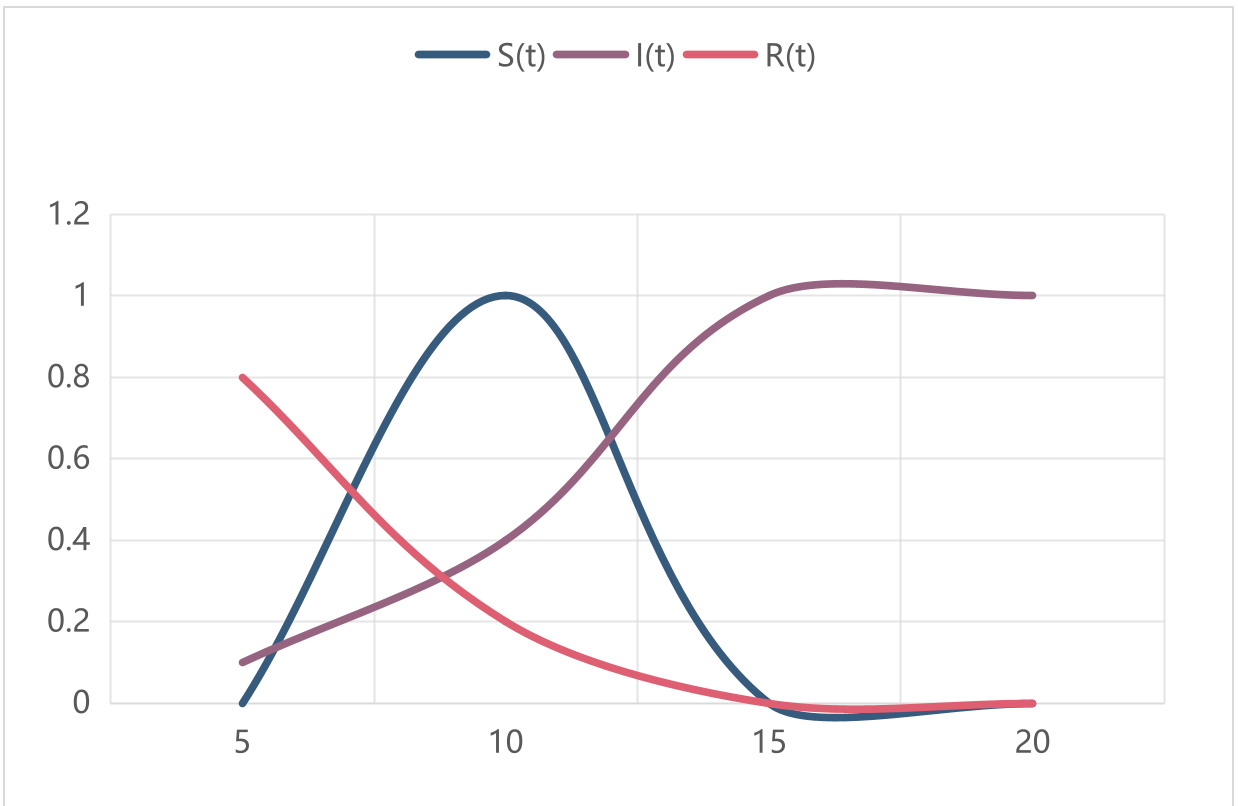 Fig 2. The evolution of Uninfected, Propagating, and Immune nodes over 300 iterations.
Critical Insight & Future Outlook
While the paper successfully applies mathematical epidemiology to digital networks, it acknowledges a present limitation: the Static Topology. In real life, social links are dynamic—we follow and unfollow people daily.
Key Takeaways for Future Research:
- Dynamic Links: Models need to account for time-varying relationships.
- Trust Factors: Propagation isn't just about connectivity; it's about the "Trust Degree" between users, which can be mined using data analysis.
- Real-world Verification: Moving from simulated 10k-node networks to massive, multi-million node real-world datasets (like X/Twitter or Weibo) is the next frontier.
Conclusion
This research bridges the gap between traditional social science and algorithmic network analysis. By quantifying the "infection" probability through node degrees, it provides a scientific basis for understanding why certain information dies in obscurity while others dominate the global conversation.