
Modeling the Pulse of Social Media: Time-Awareness and Superposition in Information Diffusion
Information Diffusion Model Based on Social Big Data
This paper introduces a specialized Information Diffusion Model for social media (Sina Weibo) that integrates temporal user behavior and "superposition theory." By combining exponential growth trends with sine-wave fluctuations for overnight periods and accounting for influential "key nodes," the model achieves high accuracy in predicting reposting dynamics.
TL;DR
Information on social networks doesn't just spread; it breathes with the rhythm of the users and leaps through the influence of key nodes. This paper presents an information diffusion model tailored for Sina Weibo that accounts for nighttime activity troughs using sine-wave adjustments and utilizes superposition theory to calculate the explosive impact of influential "Key Nodes."
The Missing Piece: Why Traditional Models Fall Short
Most classic models (like the SIR epidemic model or Independent Cascade) view information spread as a continuous process. However, the reality of Social Big Data reveals two major disruptions:
- The Human Factor: People sleep. A post made at 9:30 PM faces a natural "lull" during the early morning hours that standard exponential models fail to capture.
- The Influencer Effect: Not all nodes are equal. A single repost by a verified account with millions of followers can restart the diffusion process, creating a "second wave" that looks like an anomaly in standard models.
Methodology: The Core Mechanics
1. Temporal Dynamics (The Sine-Wave Correction)
The authors observe that while the general trend of reposting follows an exponential decay (), significant fluctuations occur between midnight and 5:00 AM.
To fix this, they introduce a sine function to model the "trough" of social activity: This allows the model to align with the real-world temporal distribution of netizens, where "Phase" () represents the gap between the post time and the natural human activity cycle.
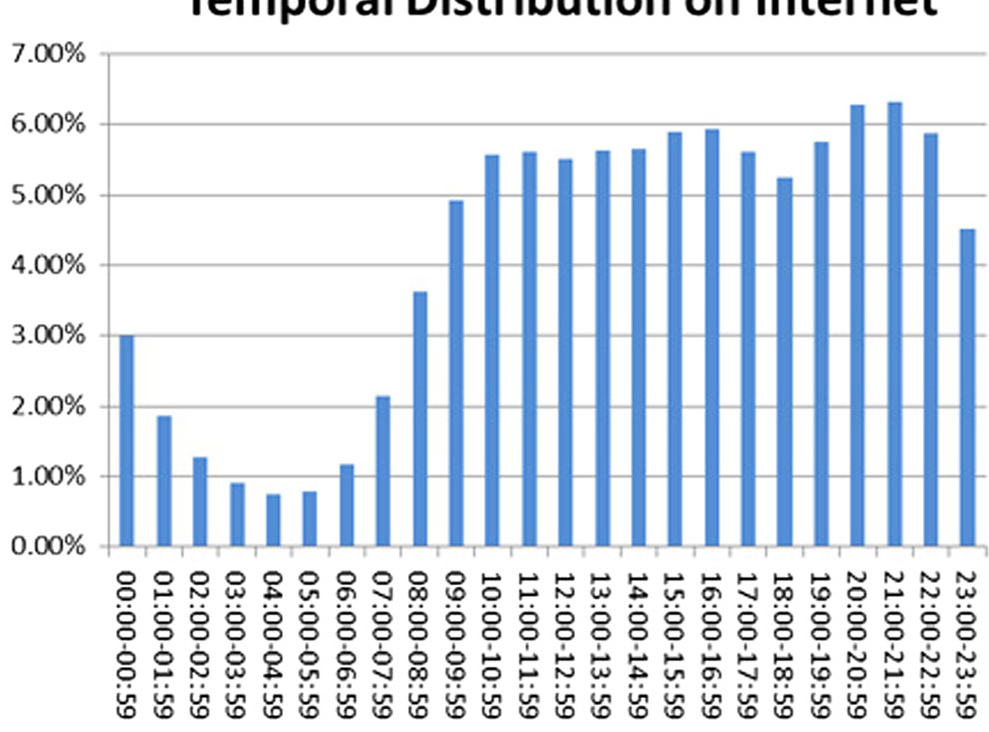 Figure: The temporal distribution of users surfing the internet, showing the clear rhythmic pattern that dictates diffusion speed.
2. Superposition Theory for Key Nodes
Instead of treating the network as a single homogeneous entity, the authors identify Key Nodes using a threshold : Where is the number of direct reposts by a specific user. If a user crosses this threshold, the model treats the total influence as the superposition of the original source and the secondary key source:
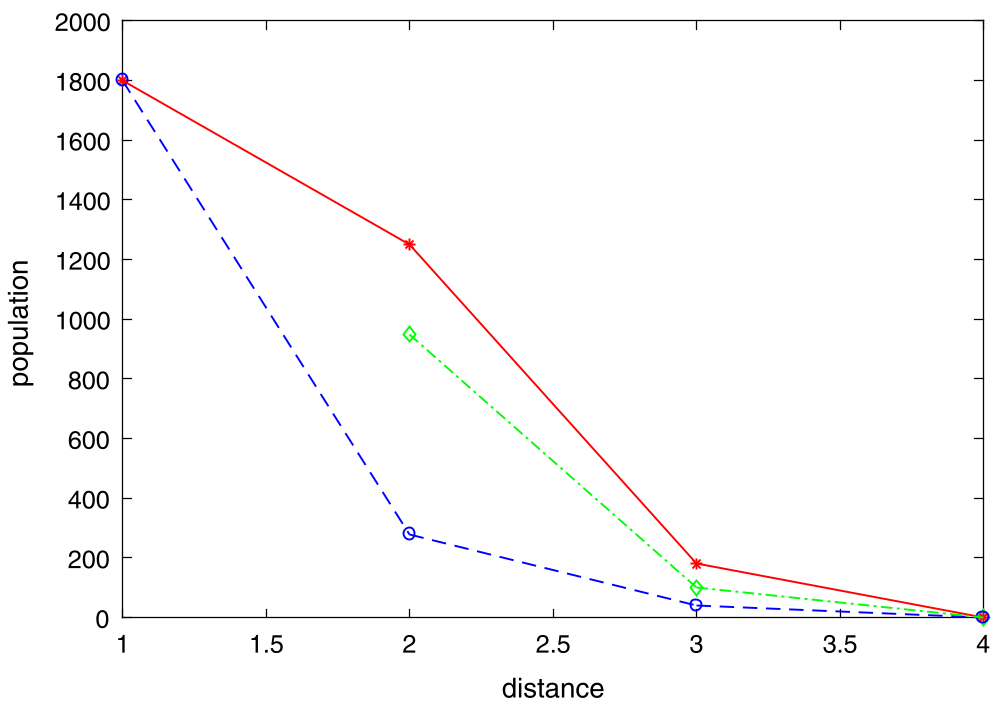 Figure: How a key user node (like "EE-Media") creates a secondary diffusion wave that overlays the primary trend.
Experiments and Results
The model was validated against real Weibo events, such as a "People's Daily" post about driver's licenses.
- Fit Accuracy: The model achieved an R-square of 0.9536, indicating that nearly 95% of the variance in reposting behavior was explained by the model.
- Impact of Activity: The study confirmed that activity levels during commuting hours significantly spike diffusion, whereas working hours and post-midnight hours act as inhibitors.
Critical Insight: The Value of "Linearity" in Complexity
The brilliance of this work lies in its simplicity. By linearizing exponential curves and applying superposition (a concept borrowed from physics), the authors provide a computationally efficient way to monitor public opinion in real-time.
Limitations & Future Work
While the model is robust for repost-based platforms like Weibo, its application to "algorithmic feed" platforms (like TikTok) where diffusion is controlled by AI recommendation rather than social following remains to be explored. The authors suggest that Fractal Analysis might be the next step to further refine these complex network structures.
Conclusion
This paper serves as a bridge between mathematical modeling and digital sociology. It proves that to understand the "Big Data" of social networks, we must first understand the "Small Behavior" of the individuals who comprise them.