
Decoding Social Ties: How Community Structure Shapes Information Diffusion
What Does an Information Diffusion Model Tell about Social Network Structure?
This paper investigates the relationship between information diffusion models (IC and LT) and social network community structures. By proposing a comparative scheme using originally observed networks and Generalized Random (GR) networks, the study identifies that the Independent Cascade (IC) model is significantly more sensitive to community structures than the Linear Threshold (LT) model.
TL;DR
Does the architecture of our social circles—the communities we belong to—actually change how information spreads? This paper demonstrates that it depends entirely on the model of diffusion. Using a clever "rewiring" experiment, the researchers found that Independent Cascade (IC) models are deeply affected by community boundaries, while Linear Threshold (LT) models are much more indifferent, primarily caring about a node's individual degree.
The Problem: Are All Networks Created Equal?
In the study of social networks, we often use models like IC (where each contact has a probability of "infecting" another) and LT (where a node only "activates" if a certain percentage of its neighbors do).
However, real social networks aren't just random connections; they are organized into dense clusters (communities). Prior work often ignored how these specific structural "lumps" accelerate or hinder diffusion. The authors ask: If we keep every person's number of friends the same but scramble their connections to destroy communities, what happens to the spread of information?
Methodology: The Art of Rewiring
To isolate the effect of community structure, the authors employed a two-step scheme:
- Constructing GR (Generalized Random) Networks: They took real networks (Blog trackbacks and Wikipedia links) and rewired the edges randomly. Crucially, they kept the node degree (the number of connections per node) identical to the original.
- Bond Percolation Estimation: They used an efficient algorithm to simulate thousands of diffusion events (M=10,000) to calculate the "Influence Degree" (expected number of influenced nodes) for every single node.
- Cross-Entropy Visualization: They mapped the networks into 2D space to visually prove that real networks have "distributed" communities while GR networks are "lumped" towards the center.
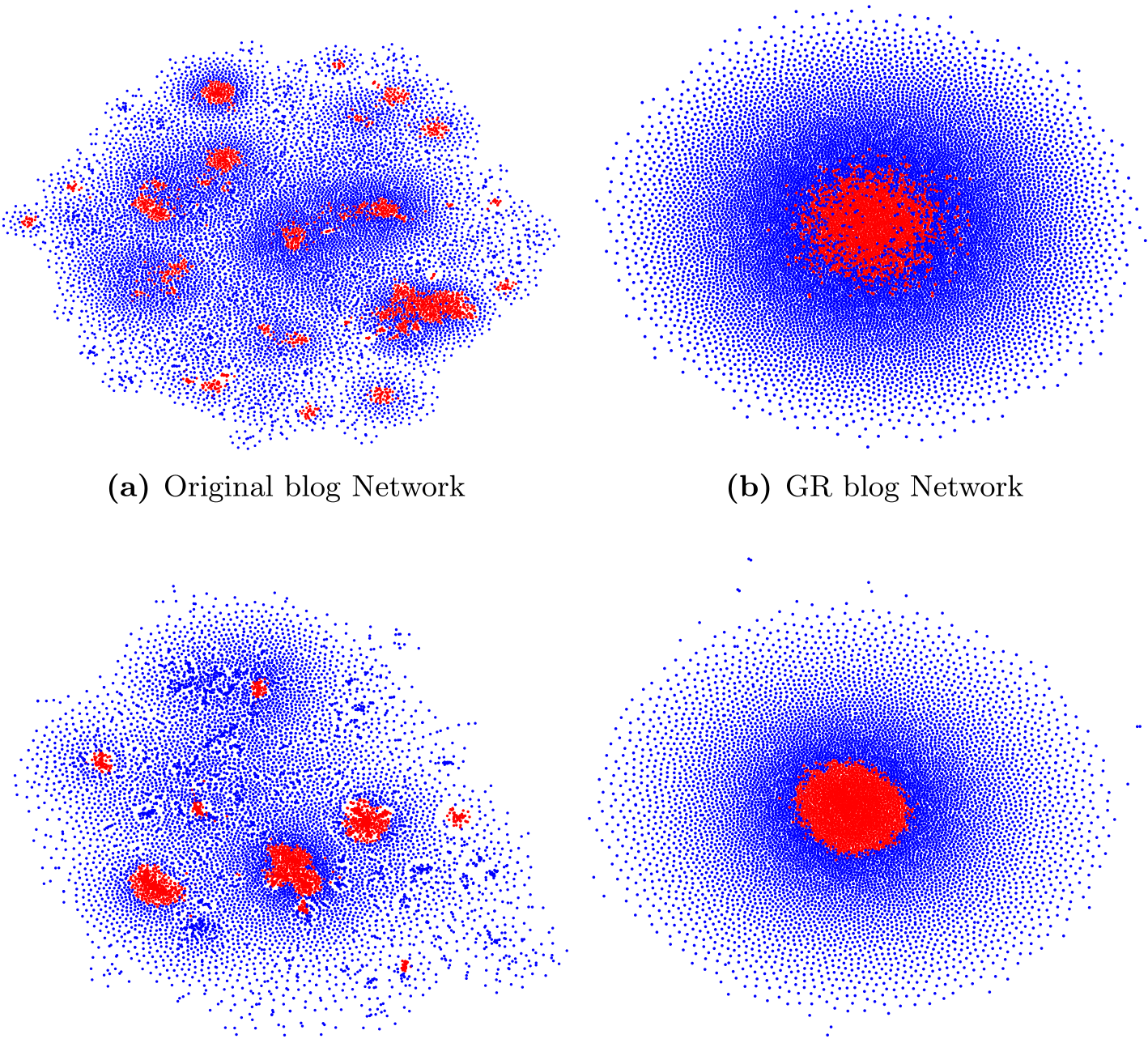 Figure: Visualization showing how real networks (a, c) have scattered communities, whereas GR networks (b, d) collapse into a central mass.
Key Insights from Experimental Results
1. The IC Model's "Lateral Lines"
A fascinating discovery was found in the IC model results. In original networks, nodes with the same degree often had wildly different influence levels, forming "lateral lines" on the charts.
- The Cause: In real networks, a high-degree node might be "trapped" inside a dense community, limiting its global reach.
- The Result: When rewired into a GR network, these lateral lines vanished, and influence became much more predictable based on degree alone.
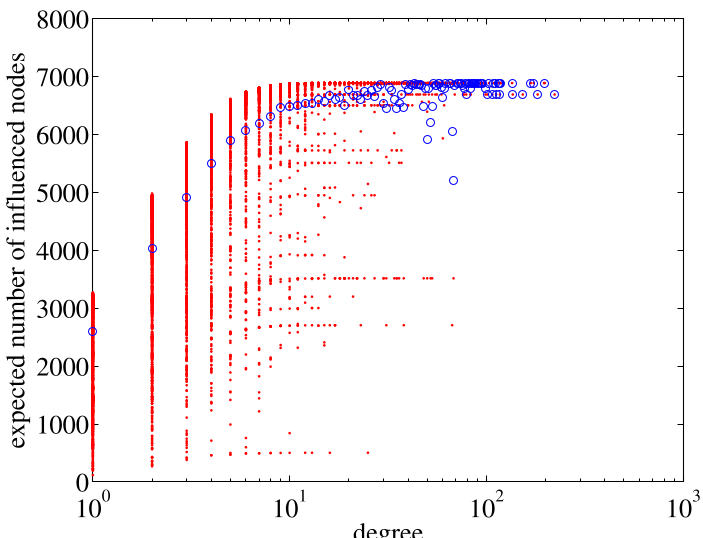 Figure: (a) shows the "lateral lines" in the IC model on the original network, which disappear in the GR version (b).
2. The Indifference of the LT Model
Conversely, the LT model behaved very similarly on both real and random networks. For LT, the "Influence Degree" is almost uniquely determined by the node's degree. This suggests that the threshold-based logic is robust against structural changes—as long as you have enough connections, the specific "clustering" of those connections matters less.
3. Structural Buffering
Across all experiments, the "Influence Degree" was generally higher in the GR networks.
- Takeaway: Real-world communities actually slow down or constrain information. The "bottlenecks" between communities in real life act as a structural buffer that prevents every single piece of information from going viral instantly.
Critical Analysis & Conclusion
This paper provides a vital "stress test" for information diffusion theory.
- Value: It proves that if you are modeling a "viral" phenomenon (like a rumor or a virus) using an IC-type model, you must account for community structure. If you are modeling "collective behavior" (like adopting a new technology) using an LT-type model, the network's macro-structure might be less critical than each individual's local popularity.
- Limitations: The study uses static networks. In reality, community structures are dynamic and evolve alongside the information spreading through them.
- Future Outlook: Integrating these structural insights into "Influence Maximization" algorithms could lead to much more surgical marketing and public health strategies.
Final takeaway: If you want to spread a message further, it's not just about how many people you know; it's about whether the "walls" of your community are permeable enough to let the message out.