
Modeling the Pulse of Public Opinion: Nonlinear Dynamics in Social Network Emergencies
3355_Information Diffusion Nonlinear Dynamics Modeling and Evolution Analysis in Online Social Network Based on Emergency Events.
The paper proposes a nonlinear dynamic modeling framework for information diffusion during emergency public events in online social networks. It introduces a multi-factor evolution model—incorporating opinion, influence, interest, conformity, and intimacy—and validates it through large-scale simulations and real-world empirical data from the Baidu search index.
TL;DR
This research moves beyond simple linear models to track how information spreads during social crises. By treating information like an epidemic and factoring in individual psychology (like conformity and intimacy), the authors developed a mathematical framework that predicts how public opinion shifts. Their findings prove that the "Step-style" strategy—gradually guiding the public with objective facts—is the most effective way to manage social stability.
Problem & Motivation: The Chaos of the Digital Town Square
When a public emergency breaks out—like a legal controversy or a major disaster—information doesn't just spread; it explodes and mutates. Existing models often struggle to capture the human element. Why do some rumors stick while others fade? Why does aggressive media intervention sometimes backfire?
The authors argue that previous research overlooked the heterogeneity of nodes. In a real social network, an opinion leader has more weight than a casual observer, and a close friend's post is more convincing than a stranger's. Furthermore, public opinion is nonlinear; it reaches tipping points based on collective cognitive thresholds.
Methodology: The Five Factors of Influence
The researchers proposed a model that treats the social network as a dynamic ecosystem. They mapped the communication process into five quantifiable characteristic values:
- Opinion: A normalized value [0, 1] representing the degree of support.
- Influence Power: Calculated based on the node's degree (connectivity).
- Interest Correlation: How much the individual actually cares about the event.
- Conformity: The tendency to change one's mind to match the group.
- Intimacy: The strength of the bond between the sender and receiver.
The Dynamic Network Architecture
The model uses a Logistic function to simulate the growth of the audience, ensuring it follows the natural "S-curve" of information adoption.
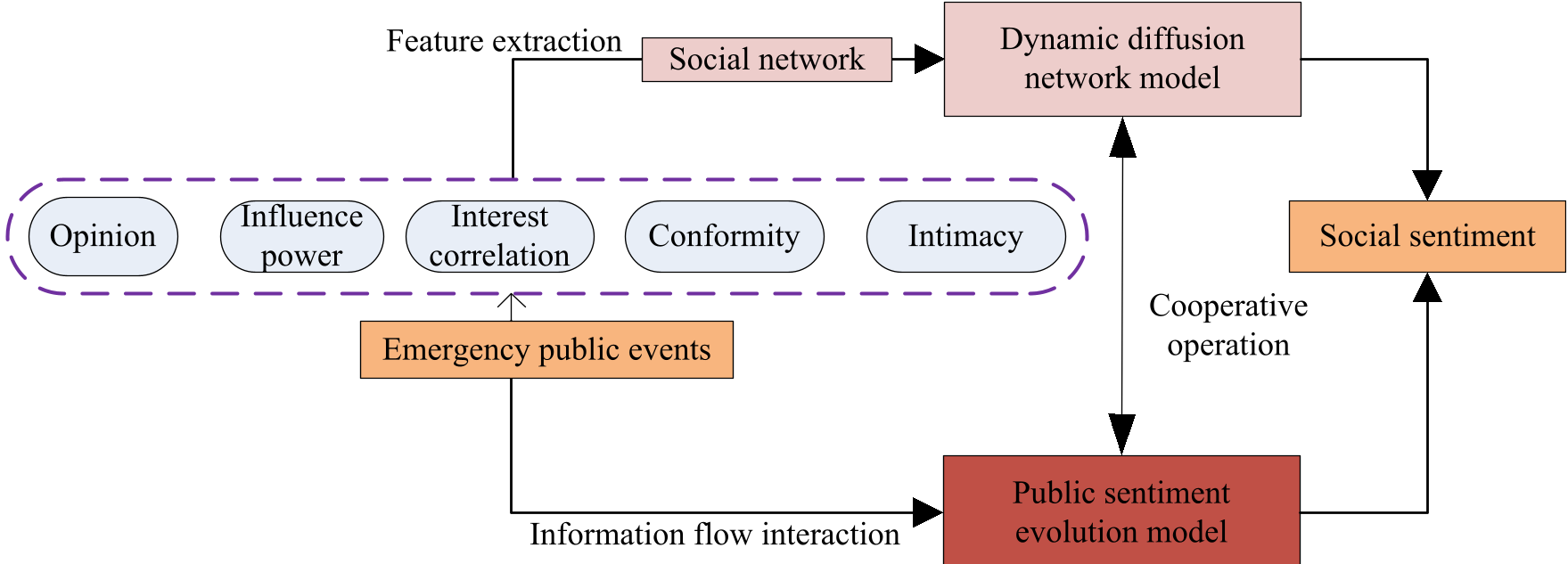 Fig 1: The organic combination of the Diffusion Network and the Opinion Evolution prototype.
The core mathematical engine is a differential equation that accounts for the state of the system (Vulnerability vs. External Force) and a self-excited point process that captures how current interest depends on the history of previous interactions.
Experiments & Results: Real-World Validation
The researchers tested their model against the "Yu Huan Case," a highly sensitive legal event in China. By comparing their simulation data with the Baidu Search Index, they achieved a striking similarity of 0.9301.
Comparing Media Intervention Strategies
A standout component of the study is the comparison of three media strategies:
- High-Pressure: Aggressive support for a specific view. Result: Minimal impact, often causes backlash.
- Progressive: Neutral information first, followed by guidance. Result: Effective (75.6% support).
- Step-Style: Gradually increasing the intensity of guidance as the public becomes familiar with the facts. Result: Superior (80% support, lowest opposition).
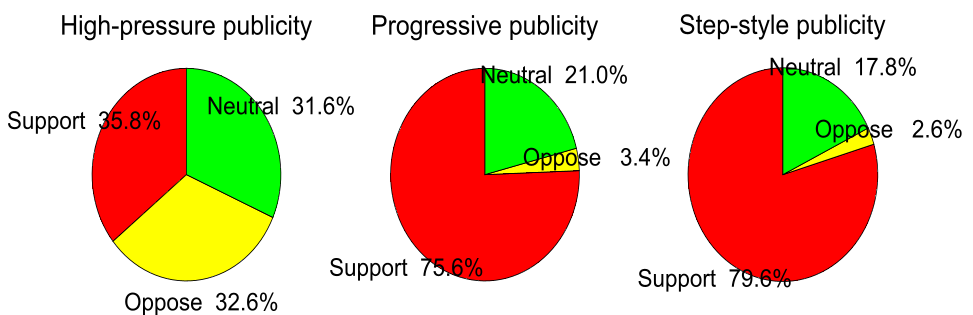 Fig 2: Comparison of different publicity strategies. Notice how "Step-style" (triangular marks) achieves the highest stabilization of opinion.
Critical Analysis & Conclusion
Takeaway
The paper confirms that Information is biological. It spreads like a virus, but its "infection rate" is dictated by human trust and social structure. For policymakers and platform moderators, the lesson is clear: Truth-telling in measured, objective steps is more powerful than forced narratives.
Limitations & Future Work
While the model is robust, it primarily relies on the Baidu Search Index as a proxy for attention. Future research could integrate real-time Sentiment Analysis from social media comments to define "Inimacy" and "Opinion" more granularly. Additionally, the model assumes a somewhat rational actor; adding parameters for "echo chambers" or "algorithmic bias" could further increase its predictive power in modern AI-driven feeds.