
T-BaSIC & SONDY: Cracking the Code of Asynchronous Information Diffusion
Information diffusion in online social networks
This paper presents a comprehensive framework for analyzing information diffusion in online social networks, introducing T-BaSIC, a graph-based predictive model, and SONDY, an open-source platform for social dynamics mining. The work achieves a 32% improvement in temporal dynamics prediction accuracy over traditional baseline models like the one-time lag predictor.
TL;DR
Information in social networks doesn't move like clockwork; it flows in bursty, asynchronous waves. This research introduces T-BaSIC, a model that predicts when and who will spread information by treating diffusion as a continuous-time process rather than a discrete step-by-step sequence. Alongside this, the author provides SONDY, an open-source workbench to help researchers stop reinventing the wheel and start benchmarking diffusion algorithms effectively.
Contextualizing the Flow
In the era of the Arab Spring and global election cycles, understanding how ideas spread is no longer just a marketing curiosity—it is a sociological necessity. However, the academic landscape has been split between models that understand the "network" but ignore the "clock" (Graph-based discrete models) and those that understand the "clock" but ignore the "network" (Non-graph-based differential equations).
The author's core insight is that diffusion probabilities are not static. Your likelihood of retweeting a post depends on your past interests, your social proximity to the sender, and—crucially—the time of day.
Methodology: The T-BaSIC Engine
Unlike the classic Independent Cascade (IC) model where a node is activated at Step and tries to activate neighbors at Step , T-BaSIC operates in continuous time.
1. The Diffusion Function
The probability of transmission between two users and at time is defined as:
This formula integrates 13 distinct features across three dimensions:
- Social: Interaction frequency and Jaccard similarity.
- Topical: User interest in specific content.
- Temporal: Non-parametric functions of user activity across 24 hours.
2. The Asynchronous Shift
When a user is activated, they transmit information with a calculated time-delay . This reflects the reality that some users react instantly, while others might not check their feeds for hours.
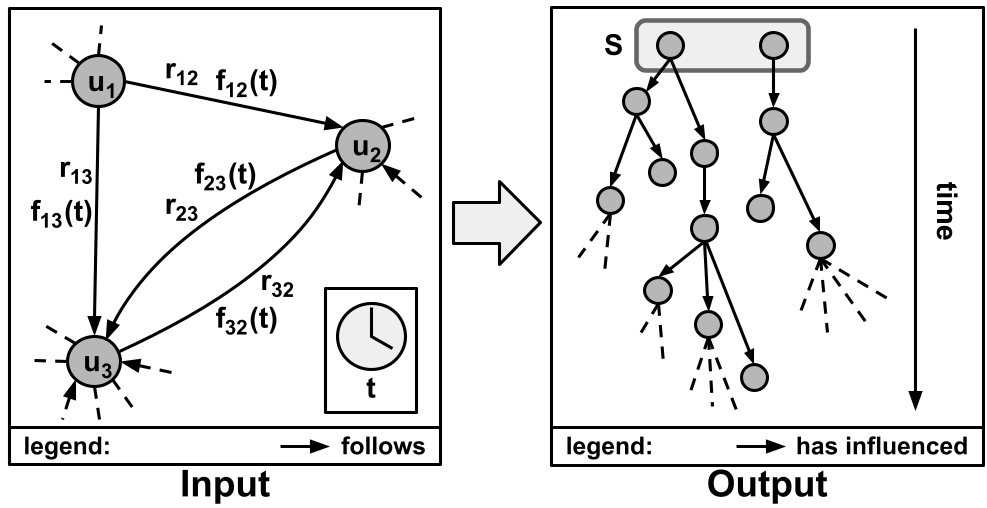 Figure 1: The T-BaSIC model predicting diffusion across a continuous time-axis.
Experimental Validation: Timing vs. Volume
The model was tested against Twitter data. The results showed a significant leap in precision (32% improvement) when predicting the shape of the diffusion curve—the rising and falling patterns of attention.
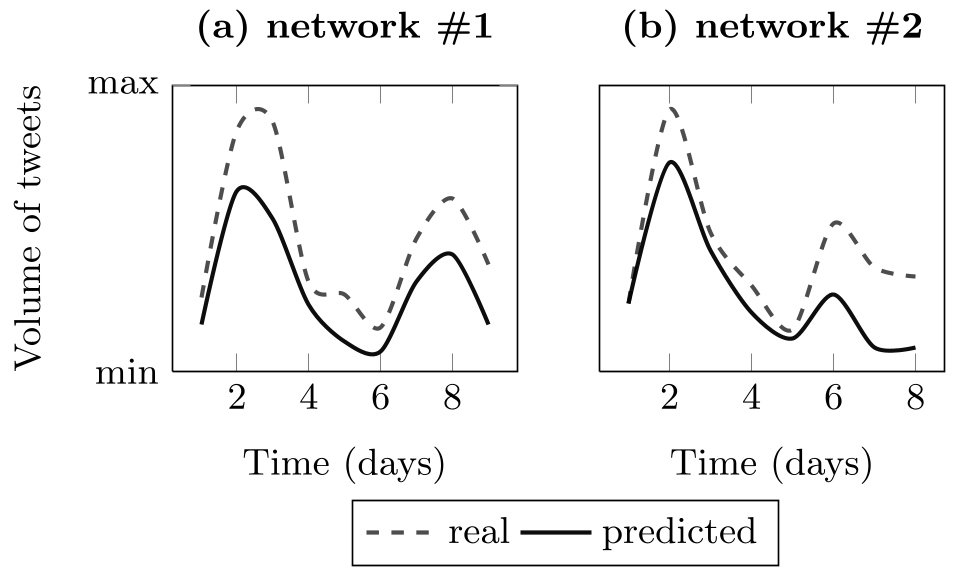 Figure 2: Comparison between real-world Twitter data (Real) and T-BaSIC predictions (Model).
The "Closed-World" Gap: An interesting finding was that T-BaSIC often underestimated the total volume of messages. The author attributes this to the "closed-world assumption"—the model assumes information only spreads through the network edges. In reality, external factors (like a TV news report) can spark "mass-media diffusion" that bypasses social links.
SONDY: A Tool for the Community
To address the lack of reproducible code in the field, the author released SONDY (Social Network Dynamics). It acts as a full-stack laboratory for:
- Data Pre-processing: Stemming and discretization.
- Topic Detection: Using algorithms like MACD and Peaky Topics.
- Network Visualization: Identifying influencers via PageRank and k-shell decomposition.
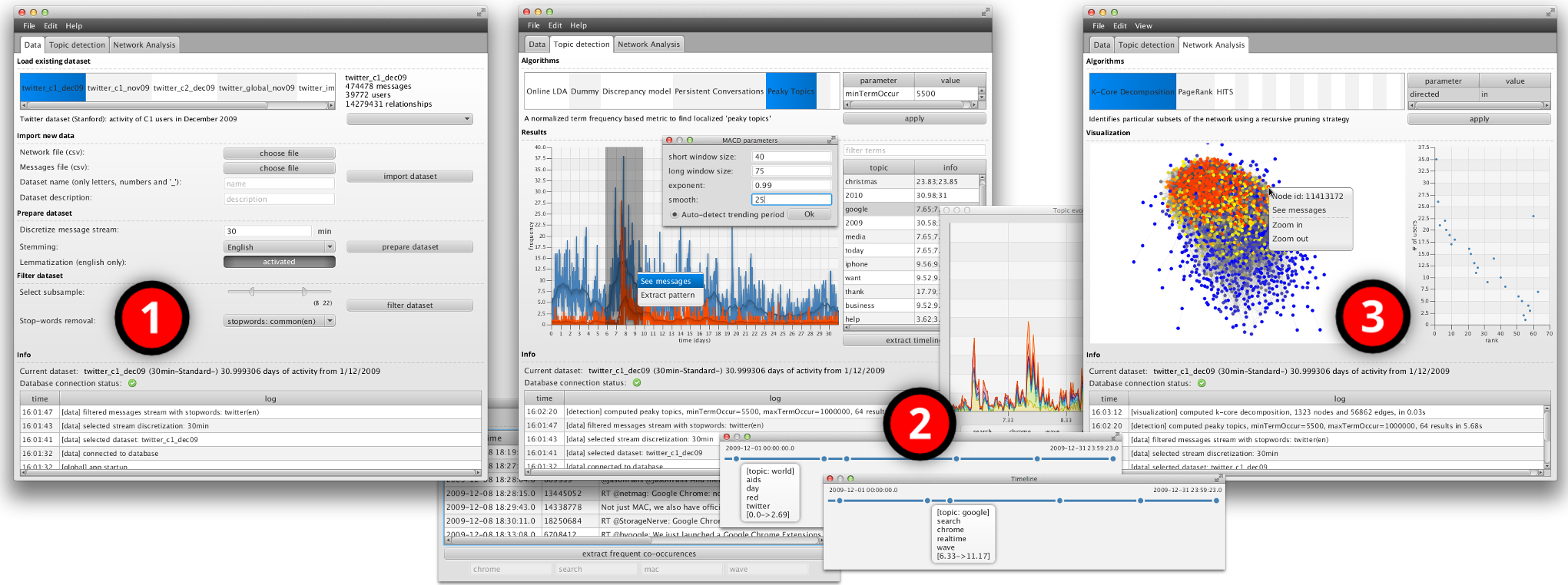 Figure 3: The SONDY platform services: Data manipulation, Trend exploration, and Network analysis.
Critical Insight & Conclusion
This work marks a shift toward asynchronous modeling. By moving away from fixed time-steps, we get closer to capturing the "bursty" nature of human digital behavior.
Future Outlook: The next frontier for this research lies in breaking the "closed-world" barrier—integrating exogenous signals (external news/events) with endogenous network flows to perfectly predict both the timing and the scale of the next viral cascade.