
Decoding Virality: A Deep Dive into Information Diffusion in Social Networks
Information Diffusion in Online Social Networks: Models, Methods and Applications
This paper provides a comprehensive survey of information diffusion in Online Social Networks (OSNs), proposing a taxonomy that categorizes models into structural, staged, and feature-based approaches. It systematically evaluates how network topology, social interactions, and content characteristics drive the SOTA mechanisms of information spread.
TL;DR
Information diffusion in Online Social Networks (OSNs) has evolved from simple biological analogies to complex, multi-dimensional computational models. This paper surveys the landscape of how information travels across the web, categorizing the field into Structural, Staged, and Feature-based models, while highlighting the critical role of external influences and network dynamics.
Positioning: This is a high-level taxonomic survey that bridges classical sociology with modern data science, providing a roadmap for future algorithmic development in recommendation systems and viral marketing.
Problem & Motivation: Beyond the "Follower" Graph
Why is predicting a "viral" post so difficult? The authors argue that while we can observe where information went, understanding how it got there requires more than just looking at a list of followers.
The core pain points identified are:
- Static Bias: Most models treat the social graph as a fixed snapshot, ignoring that relationships and interests evolve.
- Internal-Only Vacuum: Scholars often ignore "exogenous" shocks—news from TV or external websites that trigger internal social cascades.
- The Homogeneity Fallacy: Assuming all nodes (users) and edges (ties) are the same, whereas "Weak Ties" often act as the primary bridges for novel information dissemination.
Methodology: The Three Pillars of Diffusion
The paper organizes the chaotic world of diffusion research into three logical frameworks:
1. Structural Models (The "How")
These focus on the microscopic interactions between pairs of users.
- Independent Cascade (IC): Sender-centered; a node tries to infect neighbors with a certain probability.
- Linear Threshold (LT): Receiver-centered; a node is activated only when the collective influence of its neighbors exceeds a specific threshold.
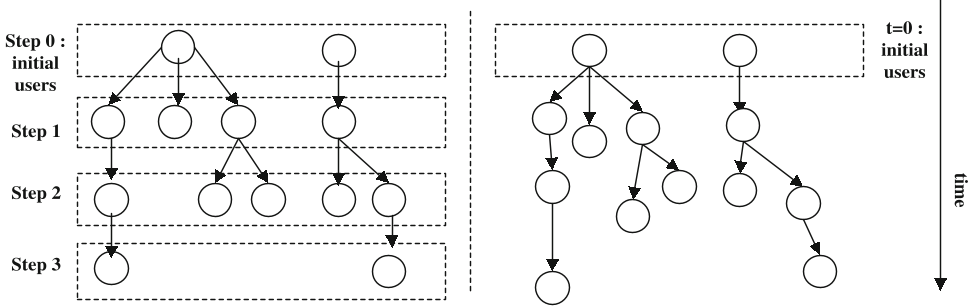 The figure above illustrates a multi-dimensional approach incorporating semantic, social, and temporal data to predict diffusion paths.
2. Staged Models (The "State")
Derived from epidemiology (SIR/SIS models), these focus on the transition of populations between states: Susceptible → Infected → Recovered. Modern adaptations like SCIR add a "Contacted" state, acknowledging that someone might read a topic but choose not to retweet it.
3. Feature Models (The "Context")
These models analyze the "physics" of the content itself. They look at temporal rhythms (when people are active) and the "Clash of Contagions"—how two different hashtags might compete for the same limited pool of human attention.
Experiments & Results: Quantifying Influence
The survey synthesizes several key empirical findings:
- External Impact: Quantitative analysis shows that nearly 30% of social media activity is driven by events outside the network.
- The Power of Influence: Bakshy et al.'s work in the survey demonstrates that content spread through direct social influence often reaches a higher depth of penetration than random noise.
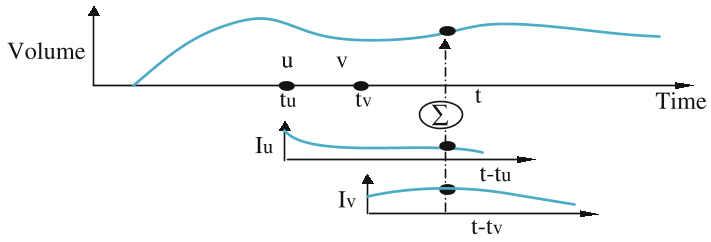 Above: Patterns showing the interplay between social networks and individual influence in content adoption.
Critical Analysis & Conclusion
Takeaway
The shift from homogeneous, static graphs to heterogeneous, dynamic interaction graphs is the next frontier. We are moving away from asking "Who follows whom?" toward "Who actually talks to whom, and about what?"
Limitations
- The "Black Box" of Influence: Current models struggle to quantify "influence" accurately across different topics (e.g., a person influential in "Tech" may have zero influence in "Politics").
- Data Sparsity: Real-time interaction data is often proprietary and gated by platforms like X (Twitter) or Meta, making universal models hard to validate.
Future Outlook
The authors advocate for a Life-Cycle Model of diffusion. Just as a biological virus has different phases, information diffusion likely follows a trajectory where different factors (sender prestige vs. content quality) dominate at different timestamps.