
The Power of Sociality: Why Interaction Frequency is the Secret to Information Cascades
Information diffusion in OSNs: the impact of nodes' sociality
This paper investigates information diffusion in Online Social Networks (OSNs) by modeling cascades on a weighted Facebook dataset. It introduces a modified Independent Cascade Model that incorporates "tie strength" (interaction frequency) and a temporal aging factor (α) to accurately simulate real-world information spread.
TL;DR
Is a user with 5,000 "friends" more influential than a user with 500 close "interactors"? This paper argues that tie strength—the actual frequency of interaction—is the true engine of information diffusion. By introducing an aging factor to simulate the decay of interest, the researchers demonstrate that weighted activity is the best predictor of how far information will travel.
Background: Beyond the Unweighted Myth
Most research into Online Social Networks (OSNs) treats them as simple maps of "who knows whom." However, in reality, our social graphs are cluttered with dormant connections. This study positions itself as a critical bridge between simple topology and the nuance of human sociality, utilizing a dataset from Facebook that captures actual wall posts and comments to weight social links.
The Problem: The Bimodal Trap
The authors identify a major flaw in the classic Independent Cascade Model (ICM). Without a mechanism for interest decay, simulations often result in a "bimodal" distribution: either the information dies immediately, or it infects nearly the entire network. This doesn't match reality, where most cascades are small and die out naturally as news gets "old."
Methodology: Tie Strength and Aging
The core innovation lies in two areas:
- Tie Strength (): A value between 0 and 1 derived from monthly interaction frequency.
- The Aging Factor (): The probability of diffusion at step is calculated as: This formula ensures that as information moves further from the source (increasing ), its "infectiousness" drops, mimicking the human tendency to ignore stale news.
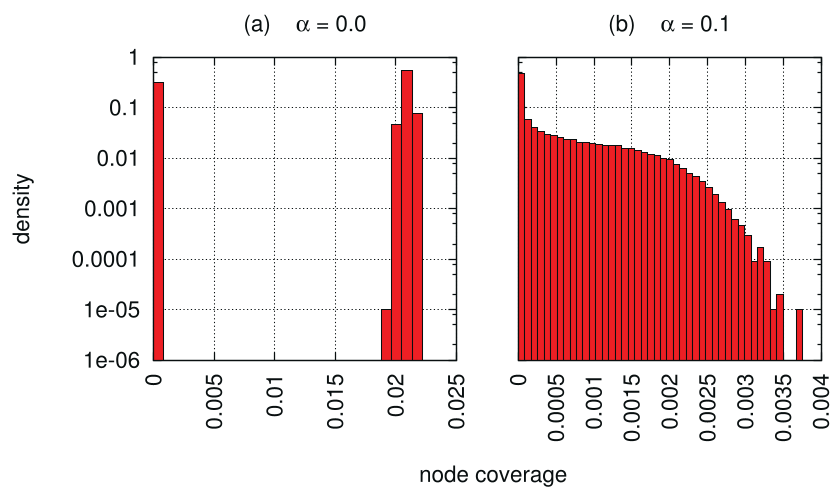 Figure: Comparing the bimodal distribution (a) of the standard model vs. the realistic unimodal distribution (b) achieved by adding the aging factor.
Experiments: Why "Activity" Outperforms "Degree"
The researchers compared several seed node statistics to see which best predicted Node Coverage (how many people see the info) and Cascade Depth (how many "hops" it travels).
Key Findings:
- Unweighted metrics failed: Simple "Degree" (number of friends) had a weak correlation (approx. 0.15 - 0.23) with cascade size.
- Weighted "Activity" won: The sum of a node's tie strengths—labeled as "Activity"—showed a massive correlation (up to 0.87).
- Centrality Matters: Weighted Eigenvector Centrality is a powerful predictor for overall coverage, while PageRank is better at predicting the depth of the cascade.
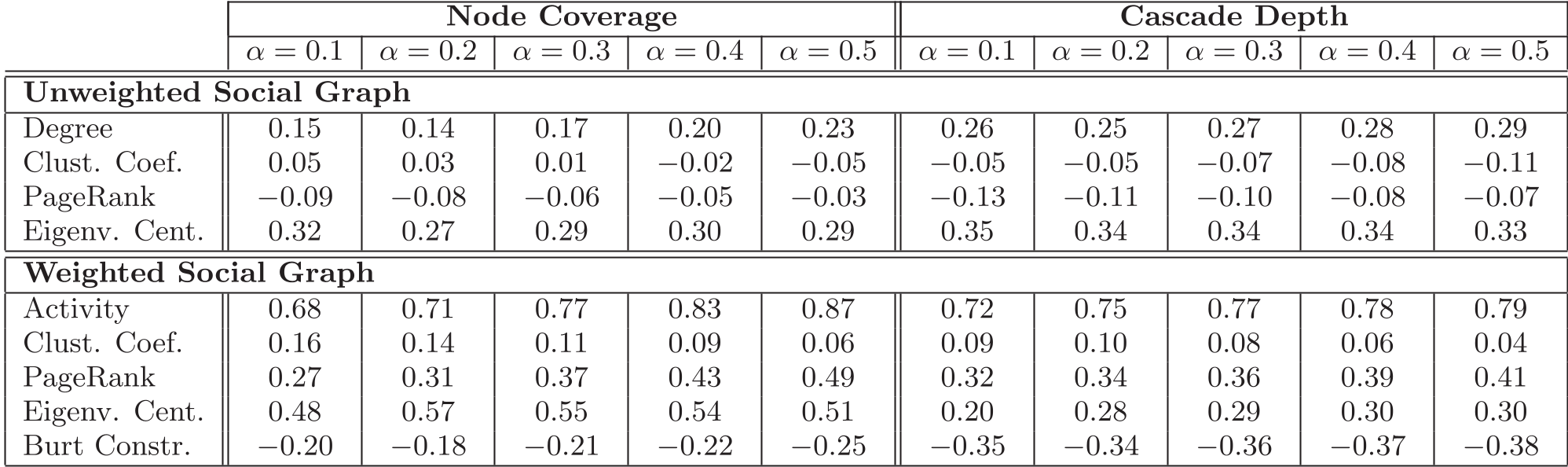 Table: Correlation results showing the superiority of weighted metrics (Activity) over unweighted ones (Degree) across different aging factors ().
Deep Insight: The Burt’s Constraint
An intriguing takeaway is the negative correlation with Burt’s Constraint Index. This suggests that nodes whose neighbors are not well-connected to each other (nodes with "structural holes") are better at spreading information to diverse, distant parts of the network. A "tight-knit" group might talk a lot, but they mostly talk to themselves, limiting the cascade's reach.
Conclusion and Future Outlook
This work underscores that not all links are created equal. In an era of "social fatigue," the aging factor is more relevant than ever. Future research should look into whether these aging parameters differ across platforms (e.g., the rapid decay on Twitter/X vs. the slower burn on LinkedIn).
Takeaway for Practitioners: If you want to launch a viral campaign, don't just look for the user with the most followers; look for the "Active" user whose followers actually talk back.