
The Physics of Gossip: Simulating Information Flow in Realistic Social Landscapes
A Study of Information Diffusion over a Realistic Social Network Model
This paper presents a high-fidelity simulation of information diffusion via face-to-face conversations within a realistic socio-technical network. Utilizing a modified EpiFast engine on a synthetic population of 74,376 individuals, the study models interactions based on demographic homophily and temporal contact duration, achieving a statistically accurate representation of urban interaction patterns.
TL;DR
Researchers from Virginia Tech have moved beyond abstract graphs to simulate how rumors actually spread in a physical city. By combining census data with daily activity schedules, they found that the "speed" of information is dictated by two factors: how similar we are to our neighbors (Homophily) and how much time we spend with them (Duration). The standout finding? Schools are the ultimate "super-spreaders" of information, with youngsters acting as the primary engine for community-wide alerts.
Deep-Dive into the Problem: Why Static Graphs Fail
Most social network models treat society as a static web of connections. In reality, your "network" changes every hour. You have a "work network" from 9 to 5, a "commuter network" at 6, and a "family network" in the evening.
The authors argue that previous work suffered from compressed dimensions. They ignored the fact that you won't share a secret with someone you only passed for 5 minutes in a grocery store, even if you are "connected" on a graph. To fix this, they built a simulation that accounts for:
- Dynamic Topology: The network evolves minute-by-minute as agents move.
- Physical Intuition: Conversations require both spatial proximity and sufficient time.
Methodology: Similarity and the "Threshold of Familiarity"
The model uses a synthetic version of Montgomery County, Virginia. Every agent has a schedule—work, school, shopping, or home.
The Interaction Logic
The probability () of information transfer between agent and is defined by:
- Similarity (): Based on three demographic markers: Age, Household Income, and Household Size. Sharing more traits increases the probability.
- Contact Duration (): A "Minimum Contact Duration" threshold. If you don't spend at least minutes together, the probability of passing information drops to zero, regardless of how similar you are.
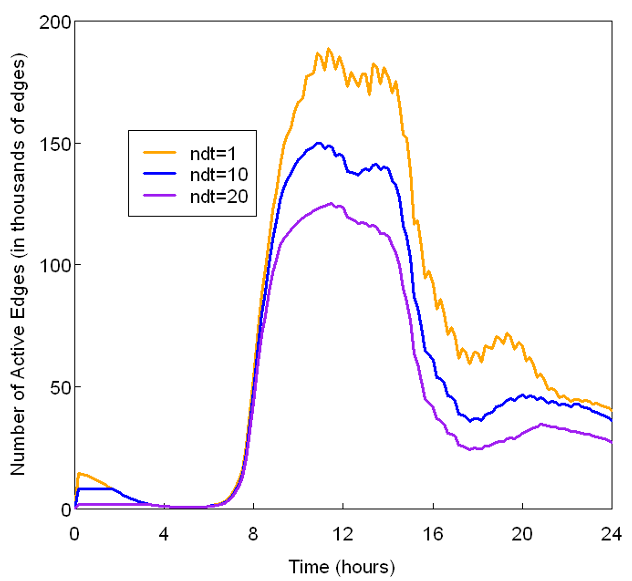 Figure 2: The degree distribution follows a power law, typical of realistic social structures, but here it is derived from physical co-location.
Experiments: What Actually Drives the Spread?
The researchers tested different "seeds" (who gets the info first) and different familiarity requirements ().
Key Inversion: Informal vs. Formal Topics
- Low (Casual Gossip): Shopping centers and recreational spots are the primary vectors. Information spreads widely but shallowly.
- High (Complex Info): Home, Work, and School become the only viable channels. Here, "Weak Ties" are pruned, and only "Strong Ties" survive.
The "School Spike" Effect
One of the most compelling results is shown in the demographic stratification. Youngsters (0-18) show a massive "spike" in informed status on the second and third days of simulation.
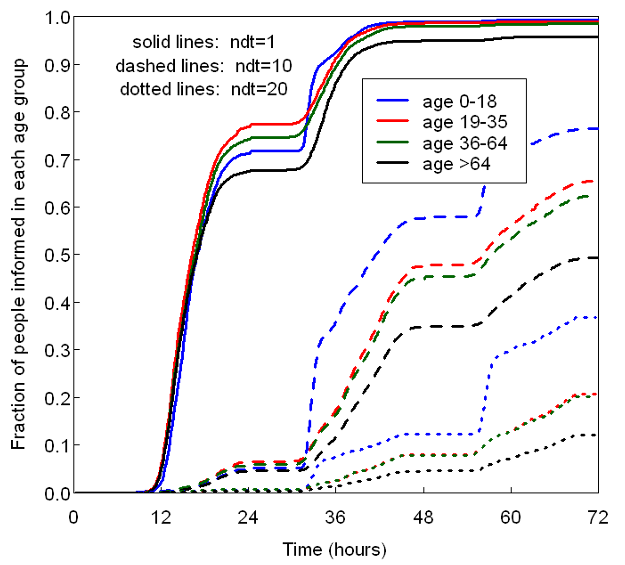 Figure 6: Note the sharp rise in the 'Age 0-18' group (Green), indicating how schools act as a high-density reservoir for information.
Critical Insight: The Power of Youngsters
The study concludes that schools are not just places of learning but high-efficiency hubs for community-wide information diffusion. Because students spend long, contiguous blocks of time with similar peers, they satisfy both the Homophily and Duration requirements perfectly. If you want a message to saturate a town quickly, informing the youth is statistically more effective than targeting random adults.
Summary & Future Outlook
This work bridges the gap between abstract network science and urban planning. While it currently focuses on face-to-face interaction, the logic of "contact duration" is a vital metric for understanding how beliefs form.
Limitations: The model does not yet account for digital "short-cuts" (social media), which effectively reduce the (contact duration) to near zero across vast distances. Future iterations combining these physical "strong ties" with digital "weak ties" will likely provide the ultimate map of human influence.