
Hybrid Intelligence: Combining Random Forest and SIR for Weibo Diffusion Prediction
Modeling of Information Diffusion in Sina Weibo Based on Random Forest Classifier and SIR Model
This paper proposes a hybrid framework for predicting information diffusion in Sina Weibo by integrating a Random Forest classifier with the Susceptible-Infected-Recovered (SIR) epidemic model. By utilizing 15 node and edge features, the model predicts individual reposting probabilities to drive macroscopic diffusion simulations.
TL;DR
Predicting how a "hot topic" spreads across social media is notoriously difficult due to the complexity of human behavior and network topology. This paper introduces a dual-layered approach: using a Random Forest classifier to predict if an individual will repost a message, and then feeding those probabilities into a SIR (Susceptible-Infected-Recovered) epidemic model to forecast the overall lifecycle of a microblog.
Problem & Motivation: The Limits of Average Probability
Traditional epidemiological models used for information spread often rely on a constant "infection rate." In the context of Sina Weibo, this incorrectly assumes that every user has the same likelihood of sharing a post.
The authors identify two critical gaps:
- Feature Neglect: Existing models ignore node-specific features like historical interaction frequency, gender, and interest similarity.
- Data Imbalance: In reality, users ignore 90% of what they see. Standard models trained on such data tend to predict "not repost" for everything to achieve high nominal accuracy, failing to capture the actual "viral" moments.
Methodology: From Individual Behavior to Global Trends
1. Feature Engineering & Balancing
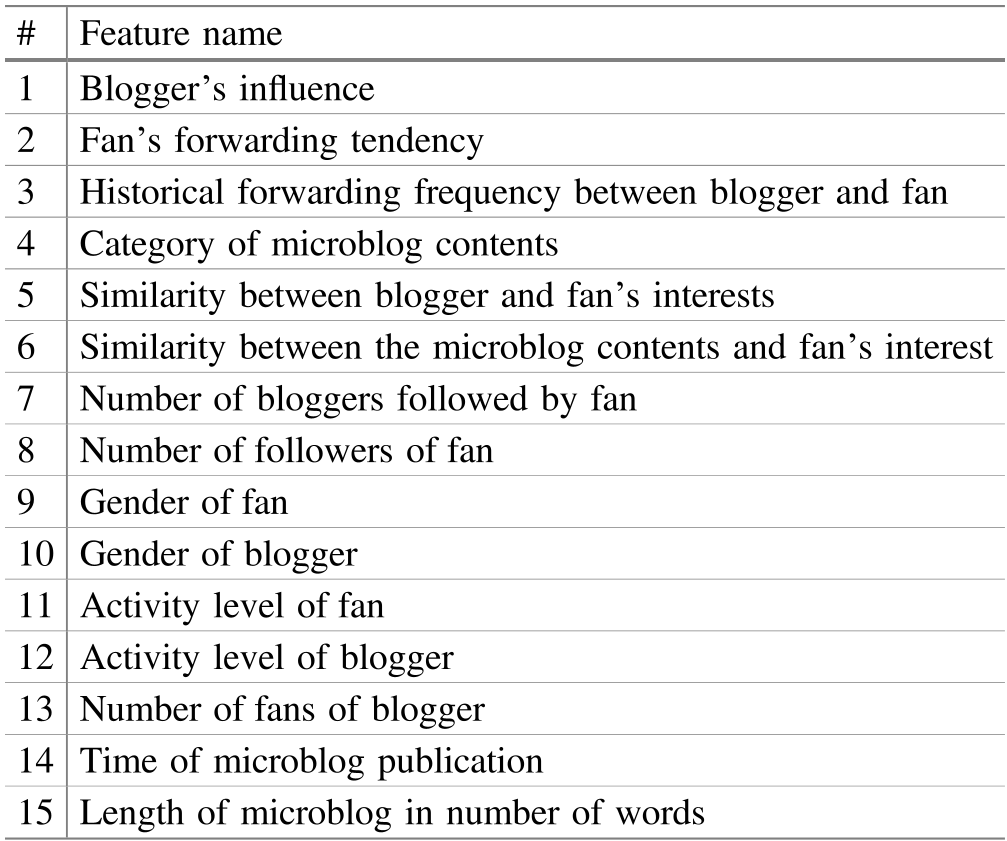
The researchers identified 15 key features across three dimensions: blogger influence, fan characteristics, and content properties. To solve the data skewness, they employed SMOTE (Synthetic Minority Over-sampling Technique), which creates synthetic examples of the minority "repost" class to ensure the classifier learns what actually triggers a share.
2. The Random Forest Engine
Why Random Forest? It handles categorical data and non-linear relationships better than traditional regressions. By analyzing "Gini Importance," the study found that Historical Forwarding Frequency and Interest Similarity were the most potent predictors of a repost.
3. SIR Simulation
The output of the Random Forest—the probability of a user reposting—becomes the (infection rate) in the SIR differential equations:
- S (Susceptible): Users exposed to the microblog.
- I (Infected): Users who repost the message.
- R (Recovered): Users who have already reposted and moved on.
Experiments & Results
The hybrid model was validated against 2018 Sina Weibo data. The results showed that the Random Forest outperformed Support Vector Machines (SVM), particularly when combined with random under-sampling of the majority class.
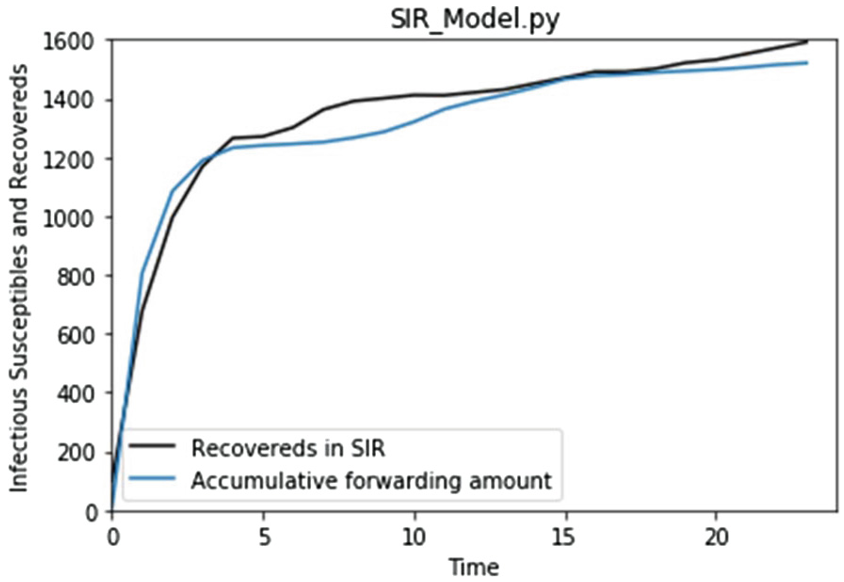 The figure shows the time history of the "Recovered" population (black curve) closely matching the actual accumulated reposts (blue curve) over time.
Key Performance Metrics:
- Classification Precision: >80%.
- Simulation Error: <15% deviation from real-world time-series data.
- Top Feature: "Historical forwarding frequency" (0.26 importance score) proved that past interaction is the strongest indicator of future engagement.
Critical Analysis & Conclusion
Takeaway
The core insight of this work is that micro-level predictions drive macro-level accuracy. By moving away from "average probability" and toward "calculated probability" per node, the SIR model becomes a powerful tool for public opinion monitoring.
Limitations & Future Work
- Static Topology: The model assumes a fixed network structure, whereas real social networks are dynamic.
- Feature Dimensionality: While 15 features are effective, the authors suggest that semi-supervised learning could further refine the model when labeled data is scarce.
- Potential Extensions: Applying this framework to multi-modal data (images/videos) or cross-platform diffusion (Weibo to WeChat) remains an open research frontier.