
Shortcut Patterns: Decoding the Dynamics of Information Diffusion in the Blogosphere
Exploring information diffusion patterns with social relationships in the blogosphere
This paper introduces a novel data mining concept called "Shortcut Patterns" to analyze information diffusion in the blogosphere. By modeling subscription relationships as a directed graph, the authors track how the topological distance between bloggers shortens over time, reflecting the dynamics of social network evolution and community formation.
TL;DR
Information in the blogosphere doesn't just sit there; it flows through evolving social ties. This paper moves beyond static graph analysis to introduce Shortcut Patterns—a mining technique that tracks how the "distance" between users shrinks as they subscribe to more relevant sources. By using a clever candidate pruning strategy, the authors provide a scalable way to observe real-time community formation and information epidemics.
Background & Motivation: Moving Beyond Static Links
In the era of Web 2.0, blogs became the primary vehicle for personal expression and "word-of-mouth" marketing. While we can easily map who follows whom, these maps are usually snapshots in time.
The authors argue that the dynamics—the way these links change—are far more telling. If User A discovers a great source through User B and eventually subscribes directly, the distance in the "influence graph" has shortened. This shortening is a concrete footprint of information diffusion. The challenge lies in efficiently mining these patterns within a massive, constantly growing graph without hitting a computational wall.
Methodology: The "Shortcut" Framework
The core innovation is the definition of a Shortcut Pattern, characterized by two parameters:
- Period: The time taken for the distance to decrease.
- Reduction Ratio: The magnitude of the distance decrease (e.g., moving from a distance of 3 to 1 is a 0.33 ratio).
System Architecture
The workflow transforms raw subscription logs into actionable diffusion insights through a 4-step pipeline:
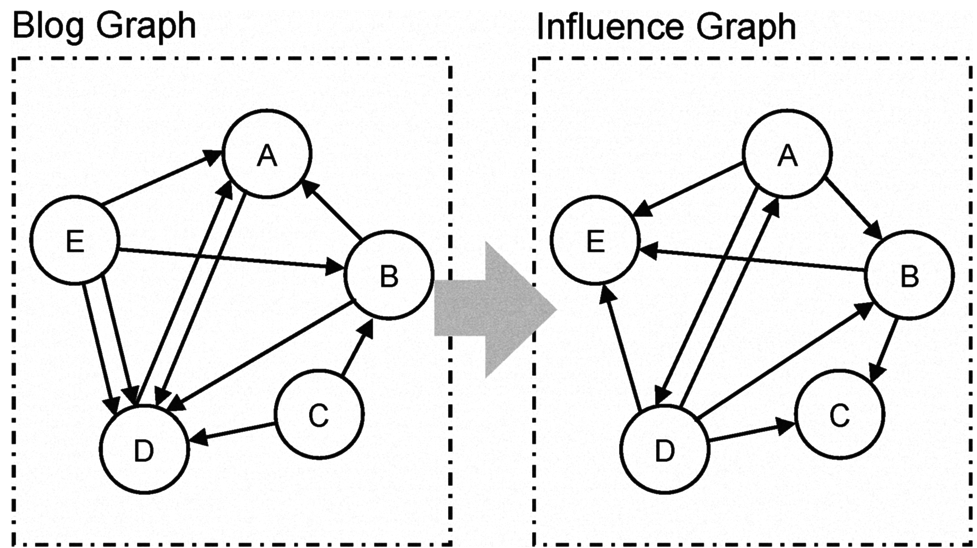 Figure 1: Conceptual mapping from a Blog Graph (citations) to an Influence Graph (information flow).
The Efficiency Hack: Candidate Pruning
Calculating the shortest path (Dijkstra) for every possible pair of nodes every time a new link is added is computationally suicidal. The authors introduce Candidate Pruning: when a new link b -> a is added, only b's ancestors (potential destinations) and a's descendants (potential sources) need to be re-evaluated. This significantly reduces the search space.
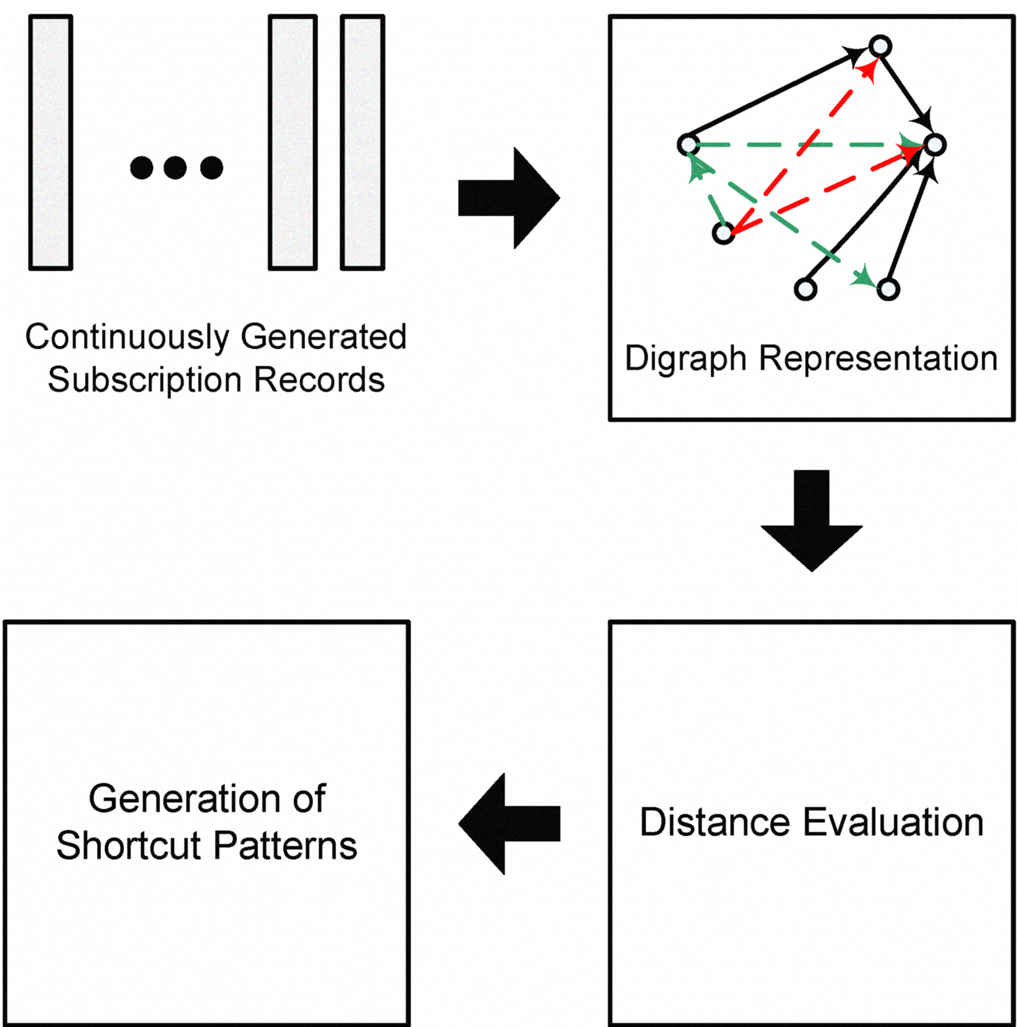 Figure 2: Visualizing how only a subset of nodes (ancestors of the subscriber and descendants of the publisher) are affected by a new link.
Experiments & Results
The researchers crawled data from Bloglines, focusing on "National Geographic" and "Digg" communities.
The 30-Day Rule
One of the most interesting findings is the temporal nature of human interest. The study found that roughly 90% of shortcut patterns are formed within 30 days. This suggests that if information doesn't "jump" to a new circle within a month, it likely never will.
Performance Gains
As shown in the efficiency plots, without pruning, the execution time grows exponentially. With pruning, the system remains scalable even as the number of subscription records increases.
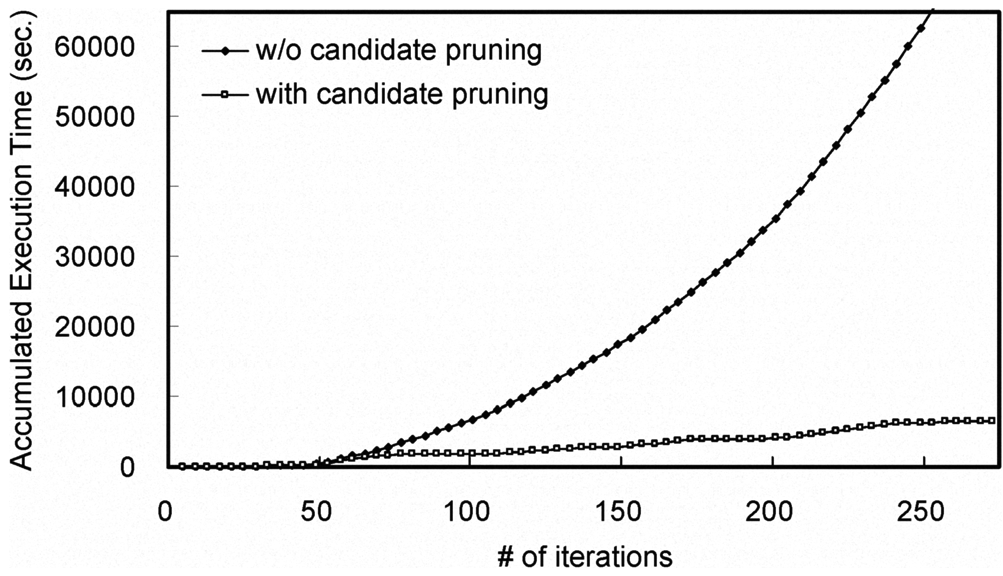 Figure 3: Accumulated execution time with vs. without candidate pruning. The blue line (pruning) shows a manageable linear-like growth compared to the steep ascent of the baseline.
Critical Insight & Conclusion
This paper provides a robust bridge between Graph Theory and Cognitive Informatics. By focusing on the "Shortening of Distance," the authors have found a way to quantify the "gravity" of information sources.
Takeaways for Practitioners:
- Viral Marketing: Identify "bridge" users who are consistently part of shortcut patterns; these are your high-value influencers.
- Recommendation Systems: If a user is "moving closer" to a specific cluster, suggest content from the center of that cluster before they even subscribe.
Limitations: The study relies on explicit subscription data. In modern social media, "soft" signals like likes, shares, or simply dwell time (scrolling) are likely more dominant but harder to model as discrete graph arcs. Future work should integrate these probabilistic links into the shortcut framework.