
Information Diffusion on Twitter: All Chances Are Not Equal
Information Diffusion on Twitter: Everyone Has Its Chance, But All Chances Are Not Equal
2013-12-01
Summary
Problem
Method
Results
Takeaways
Abstract
This paper investigates information diffusion on Twitter, specifically analyzing how a user's follower count influences retweet chain lengths. By introducing a simple yet robust power-law-based model, the authors demonstrate that while "everyone has a chance" to go viral, the probability of generating long propagation chains is significantly higher for popular users, especially during crises like the 2011 Japanese earthquake.
## TL;DR
Why do some tweets reach millions while others die in obscurity? This paper analyzes a massive dataset of 360 million tweets to prove that while any user *can* go viral, the mathematical probability of long-range diffusion is dictated by the **power-law distribution** of a user's followers. By observing Japan's 2011 earthquake data, the authors reveal a simple but powerful model: once a user crosses the 100-follower threshold, their ability to spark massive "retweet chains" increases logarithmically, a phenomenon that intensifies during a crisis.
## Problem & Motivation: The Content vs. Context Debate
In the quest to understand "virality," many researchers have focused on **what** is being said (Semantic Analysis). However, these content-based models often fail because success is highly contextual and subject to external shocks (like a natural disaster).
The authors shift the perspective to **who** is saying it. They argue that the network structure—specifically the **in-degree (follower count)**—is a much more reliable predictor of a tweet's potential "travel distance" than the text itself. The core problem they address is moving beyond "average retweet counts" to understand the full distribution of how information flows through the Twitter ecosystem.
## Methodology: The Power-Law of Influence
The heart of the paper lies in the observation that retweet chain lengths follow a **power-law distribution**. Instead of looking at the mean, the authors track the **scaling parameter ($\alpha$)**.
### The "100 Follower" Pivot
The researchers found a fascinating transition point at approximately **100 followers**:
1. **Below 100 followers**: The value of $\alpha$ is relatively stable; having 20 followers vs. 80 doesn't drastically change your probability of starting a massive chain.
2. **Above 100 followers**: There is a clear **logarithmic correlation**. As followers increase, $\alpha$ decreases, which mathematically shifts the "tail" of the distribution, making extremely long chains (500+ retweets) exponentially more likely.
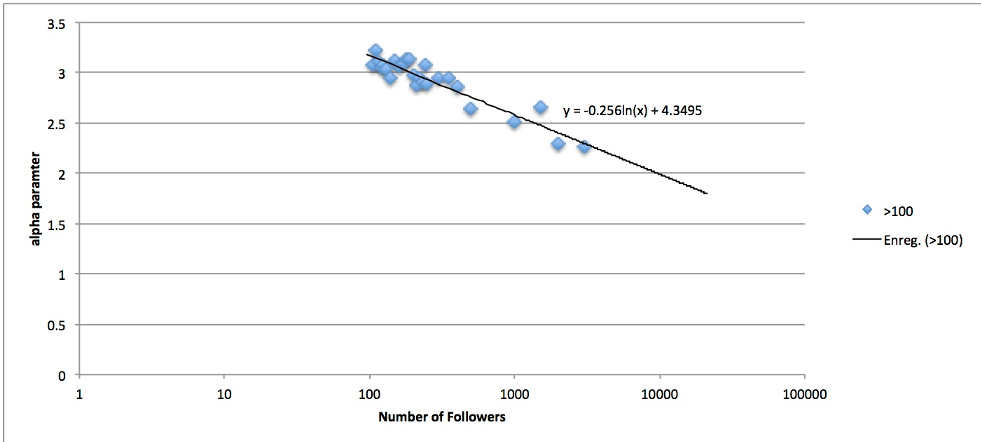
*Fig 4 & 6: The relationship between the scaling parameter and follower count, showing the logarithmic shift for high in-degree users.*
## Experiments: Crisis as a Catalyst
The authors tested their model against the backdrop of the **2011 Great Tohoku Earthquake**. This provided a unique laboratory to see how human behavior changes under stress.
### Key findings from the Earthquake Data:
* **Propensity to Share**: Immediately after the quake, the $\alpha$ parameter dropped across the board. This means that *even for the same user*, a tweet became significantly more likely to be retweeted after the disaster than before.
* **Originals vs. Retweets**: Initially, the surge in Twitter traffic was driven by original reports (2/3 of the increase). In the following days, the volume of original tweets normalized, but the "retweet behavior" remained elevated, as the network acted as a massive amplifier for recovery info.
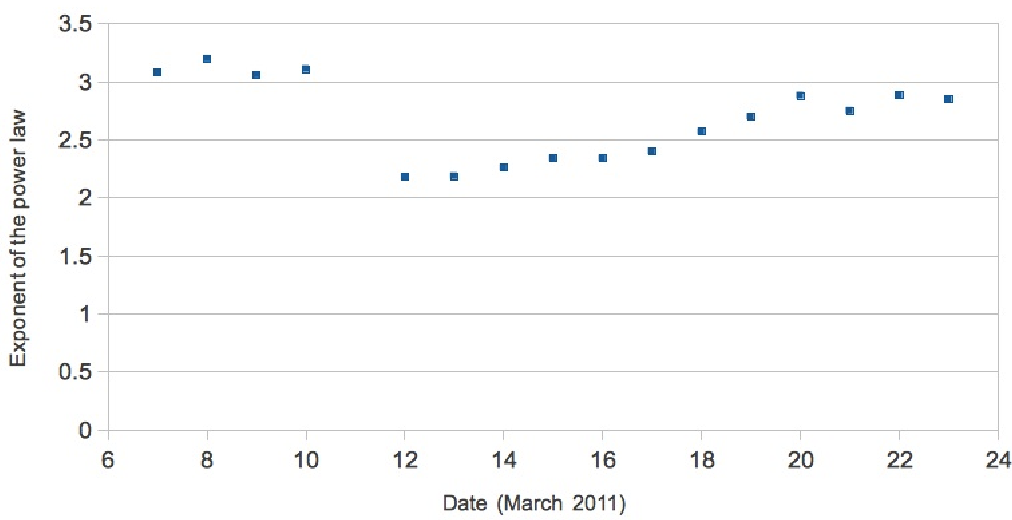
*Fig 9: The sharp drop in 'alpha' post-earthquake signifies an increased probability of wide information diffusion.*
## Critical Analysis: Is More Always Better?
The paper concludes with a strategic insight for information diffusion. If your goal is to reach a **specific niche**, the "influence" of your source doesn't matter much. However, if you want **global reach**, the math is clear:
* To produce a chain of length 10, a hub is only slightly better than a normal user.
* To produce a chain of length 1,000, a "Super Hub" (10k+ followers) is over **100 times more effective**.
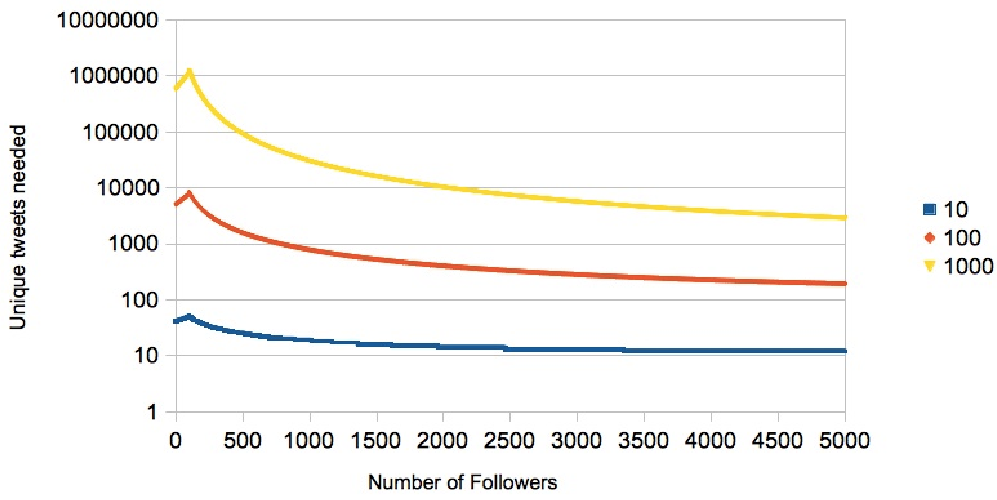
*Fig 10: The staggering difference in the volume of tweets required to achieve "viral" status based on follower count.*
## Conclusion
This work demystifies the "randomness" of viral information. By quantifying the shift in power-law parameters, the authors provide a framework that explains why hubs are essential for the survival of long-distance information.
**Limitations**: The study relies on a Japanese-centric dataset and simplified power-law fitting that ignores some "cut-off" effects for ultra-popular users. Future work needs to integrate the actual structure of the follower graph (who follows whom) into the simulation to move from predicting *length* to predicting *path*.