
Multilayer Information Flow: Mapping the Cross-Platform Journey of Viral Content
On the Information Diffusion Between Web-Based Social Networks
This paper introduces the concept of multilayer information flow to track how digital content diffuses across different Online Social Networks (OSNs). By analyzing Reddit posts linked to ImgUr and YouTube, the authors demonstrate how information originates in a source layer and propagates through Twitter and Facebook as subsequent layers.
TL;DR
Information doesn't stay in one place. This paper treats the ecosystem of Online Social Networks (OSNs) as a multilayer stack, tracking how content born on Reddit migrates to Twitter and Facebook. By standardizing interaction metrics into "Units of Interest" (UoI), the researchers reveal a distinct temporal hierarchy: content typically hits Twitter within 3 hours of a Reddit spike, while Facebook follows nearly 12 hours later.
Background & Positioning
Since the 1940s, sociologists have studied how information moves from media to "opinion leaders" and then to the public. In the digital age, this has evolved into "Viral Marketing." However, most studies look at a single platform (e.g., just Twitter). This work positions itself as a structural bridge, viewing the internet not as a single flat web, but as a series of interconnected layers where the content itself acts as the link between disparate social environments.
Problem: The Silo Effect in Network Research
The primary pain point addressed is the lack of cross-platform quantification. Previous works focused on "weak ties" versus "strong ties" within a single graph. The authors argue that to understand modern virality, we must measure how a "success" on one platform (like a front-paged Reddit post) triggers a ripple effect on others. The difficulty lies in the fact that a "like" on Facebook is not the same as a "vote" on Reddit or a "view" on ImgUr.
Methodology: The Multilayer Framework
The authors propose a Multilayer Information Flow model. To validate this, they scraped two Reddit categories—"new" and "rising"—collecting nearly 1 million posts over 60 days.
The UoI Metric
To compare apples to oranges, they defined Units of Interest (UoI):
- ImgUr/YouTube: 1 View = 1 UoI
- Reddit: 1 Vote (Up + Down) = 1 UoI
- Twitter: 1 Mention = 1 UoI
- Facebook: 1 Like/Mention = 1 UoI
Selection Logic
They focused specifically on posts linking to ImgUr and YouTube because these domains provide public viewership counters, allowing the researchers to see if external social media buzz actually translates into raw traffic at the source.
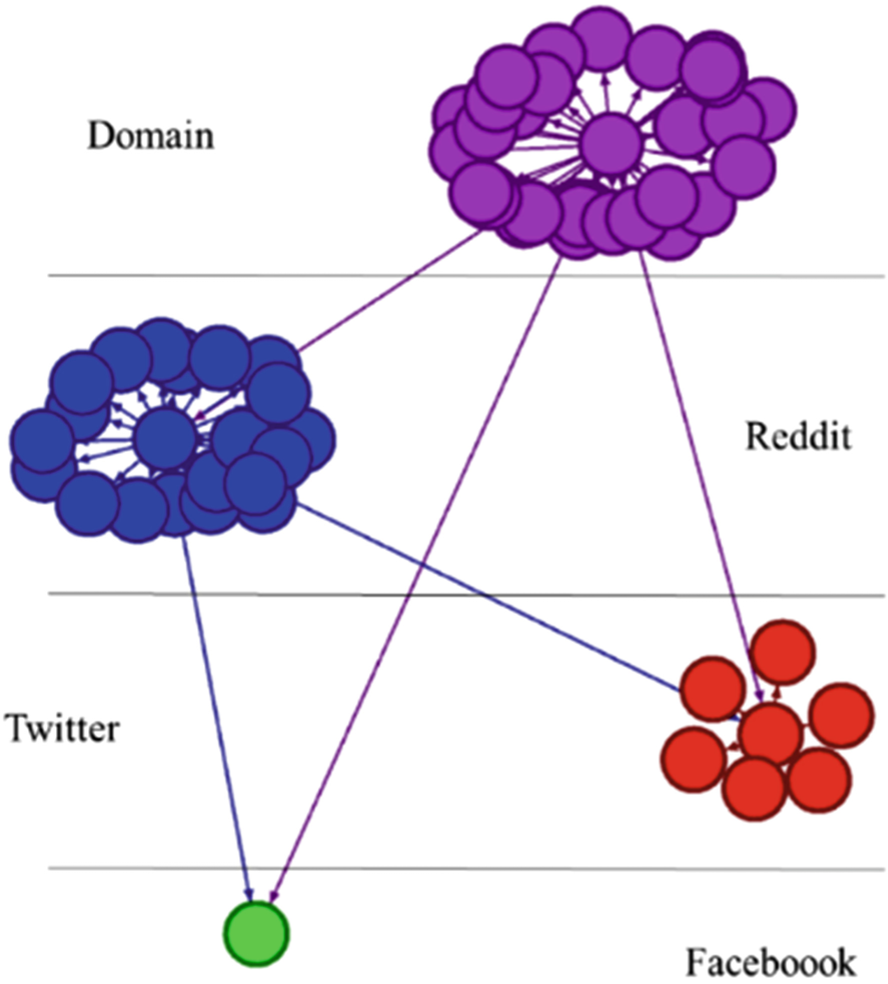 Figure: The proposed perception of layers, showing information flowing from a source layer (Domain) downwards through OSN layers.
Key Results & Experimental Findings
The study discovered that "virality" is highly dependent on both the topic and the hosting domain.
1. The Virality Filter
Only 0.66% of posts passed the authors' "check criterion" (doubling UoI every hour for 4 hours). Socially, "Funny" and "WTF" topics were the most likely to diffuse, while "Gaming" and "Movies" showed the highest "persistence" (continued interest over time).
2. Time Lag and Diffusion Ratios
- ImgUr Flow: Content reaches Twitter in ~3 hours and Facebook in ~12 hours. The volume ratio is staggering: for every 1 Facebook UoI, there are 426,656 ImgUr views.
- YouTube Flow: The temporal gap is shorter (2-3 hours), but the source domain (YouTube) often shows zero variance. This is because Reddit users often link to old videos that are already established, whereas ImgUr links are usually created specifically for the Reddit post.
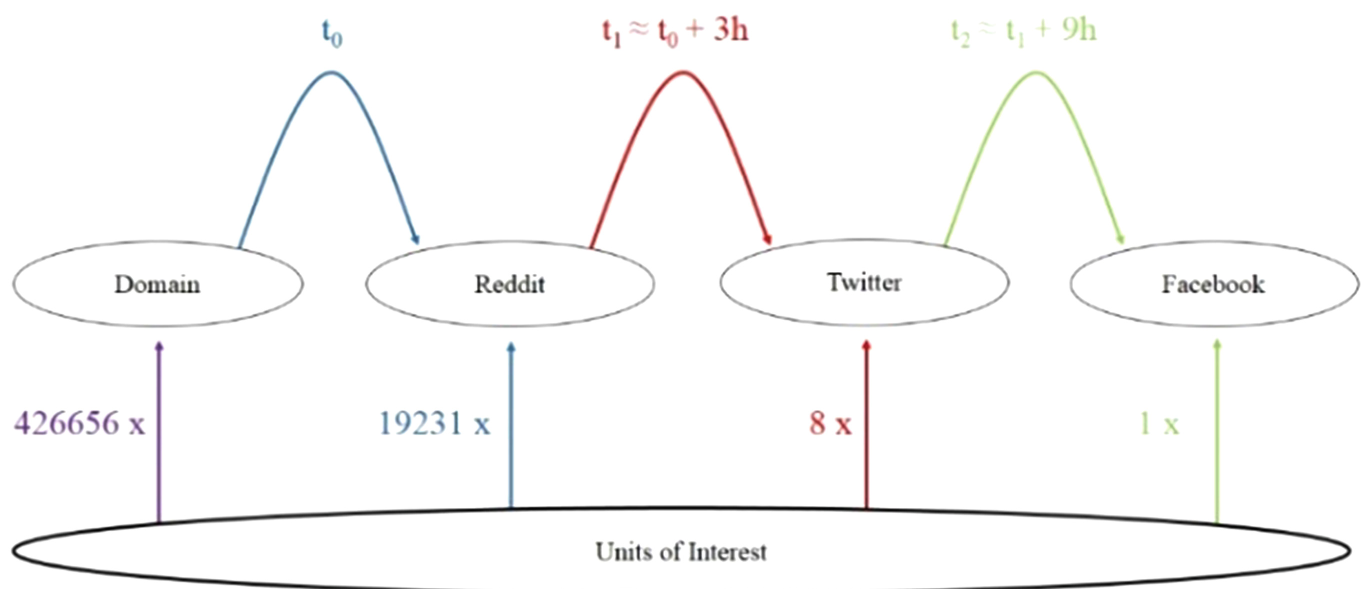 Figure: Diffusion time and UoI allotment for ImgUr content across the multilayered stack.
Critical Analysis & Conclusion
Takeaway
The study confirms that OSNs act as a worldwide events station. The "vertical" flow of information—from the hosting domain down through curated social layers—suggests that virality is an organized migration rather than a random explosion.
Limitations
- API Restrictions: The authors admit that Facebook’s private wall settings heavily skewed their data, likely undercounting its actual role in diffusion.
- Metric Weighting: Equating 1 Reddit vote to 1 YouTube view is a simplification; a vote requires an active account and more "effort" than a passive view, which might explain the high Domain-to-OSN ratios.
Future Outlook
This work lays the groundwork for predictive virality algorithms. By observing the early "vibrations" on Reddit and Twitter within the first three hours, researchers might soon be able to predict with high accuracy which content will eventually dominate Facebook feeds 12 hours later.