
The Social Network Paradox: When "Too Much" Communication Fails Prediction Markets
Information Exchange in Prediction Markets: Do Social Networks Promote Forecast Efficiency?
This paper investigates how information exchange within social networks affects the forecast efficiency of prediction markets. Using a game-theoretic framework with endogenous information acquisition, the authors demonstrate that while social networks can enhance accuracy when information costs are low, they can paradoxically degrade performance when costs are high due to "free-riding" effects.
Executive Summary
TL;DR: Does talking to your friends make the "crowd" wiser? Not necessarily. While social networks are conduits for information, they also incentivize "free-riding." This paper proves that in prediction markets, social networks only improve forecast accuracy when information is cheap to get. If the information is expensive, social connectivity actually makes the market less efficient than if everyone worked in isolation.
Background: This work sits at the intersection of Game Theory and Financial Economics. It challenges the naive "Wisdom of Crowds" assumption by introducing Endogenous Information Acquisition—the idea that people only "buy" information if it's worth the cost—into a networked environment.
The Free-Rider Problem in Information Networks
Most prediction market theories assume participants are isolated silos of data. In reality, we use Twitter, Facebook, and professional circles to "compare notes." The authors identify a critical tension:
- The Benefit: Networks spread valuable signals farther.
- The Pitfall: If I can see my friend's signal for free, why should I pay the cost to acquire my own?
This creates a condition of Strategic Substitutes: the more my friends acquire information, the less motivation I have to do the same.
Methodology: The Threshold Strategy
The authors analyze two market mechanisms:
- Forecast-Report: A scoring-rule based system.
- Security-Trading: A traditional market where participants trade assets (CARA utility).
They prove that in a symmetric Bayes-Nash equilibrium, everyone follows a Threshold Strategy.
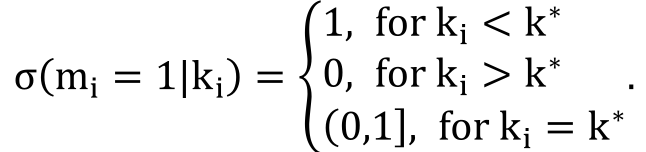
If your "degree" (number of connections) is below a certain threshold , you pay for information. If you have too many friends, you stop buying information and simply "free-ride" on what they have.
Experimental Insights: The Cost-Benefit Flip
Through agent-based simulations (100 participants), the authors compared Socially-Embedded Prediction Markets (SEPM) against Non-Networked Prediction Markets (NNPM).
The Critical Turning Point
The most profound finding is the "crossover" in Mean Square Error (MSE).
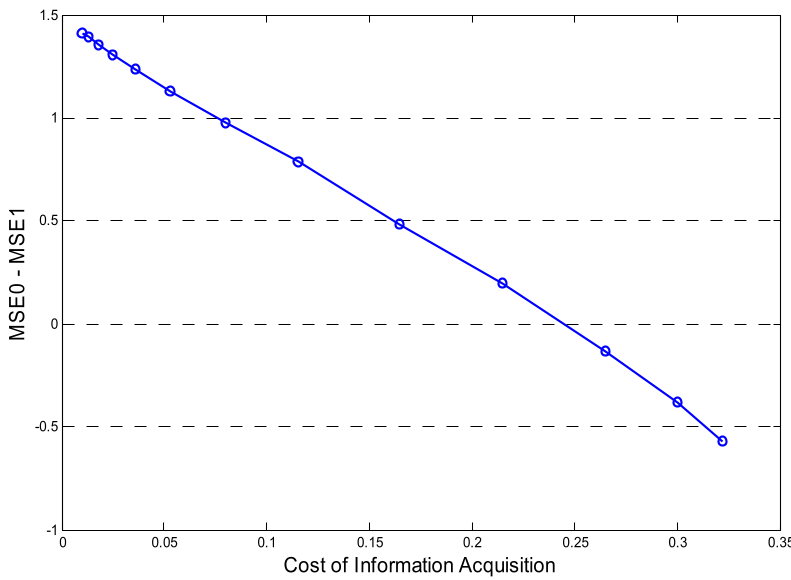 Figure 3: Comparison of MSE. When cost is low, the SEPM (networked) is better. When is high, the NNPM (isolated) is superior.
When information is expensive, the network causes such a massive drop in total signals acquired that the "internal communication" cannot compensate for the lack of "external information input."
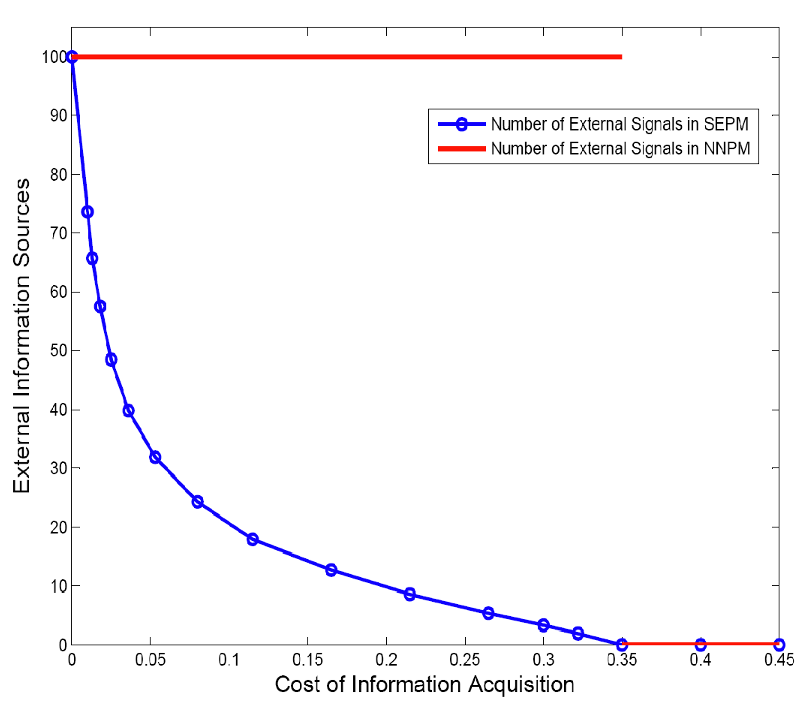 Figure 5: Total signals acquired. In non-networked markets, it's an all-or-nothing cliff. In networked markets, it declines gradually, leading to under-sampling of the truth at high costs.
Critical Analysis & Conclusion
Key Takeaway
The design of a prediction market (e.g., within a corporation like Google or HP) must be matched to the complexity of the task:
- Low Cost/Simple Tasks: (e.g., "Will this movie break the box office?") Encourage social features. The network helps aggregate easy-to-find opinions.
- High Cost/Complex Tasks: (e.g., "Will a specific geopolitical event occur?") Discourage social interaction. You need every participant to dig for their own unique data rather than relying on their neighbor's "filtered" view.
Limitations
The model assumes an Incomplete Information Network Game, meaning participants know their own degree but not the whole map. In highly transparent or small professional circles, complete information might change the strategic dynamics. Furthermore, the model uses a "Simple Averaging Rule" for forecasts; an optimized weighting system (if the principal knew the network) might mitigate some of the network's detriments.
Final Thought: Paradoxically, for the crowd to be truly wise about difficult problems, individuals must stay in the dark about what others are thinking.