
WebPIE: Why Your Hidden Social Media Profile Isn't Actually Private
An Information Extraction Attack against On-Line Social Networks
The paper introduces WebPIE (Web-based Private Information Extraction), a novel information re-association attack that uncovers hidden private data in On-line Social Networks (OSNs). By integrating web search, Named Entity Recognition (NER), and clustering, it demonstrates that even if a user's profile is partially private, an adversary can reconstruct hidden attributes using external web data.
TL;DR
Think setting your Facebook hometown or employer to "Private" keeps you safe? Think again. This paper reveals the WebPIE (Web-based Private Information Extraction) attack, a method that uses your public "anchor" data (like your name and university) to scour the open web, extract disparate fragments of your life, and re-associate them to "guess" your hidden profile attributes with startling accuracy.
Executive Summary
In the landscape of cybersecurity, we often focus on "leaks" from within a database. However, this paper shifts the focus to Information Re-association. The authors argue that your identity is a "Feature Vector" distributed across the internet. By using an automated pipeline of web search and Data Mining, an attacker can bypass OSN privacy settings without ever "hacking" the platform itself.
The Problem: The Illusion of "Selective Visibility"
Existing On-line Social Networks (OSNs) like LinkedIn or Facebook allow users to toggle visibility for specific fields. The fundamental flaw in this logic? The Open Web is a shadow of your social profile.
Current privacy research (like k-anonymity) focuses on static, published datasets. This paper addresses the "live" threat where an adversary uses:
- Incomplete Knowledge: The attacker starts with only 1 or 2 public facts about you.
- The Namesake Issue: The difficulty of distinguishing between multiple "John Smiths" across the web.
Methodology: The WebPIE Framework
The authors designed a modular system to automate the "stalking" process at scale.
1. The Model: Feature Vectors
Identity is modeled as a sum of feature sets: Where represents a type (e.g., Organization, Location) and represents the frequency (multiplicity) of that feature appearing across documents.
2. The Attack Pipeline
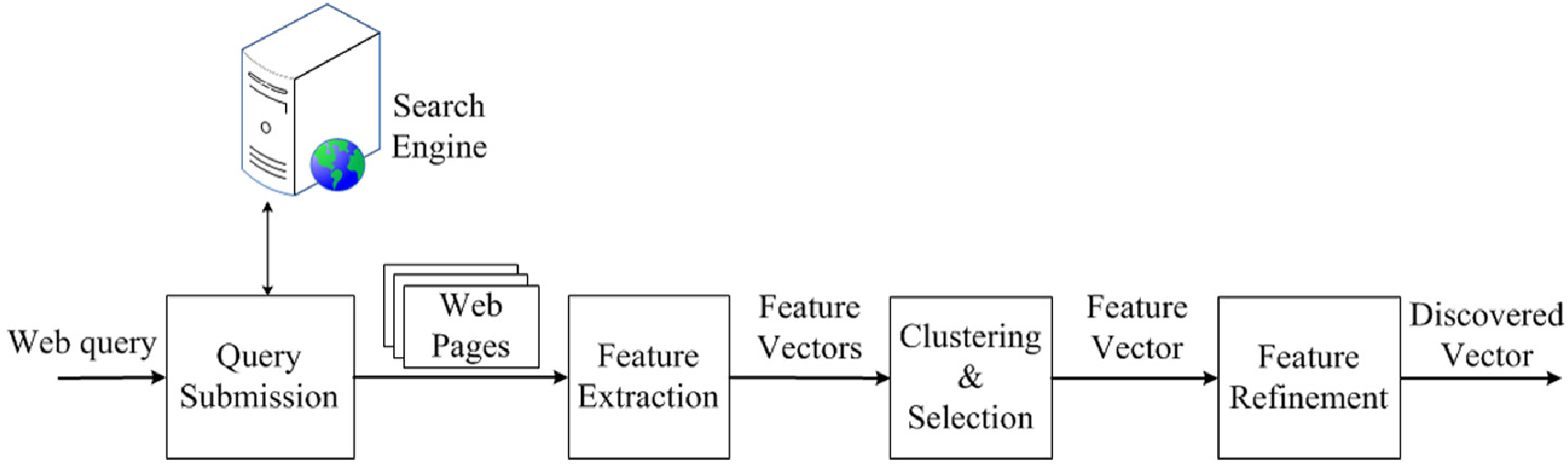
- Query Submission: Uses your name + an "anchor" (like your college) to generate Google queries.
- Feature Extraction: Scans page titles, metadata, and body text using Named Entity Recognition (NER).
- Clustering & Disambiguation: This is the "secret sauce." Since many people share names, the system uses Hierarchical Agglomerative Clustering to group web pages that share similar attributes, identifying the specific "cluster" that belongs to the victim.
- Refinement: It applies a "multiplicity threshold"—if a location (e.g., "Austin") appears across multiple sources, it's weighted as highly likely to be true.
Experimental Insights: Who is most at risk?
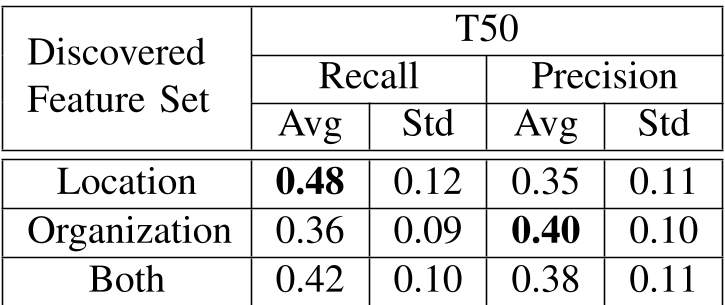
The study analyzed 1,600 Facebook profiles, categorized by university ranking (Top 50 vs. Average).
Key Finding 1: The "Elite" Vulnerability
Users from Top-50 Universities (T50) showed significantly higher recall and precision in the attack. Why? High-profile individuals tend to have a larger "web footprint" (mentions in news, alumni directories, or professional associations), providing more external data for the attack to scrape.
Key Finding 2: The "Network" Anchor
The experiments compared different "anchors" for the initial query:
- Name + Location: Surprisingly poor performance due to high namesake density.
- Name + Network (e.g., a University): The most effective. Using a specific organization narrows the search space effectively.
Deep Insight & Conclusion
This paper serves as a sobering reminder that privacy is not local. Even if an OSN provides "perfect" access control, your external digital shadow (academic records, news mentions, legal filings) can be used to reconstruct your private profile.
Takeaways for the Industry:
- Platform Responsibility: OSNs shouldn't just hide fields; they need to warn users about the "uniqueness" of their public attribute combinations.
- Anti-Crawling is key: The effectiveness of WebPIE relies on search engine indexing; more aggressive anti-bot and anti-scraping measures on peripheral web pages are required.
- Future Risks: With today's Advances in LLMs, the "Refinement" phase of this attack could be far more sophisticated, moving from simple multiplicity counts to deep semantic reasoning.
Limitations: The study was limited to text-based extraction. In 2024, an attacker would likely integrate facial recognition and social graph crawling to increase precision to near 100%.