
Information Extraction Meets Crowdsourcing: Building the Ultimate Hybrid Intelligence
Information Extraction Meets Crowdsourcing: A Promising Couple
The paper "Information Extraction Meets Crowdsourcing: A Promising Couple" explores the synergy between algorithmic Information Extraction (IE) and human intelligence platforms like Amazon Mechanical Turk. It introduces a systematic classification of crowdsourcing tasks and proposes a hybrid framework that interweaves Information Extraction, Machine Learning, and Crowdsourcing to achieve low-cost, high-quality data acquisition for complex experiential attributes.
Executive Summary
TL;DR: This paper tackles the limitations of automated Information Extraction (IE) by integrating it with human crowdsourcing. By classifying tasks based on "Skill Requirements" and "Answer Consensus," the authors reveal why simple crowdsourcing often fails. Their solution is a hybrid architecture that uses Perceptual Spaces—latent representations of user behavior—to amplify the power of a small, expertly labeled dataset across millions of items.
Positioning: This work is a foundational exploration of Human-in-the-Loop (HITL) systems, moving beyond simple "Mechanical Turk" setups toward sophisticated, machine-learning-augmented data extraction.
The Problem: The Crowdsourcing Trilemma
Even the best IE algorithms hit a wall when dealing with implicit concepts—information that isn't written down in a structured way but requires human intuition. Crowdsourcing seems like a silver bullet, but it usually falls into one of three traps:
- Quality: Malicious workers (cheaters) and lack of expertise.
- Latency: Human tasks don't scale instantly; they depend on worker pool availability.
- Cost: Paying for thousands of manual labels is prohibitively expensive for large datasets.
Methodology: The Perceptual Space Hybrid
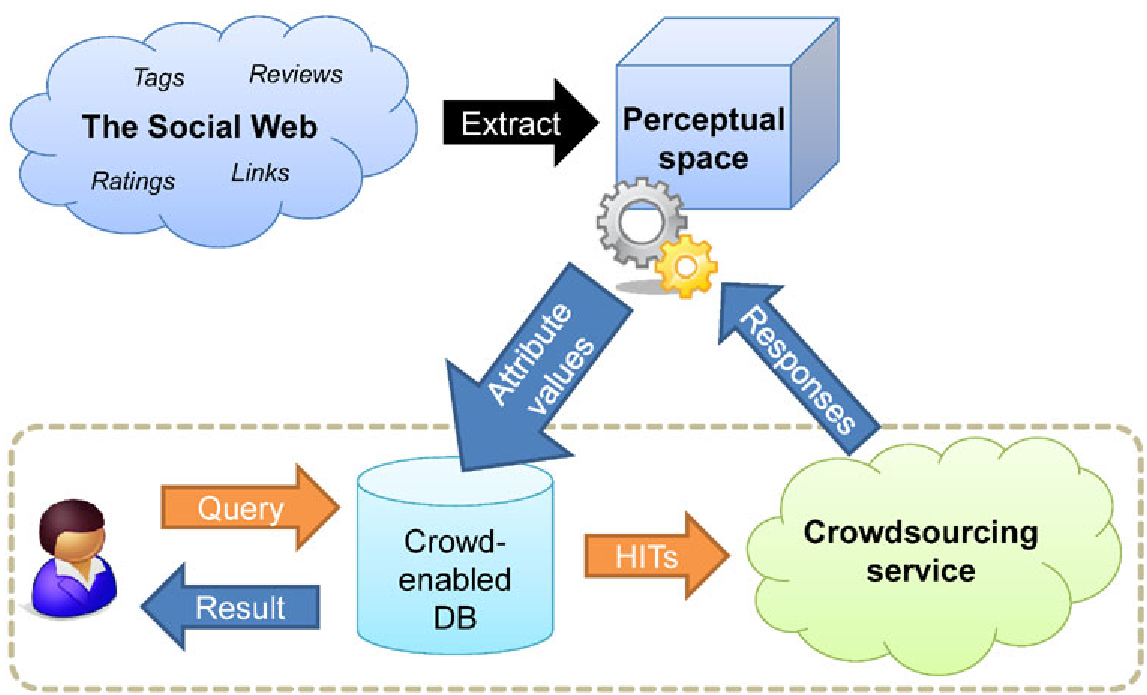
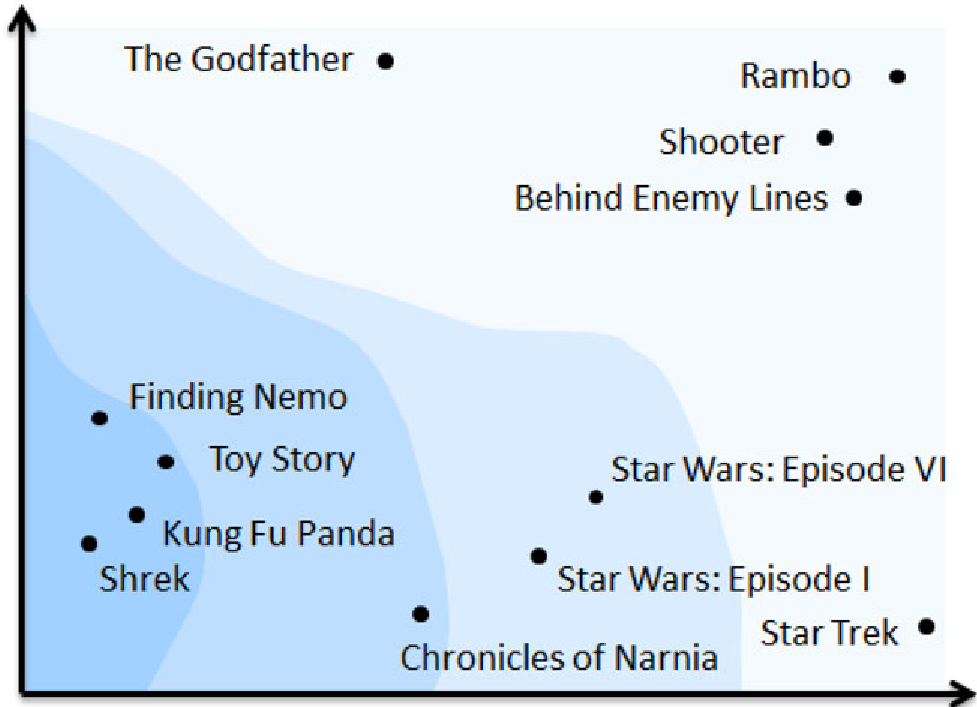
The authors' core "Insight" is that we don't need to ask humans everything. Instead, we can use the Social Web (ratings, reviews) to build a "Perceptual Space."
1. Task Classification
The paper categorizes crowdsourcing into four quadrants based on whether the task is Factual vs. Consensual and whether it requires General vs. Special Skills.
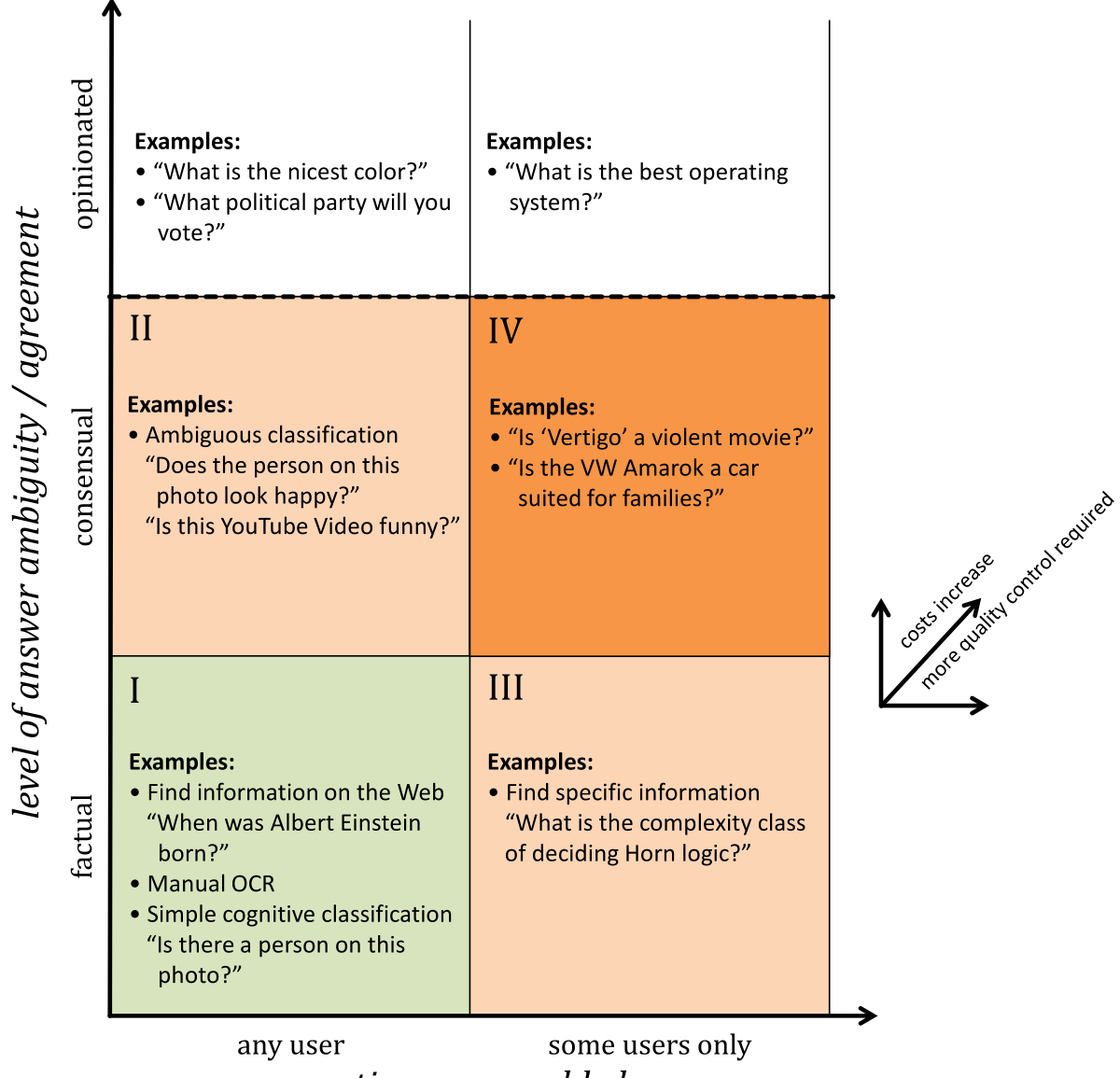
- Quadrant I: Easy, factual (e.g., OCR). Standard quality control (Gold Questions) works well.
- Quadrant IV: Hard, subjective (e.g., is this movie "suspenseful"?). This is where traditional IE fails most.
2. The Hybrid Workflow
Instead of asking the crowd to label every movie in a database, the authors follow this pipeline:
- Step 1: Extract Perceptual Space: Use Matrix Factorization on existing user-item ratings (e.g., from Netflix) to map items into a latent coordinate system.
- Step 2: Expert Crowdsourcing: Pay a higher rate for a small but high-quality training set from trusted workers.
- Step 3: ML Expansion: Use Support Vector Regression (SVR) to map the expert labels onto the entire latent space, "guessing" the attributes for all other items.
Experiments & Results: Efficiency Overpowering Manual Labor
The authors compared pure crowdsourcing against their hybrid model. The results were startling:
- The "Cheater" Effect: In consensual tasks without gold questions, workers chose the first available checkbox 62% of the time just to finish quickly and get paid.
- The Hybrid Advantage: By using only $0.32 worth of expert-labeled data, the hybrid system reached 73% accuracy for 1,000 items in minutes. Achieving the same with pure crowdsourcing was not only slower but significantly more prone to quality degradation.
Critical Insight & Conclusion
Takeaway: The real power of crowdsourcing isn't "manual labor"—it's "ad-hoc training." By treating the crowd as a source of high-quality supervision for machine learning models rather than a replacement for automated scripts, we can handle subjective, complex data at scale.
Limitations: The Perceptual Space relies on the existence of dense "Social Web" data. If you have a brand-new dataset with no user interaction (the "Cold Start" problem), building the latent space becomes impossible, forcing a return to more expensive, manual quadrants.
Future Outlook: While this 2012 paper used SVMs, the logic holds today: replace the SVM with a Large Language Model (LLM), and the "Crowd" with "Human-in-the-loop RLHF" (Reinforcement Learning from Human Feedback), and you have the modern blueprint for AI alignment.