
Information vs. Favoritism: Decoding the Causal Power of Networks in China's Labor Market
Information and favoritism: The network effect on wage income in China
This paper investigates the causal mechanisms of social networks on wage income in urban China, proposing a dual-path model of "Information" and "Favoritism." Using a 5-city survey of 4,350 wage earners, it demonstrates that social contacts facilitate job attainment for 59% of workers, significantly boosting wages through improved job-worker matching and access to superior earning opportunities.
TL;DR
Is "who you know" more important than "what you know"? In the context of urban China, the answer is a resounding "yes," but for complex reasons. This study moves beyond simple tie-strength metaphors to prove that social networks exert a causal, non-spurious effect on wages through two distinct channels: informational efficiency and the mobilization of favoritism. While weak ties help you find the right job, strong ties (Guanxi) ensure that job pays significantly more.
Context: Beyond the "Spuriousness" Debate
For decades, sociologists have debated whether social networks actually cause higher wages or if successful people simply happen to have successful friends (the "homophily" problem). Ted Mouw’s famous 2003 challenge suggested the "network effect" might be a myth.
The authors of this paper, led by Yanjie Bian, tackle this head-on by surveying 4,350 workers across five major Chinese cities. Their goal: to prove that network-transmitted resources are not just proxies for status, but active drivers of income inequality in a "socially crowded" labor market.
Methodology: The Dual-Resource Model
The core innovation of this paper is the decoupling of Information and Favoritism.
- Information: Reduces asymmetry. It helps a job-seeker find a vacancy and helps an employer assess a candidate's fit.
- Favoritism: Mobilizes influence. It involves contacts approaching authorities, delivering applications personally, or solving "concrete problems" to ensure a specific candidate is selected regardless of the open market.
The authors propose that these resources are mobilized by different tie strengths, as illustrated in their theoretical framework.
Key Findings: The Reversal of Efficacy
The data reveals a striking "X-curve" of tie efficacy (see Table 2 in the paper):
- Weak Ties (The Information Bridge): Highly effective at providing non-redundant information (80.1% probability) but less likely to yield favoritism.
- Strong Ties (The Favoritism Engine): The probability of obtaining favoritism jumps to 84.9% with the "strongest ties."
The Wage Premium
The paper’s most provocative finding is the quantifiably massive impact of favoritism on wealth. While information only helps wages indirectly (by making sure you get a job that matches your skills), favoritism provides a direct "bonus."
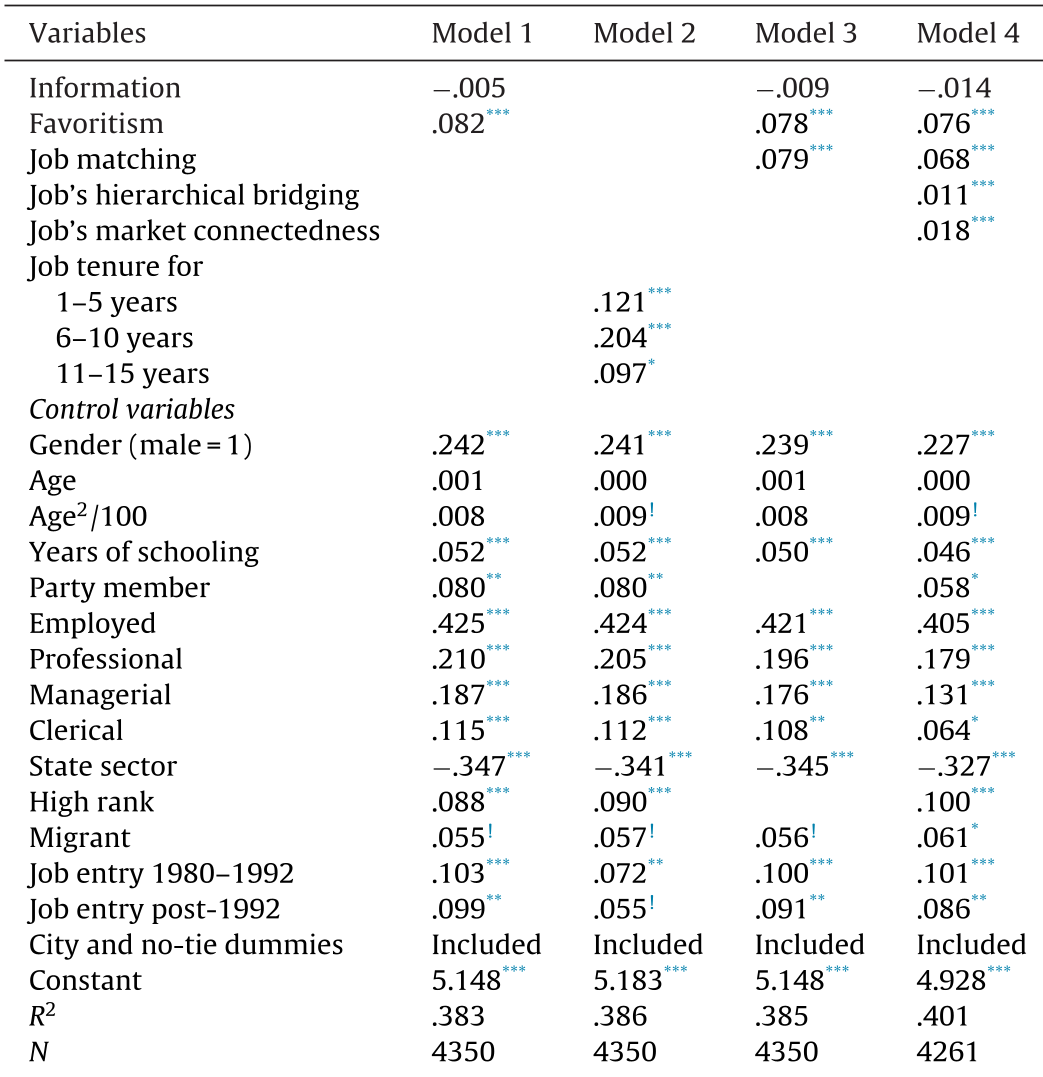
- Those receiving favoritism see a direct wage increase of 8.5%.
- For mid-career workers (6-10 years), this favoritism "premium" can swell to a staggering 22.6%.
- Favoritism also channels workers into "Superior Earning Positions"—jobs with high hierarchical bridging (access to power) and market connectedness.
Critical Insight: Is This Market Efficiency or Corruption?
One might assume favoritism is purely "bad" for the economy. However, the authors find a nuance: favoritism also promotes job-worker matching. Even when a favor is pulled, the employer often picks someone whose qualifications actually fit the role.
However, the "ugly side" remains: the favor-receiver gets a higher wage than a similarly qualified peer who lacked the right "Guanxi." This suggests that even as China moves toward a market economy, the "social character" of its labor market remains a dominant force.
Conclusion
This study provides a robust defense of network theory. It proves that networks don't just help you "get" a job—they determine the quality and remunerative value of that job for years to come. For researchers, the takeaway is clear: we must stop using "tie strength" as a catch-all variable and start measuring the specific resources—Information and Favoritism—flowing through those ties.
Takeaway for the Future: As global labor markets become increasingly digital, will algorithms replace the "Information" role of weak ties while leaving the "Favoritism" of strong ties as the last remaining bastion of human-driven inequality? This research suggests that social influence is far harder to "marketize" than pure information.