
Information Flow on Blogs: Why Text is Not Enough in the Web 2.0 Era
Information Flow Detection and Tracking on Web2.0 BLOGS Based on Social Networks
This paper introduces a hybrid approach for information flow detection and tracking in Web 2.0 blogs by integrating social network features with traditional text analysis. Utilizing k-medoids clustering and Network Structure Index (NSI), the method achieves superior performance on real-world SOHU blog data compared to text-only TDT (Topic Detection and Tracking) baselines.
TL;DR
Researchers from the National University of Defense Technology have developed a tracking system that doesn't just read what bloggers say, but looks at who they talk to. By combining textual features with social network structures, they improved information tracking accuracy by over 8% on real-world blog data, revealing how community boundaries act as "filters" for different types of news.
Problem & Motivation: The Silent Dimension of Blogs
In the traditional Information Retrieval (IR) paradigm, topics are tracked as a stream of text. However, the Web 2.0 revolution—led by blogs and social media—changed the game. Information is no longer just a sequence of words; it is a diffusion process driven by user actions like commenting, linking, and reading.
The authors argue that existing Topic Detection and Tracking (TDT) models are "blind" to the social fabric. A star blogger’s post has a different weight and trajectory than a private diary entry. To solve this, they set out to map the hidden social graph beneath the blogosphere to understand how information actually migrates from one user to another.
Methodology: Mapping the Social Substrate
The paper proposes a two-stage methodology: Social Network Mining and Social-Text Tracking.
1. Mining the Hidden Graph
To handle the sheer scale of social data, the authors utilize a k-medoids clustering algorithm. To avoid the computational "death trap" of calculating distances between thousands of users, they employ the Network Structure Index (NSI).
- Insight: They use "Distance to Zone" (DTZ) to approximate graph distances in time, making it feasible to analyze massive datasets.
- Distance Metrics: Relationships aren't just binary. The model weights edges based on "Online Actions" (Reads, Comments, Referrals) and uses a TF-IDF-like measure to penalize links to "famous" blogs while rewarding more personal, bidirectional connections.
2. Information Flow Detection & Tracking
The system detects "burst" words (sudden frequency spikes) aided by User Tags, a hallmark of Web 2.0. When tracking how a topic moves, the model calculates a hybrid similarity score:
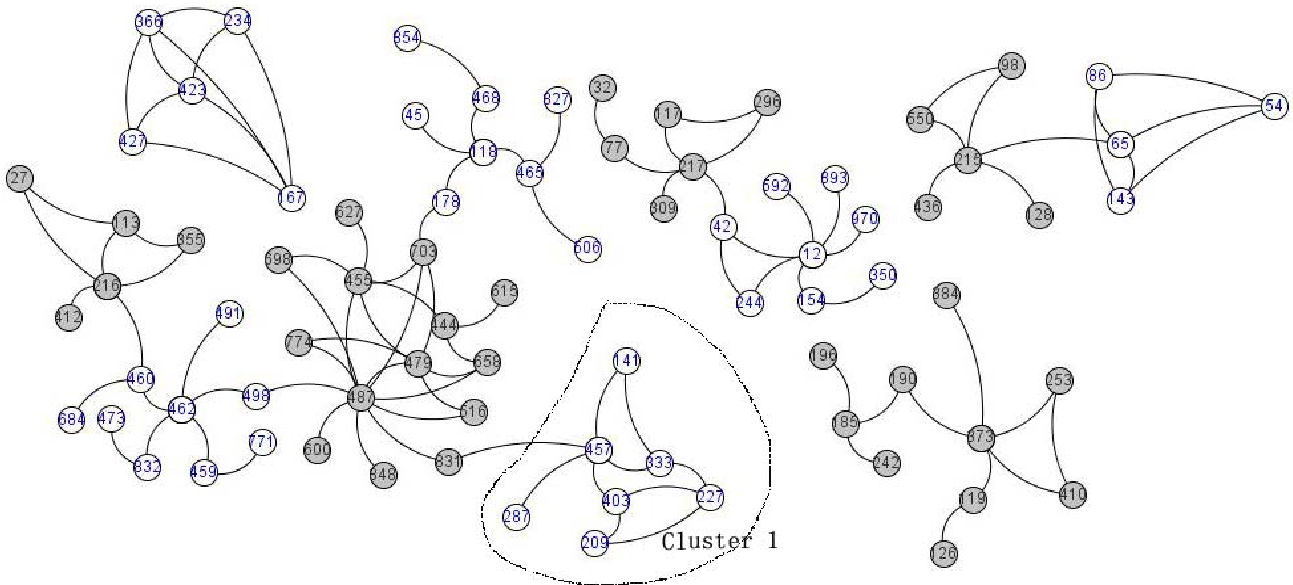 Figure 1: Visualization of internal social structures within the business blog circle, showing how users form distinct clusters.
Experiments & Results: Social Features as a Force Multiplier
The authors tested their approach on data from SOHU blogs, focusing on three circles: Business, Sports, and Entertainment.
- Performance Leap: By including features like
isOneClst(same cluster) andisComment, the tracking Precision reached 90.67%. - Baseline Comparison: It outperformed text-only VSM models significantly. Without social features, the system missed 25% more relevant entries.
 Table 1: Quantitative results showing the superiority of the Social + Text hybrid approach.
Critical Insight: "Burst" vs. "Chatter"
The most fascinating part of the study is the analysis of information "laws":
- Burst Topics: Driven by external news (e.g., a stock market crash). These spread instantly across the entire network, ignoring social boundaries, but die out within 2-3 weeks.
- Chatter Topics: These are "community-bound." Their spread is heavily dictated by Local Centrality. If a topic doesn't hit a "hub" node (a highly connected user in a cluster), it rarely leaves its original community.
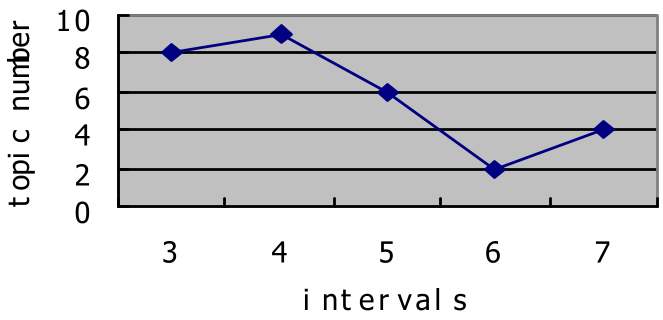 Figure 2: The flow of a "chatter" topic (QFII) through specific network nodes, highlighting the role of central hubs in propagation.
Conclusion & Future Outlook
This work serves as a foundational bridge between NLP and Social Network Analysis (SNA). It proves that topology is content in the era of Web 2.0. While the k-medoids and VSM approach may seem classic by today's standards (compared to current LLMs), the core intuition—that community structures act as logic gates for information—remains highly relevant for understanding misinformation and viral marketing today.
Limitations: The study relies on manual labeling for Ground Truth, which is difficult to scale. Future work could benefit from automated sentiment and influence analysis to better qualify the type of flow.