
Smarter Social Search: Scaling Decentralized Networks with Trust and Pruning
Information Flow and Search in Unstructured Keyword Based Social Networks
This paper introduces an Information Flow and Search model for unstructured keyword-based Online Social Networks (OSNs). The core methodology utilizes a trust-weighted keyword propagation mechanism and a search algorithm that balances topological proximity with edge-based trust to significantly optimize decentralized user discovery.
TL;DR
In the realm of Online Social Networks (OSNs), finding a user with specific expertise or interests usually requires a massive centralized database. This paper challenges that status quo by proposing a decentralized, keyword-based search model. By combining trust metrics with topological distance and employing a dynamic pruning function, the authors achieved a search efficiency orders of magnitude higher than standard Breadth First Search (BFS).
The Problem: The "Small World" Complexity Trap
Modern OSNs are defined by high average node degrees and high clustering coefficients (the "small world" property). While this makes everyone "six degrees" away, it makes decentralized search a nightmare:
- Flooding Bottlenecks: Standard BFS creates an exponential explosion of query messages.
- Relevance Gap: Global relevance doesn't exist in social contexts; users care about results that are "trustworthy" and "near" them.
- Privacy vs. Discovery: How do you let people find you via keywords without exposing your entire identity to the whole network?
Methodology: Trust-Aware Routing
The authors' solution rests on two pillars: an Information Flow Model and a Dynamic Search Algorithm.
1. Privacy-Preserving Information Flow
When a user adds a keyword (e.g., "Soccer"), it propagates through the network based on a policy: Policy(k) = [D, T], where D is the max hop distance and T is the minimum trust. Crucially, identity is only shared with direct friends; beyond that, only the "existence" of the keyword is known, protecting user privacy.
2. The Search "Value" Function
Instead of blindly forwarding queries, each node evaluates its friends using a linear combination of Distance (DV) and Trust (TV):
- DV: Favors friends who have historically provided paths to closer targets.
- TV: Favors friends with whom the user has a higher trust relationship.
- : A tunning parameter to prioritize either proximity or reliability.
3. Dynamic Pruning
To prevent network congestion, the paper introduces a Pruning Function. Instead of a fixed threshold, each node calculates a threshold based on its own degree. As the number of friends increases, the "bar" for forwarding a query rises, effectively cutting out low-value paths.
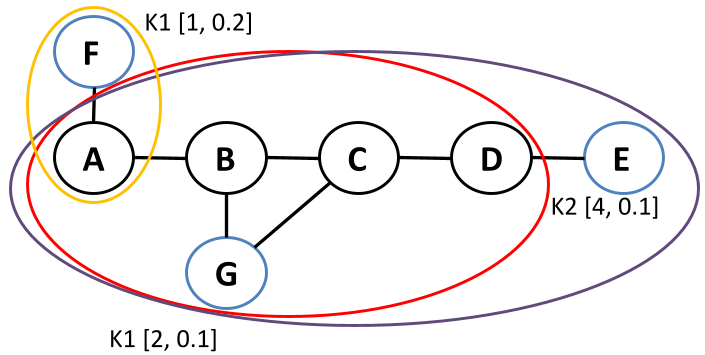 Figure 1: Example of keyword propagation and the resulting search boundaries within the social graph.
Experiments & Results
The authors tested their model against BFS using a synthetic graph of 1,000 nodes with realistic social properties (Diameter 5, Clustering 0.399).
Key Findings:
- Message Efficiency: While BFS generated over 120 messages per query, the proposed algorithm stayed below 12 messages in restrictive environments.
- Success Rate: The "Targets found per query message" metric showed that the proposed method is much more "surgical." It avoids redundant probes and finds high-trust targets more effectively than BFS.
- The Power of : The research found that the best performance occurs when , suggesting that a mix of trust and distance is superior to using either alone.
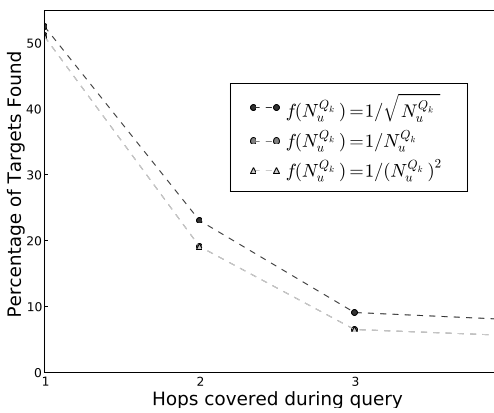 Experimental results showing that the proposed pruning functions consistently deliver more relevant targets per message than the BFS baseline.
Critical Insights & Takeaways
Why does it work? The "magic" isn't just in the math, but in the Inductive Bias. By mimicking human behavior—asking your closest, most trusted friends first and only branching out if needed—the algorithm aligns technical routing with social reality.
Limitations:
- The study used a static graph. In a real-world OSN, frequent "churn" (users joining/leaving) would require high beacon frequency for the Information Flow model to stay accurate.
- The trust model is currently subjective and unidirectional.
Conclusion: This work provides a solid framework for "Future OSN Architectures" that prioritize decentralization. It proves that we don't need a central authority to have an efficient, searchable, and private social web.