
Collective Intelligence in SAR: Scaling Multi-Robot Victim Detection via Information Fusion
Information Fusion Based on Collective Intelligence for Multi-robot Search and Rescue Missions
This paper introduces an automated information fusion method for multi-robot Urban Search and Rescue (USAR) that leverages "Collective Intelligence" and crowdsourcing. By decoupling robot navigation from victim localization, it allows operators to perform simple binary image annotations while an Occupancy Grid-based system automatically calculates victim coordinates.
TL;DR
Researchers from the University of Pittsburgh have developed a method to scale robotic Search and Rescue (SAR) missions by treating robot teams and human operators as a "crowdsourced" collective. Instead of operators manually mapping victims, they simply "tag" images, while an automated fusion engine uses laser scans to mathematically converge on victim locations.
Background: The Scalability Bottleneck
In traditional Urban Search and Rescue (USAR), a human operator is tethered to a robot, watching a live video feed and trying to pinpoint locations on a map. This doesn't scale. When you have 24 robots and dozens of victims, the operator becomes a bottleneck, leading to "detection fatigue," where victims are missed or mistakenly counted twice.
The authors argue that the problem isn't a lack of data, but the way we process it. We need to shift the operator's cognitive load from spatial mapping to simple pattern recognition.
Methodology: Crowdsourcing the "Where"
The core innovation lies in the decoupling of detection and localization.
- Image Queueing: Robots send pre-filtered images to a "crowd" of observers.
- Simplified Annotation: The human only answers a binary question: "Is there a victim in this image?"
- Automated Fusion: The system uses Scanning Laser Range Finders (SLRF) data. When an image is tagged, the system looks at the laser scan from that exact moment. It updates an Occupancy Grid—a map split into quadrants—increasing the "Victim Presence Probability" (VPP) in cells where the laser beam hit an object.
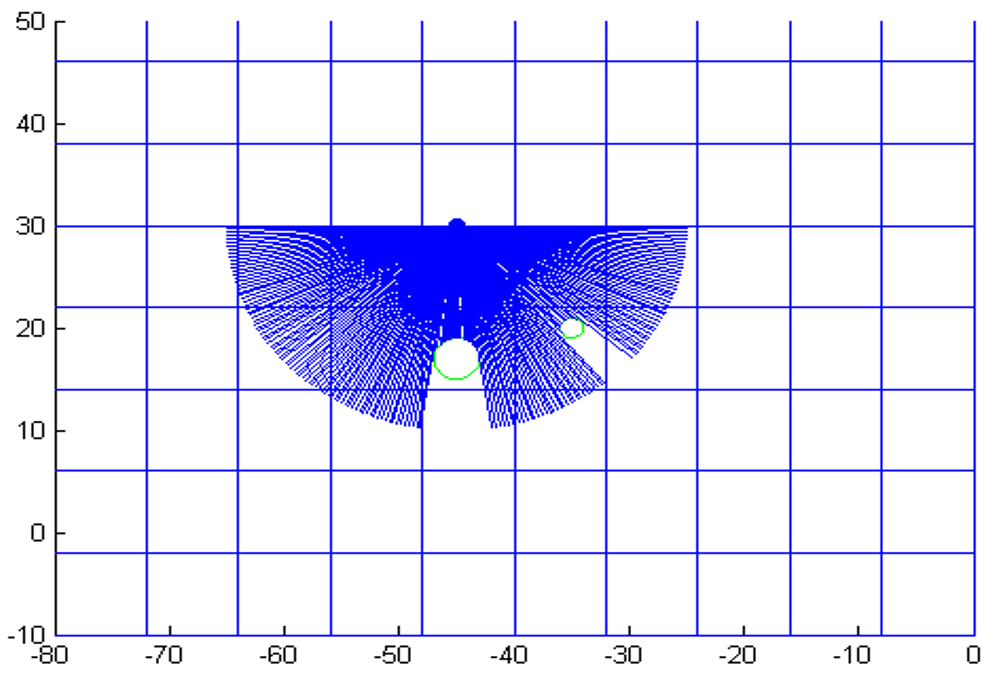 Figure 1: A laser scan identifies potential victim locations (PVC) by detecting circular objects in the grid.
The "Controversial Cell" Problem
The paper introduces a critical nuance: what if one robot sees a victim in a cell, but another robot's scan of the same cell is "empty"? These are Controversial Cells (CC). By factoring in the ratio of victim-positive scans to empty scans, the system gains a probabilistic "confidence" level, allowing the heat map to refine itself as more data flows in.
Experiments and Results
The team utilized USARSim, a high-fidelity simulator built on the Unreal Engine, to test their theory with 24 robots in an 80x60 cell environment.
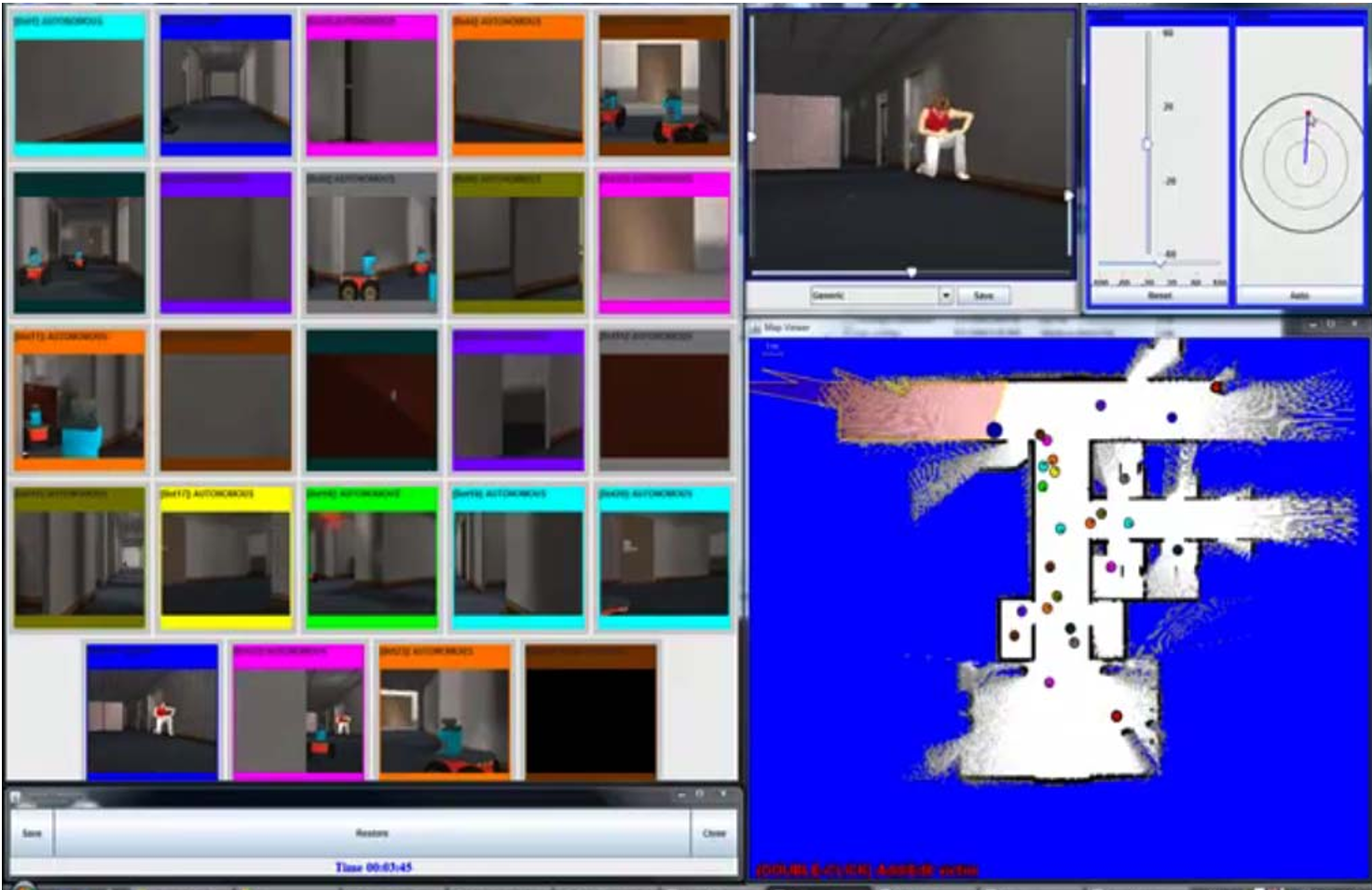 Figure 2: The Multi-robot Control System (MrCS) used to manage a fleet of 24 robots simultaneously.
Key Findings:
- Convergence: As the number of scans (over 21,000) increased, the estimated victim distribution converged toward the ground truth.
- Granularity Matters: The system was highly effective at identifying general areas of victims (coarse granularity). However, at very fine granularities (small grid cells), the basic fusion model struggled, suggesting that more advanced Maximum Likelihood Estimation (MLE) is needed for "pinpoint" accuracy.
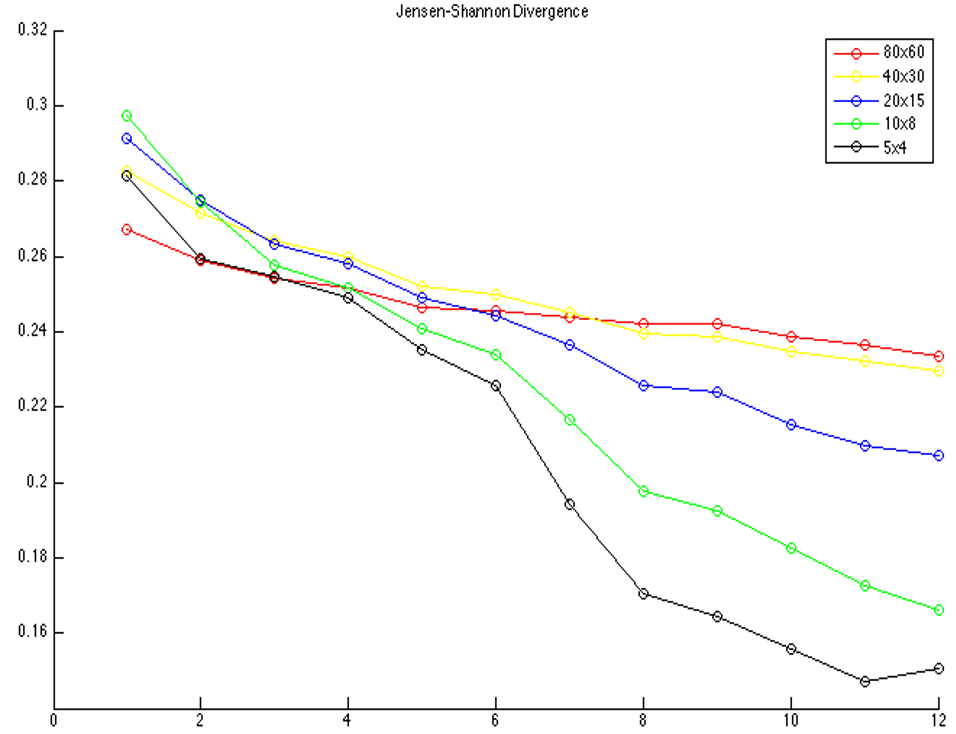 Figure 3: Jensen-Shannon Divergence (JSD) showing how the estimated distribution aligns with actual victim locations over time.
Critical Insight & Future Outlook
This work represents a shift toward Human-Centered Information Fusion. It acknowledges that while robots are great at gathering raw spatial data (lasers) and humans are great at semantic recognition (identifying a person), neither is perfect at doing both simultaneously under pressure.
Limitations: The current "basic" approach treats every positive scan with equal weight. Future iterations will likely need to account for robot pose uncertainty and sensor noise using Bayesian filtering or more sophisticated probabilistic sensor models.
Conclusion: By treating a robot fleet as a "collective sensor" and the human team as a "distributed validator," we can move past the limitations of 1-to-1 teleoperation and explore disaster zones at an unprecedented scale.