
The Lucy Model: Bridging the Gap Between Math and Social Reality in Influence Prediction
Extent prediction of the information and influence propagation in online social networks
This paper introduces the Lucy Model (LM), a novel mathematical framework for predicting information and influence propagation in Online Social Networks (OSNs). By quantifying social tie-strength through node affinity and relevance, the model significantly outperforms traditional Linear Threshold (LTM) and Independent Cascade (ICM) models in prediction accuracy and precision.
TL;DR
Predicting how a message spreads on Facebook or Twitter has long relied on generic models like Independent Cascade. The Lucy Model (LM) changes the game by treating social links like electrical circuits—calculating a "conductance" of affinity—and acknowledging that we react differently to a friend's favor (homophilic) than to a professional's advice (nonhomophilic). The result? A prediction accuracy boost that leaves traditional models in the dust.
Problem & Motivation: Why Current Models Fail
For decades, Social Network Analysis (SNA) has used the Linear Threshold Model (LTM) and Independent Cascade Model (ICM). While mathematically elegant, these models possess critical blind spots:
- Message Neutrality: They treat a "cat video" and "investment advice" as the same.
- Static Thresholds: They often ignore the fact that your willingness to be influenced depends on who is talking to you and how important the news is.
- Ignored Affinity: Contextual closeness (mutual friends, shared tastes) is frequently omitted.
The authors argue that without considering message importance and the specific nature of the social tie (relevance vs. affinity), predictions will always be "far from reality."
Methodology: The Core of the Lucy Model
The "Secret Sauce" of the Lucy Model is its three-pronged approach to activation, represented by distinct modules:
1. The Electrical Analogy of Affinity
The authors propose a fascinating abstraction: treating a social network like an electrical grid. Using Kennelly’s Theorem, they calculate the "conductance" of a link based on the number of common neighbors. High conductance = High Affinity ().
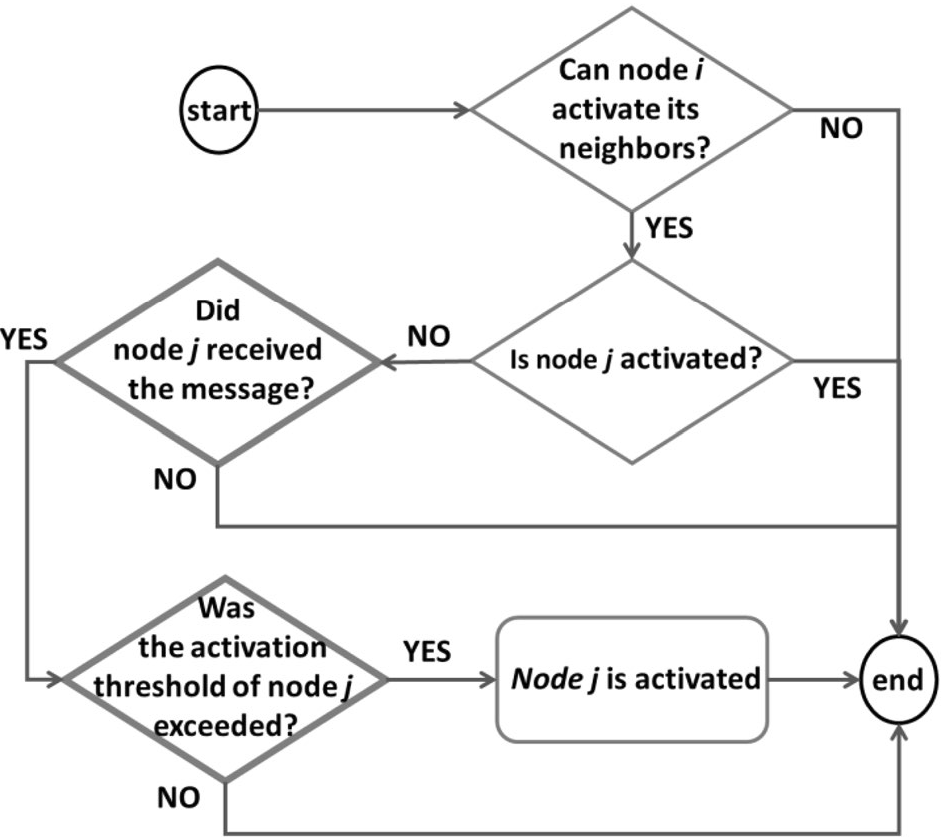 Figure 1: The flow of message processing in the Lucy Model, showing the transition from Inactive to Active states.
2. Tailored Activation Thresholds
Unlike LTM, where thresholds are often random, LM defines specific equations:
- Nonhomophilic (): Governed by the Relative Relevance () of the sender (e.g., an expert's advice).
- Homophilic (): Governed by Relative Affinity () (e.g., a close friend's request).
- Information (): Simply governed by the subjective importance of the news.
3. Tie-Strength as Probability
The model defines tie-strength () as the joint probability of receiving a message, combining normalized affinity and normalized relevance.
Experiments & Results: Crushing the Baselines
The researchers didn't just stay in the lab; they used a group of 23 seeds to spread actual messages on Facebook (tracking "WhatsApp espionage," "pet abandonment," and "racism") to gather empirical data.
Performance Mastery
The results were conclusive. On a tracked Facebook network of nearly 1 million nodes, the Lucy Model tracked the empirical "A-curve" with remarkable precision.
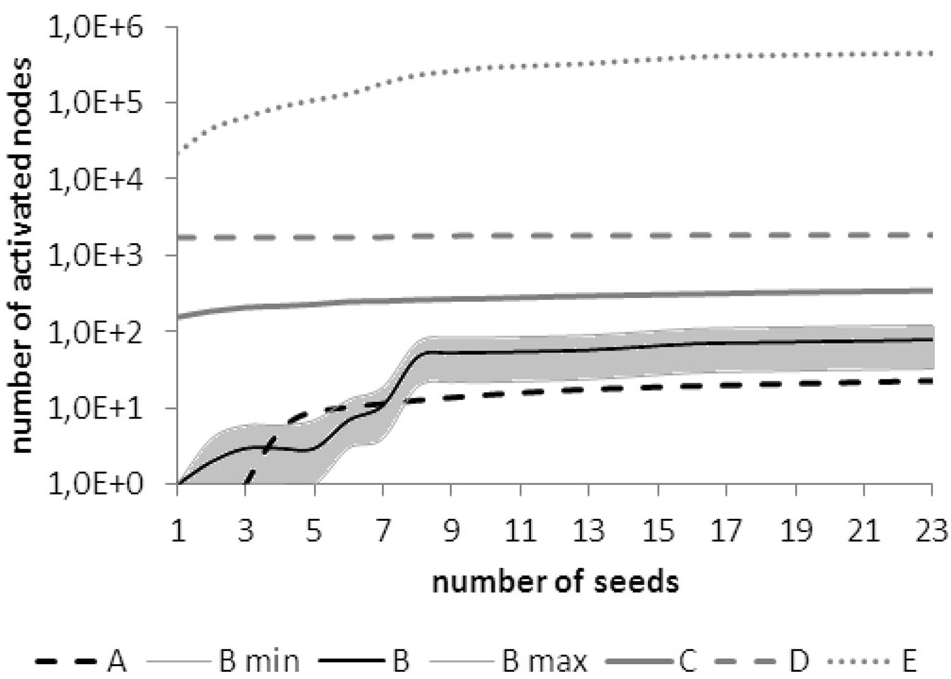 Figure 2: Accuracy comparison. Note how the Lucy Model (B) hugs the empirical data (A), while LTM (D) and WCM (E) deviate wildly.
Key Metrics:
- Accuracy: LM's error was 4-5x lower than LTM.
- Precision: The standard deviation of LM’s predictions was only 12.47, whereas LTM’s was a staggering 861.
Critical Insight: The Symmetry of Relevance and Affinity
One of the most profound findings of the paper is the empirical discovery that Relative Affinity Relative Relevance. This suggests that in the architecture of our social digital lives, the "closeness" we feel for someone is mathematically proportional to their "relevance" within our local network cluster. This symmetry allows the model to simplify complex social dynamics into a unified predictive variable.
Conclusion
The Lucy Model represents a significant step forward in Social Cyber-Security. By moving away from "black box" stochastic transitions and toward a "socially-aware" mathematical framework, it provides governments and organizations a far more reliable tool for predicting the reach of everything from viral marketing to disinformation.
Future Outlook: The next frontier for LM is modeling "Opposite Influences"—how a counter-message might stop a propagation in its tracks—and adapting the model for networks that change their topology in real-time.