
Information Leaders: Decoding the Hidden Social Fabric of Engineering Networks
13613_Information Leaders in Product Development Organizational Networks Social Network Analysis of the Design Structure Matrix.
Summary
Problem
Method
Results
Takeaways
Abstract
This paper proposes a framework to identify "Information Leaders" in complex Product Development (PD) organizational networks by integrating Social Network Analysis (SNA) with the Design Structure Matrix (DSM). It identifies a specialized "Information Leaders Team" (ILT) that controls the majority of information flow, essential for system integration in large-scale engineering projects like aircraft engine design.
## Executive Summary
**TL;DR**: In the labyrinth of modern product development (PD), hierarchy often hides the true "hubs" of information. This paper applies **Social Network Analysis (SNA)** to the **Design Structure Matrix (DSM)** to identify the "Information Leaders"—the teams that actually control the flow of knowledge. By identifying these leaders in an aircraft engine project, the authors propose a new organizational unit: the **Information Leaders Team (ILT)**.
**Positioning**: This work bridges the gap between mechanical system modeling (DSM) and organizational theory (SNA), moving from "how tasks are linked" to "who controls the project's pulse."
## The Motivation: Moving Beyond Static Gantt Charts
Complex products like the Boeing 777 involve over 16,000 specialists. Traditional tools like PERT/CPM are insufficient for these environments because information flow in PD is non-linear—it’s full of feedback loops and "concurrent engineering."
The authors argue that although we can map these dependencies using a DSM, we often ignore the **Inductive Bias** of the network structure itself. Specifically, PD networks are often **Scale-Free**, meaning a tiny fraction of teams (hubs) control the vast majority of coordination. If these hubs fail, the project drifts into "design churn."
## Methodology: The SNA Toolkit for Engineers
The core of the paper lies in applying four distinct mathematical lenses to the organizational DSM:
1. **Degree Centrality**: Who has the most "adjacent" neighbors? These are your busy communicators.
2. **Closeness Centrality**: Who is "fewest hops" away from everyone else? These are your rapid information diffusers.
3. **Betweenness Centrality**: Who sits on the shortest path between unrelated teams? These are the **Gatekeepers**.
4. **Brokerage Measures**: Identifying roles like *Liaisons* (connecting different functional groups) and *Representatives*.
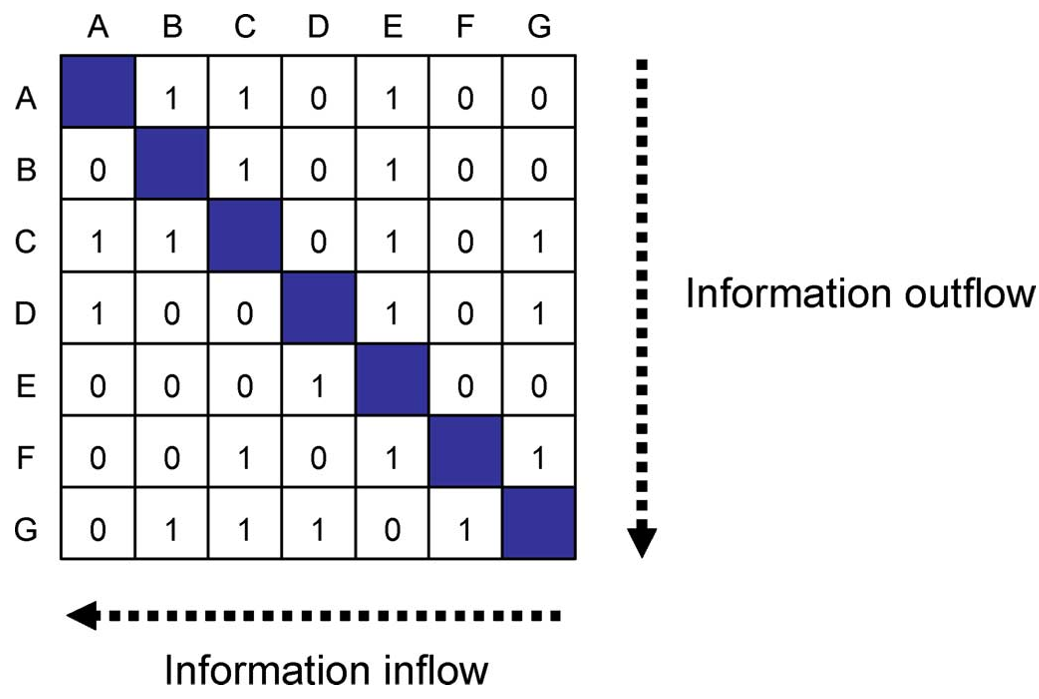
*Fig 1: A sample DSM showing how information inflows/outflows are mapped into a square matrix.*
The authors then integrate these scores to form the **ILT**. They suggest that these teams should not just be viewed as technical designers but as strategic integrators.
## Case Study: The Pratt & Whitney Aircraft Engine
The paper analyzes a real-world dataset of 54 design teams. The results were striking:
* **Correlation**: There was a high correlation between being a "Gatekeeper" and having high "Betweenness." In this specific engine project, information power was highly concentrated.
* **The ILT Composition**: Nine teams emerged as the "Information Leaders." Surprisingly, nearly half of these (44%) came from **modular chunks** (like the Combustion Chamber), not just the dedicated integration teams.
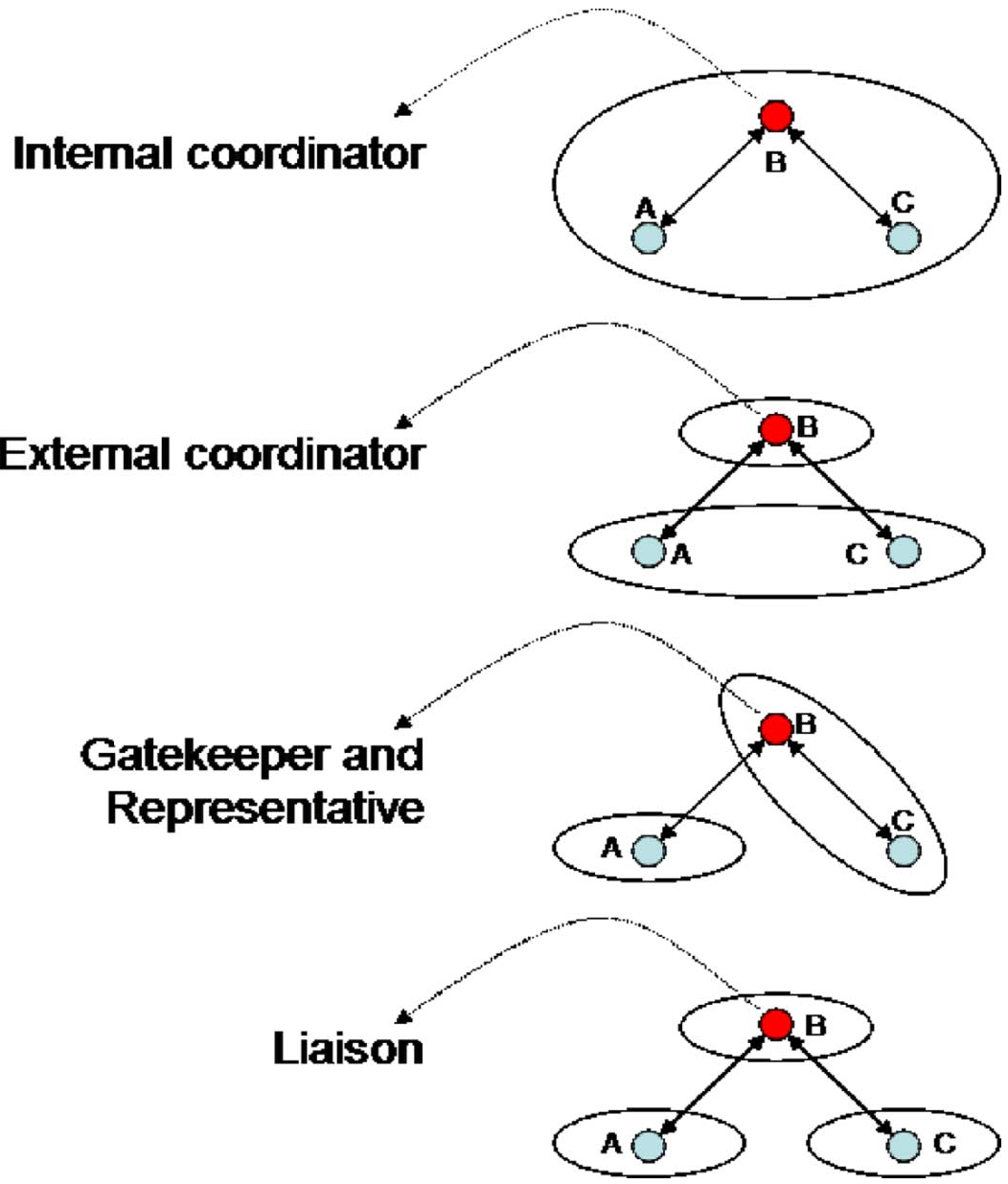
*Fig 2: Classification of brokerage roles (Coordinator, Gatekeeper, Liaison) used to tag the behavior of leader teams.*
## Critical Insight: The Innovation Paradox
The authors identify a major conflict for Information Leaders: **The Coordination-Innovation Trade-off**.
High-centrality teams are prone to "Information Overload." Because they spend so much time in meetings and synchronizing others, their own creative design work often suffers. However, because they "see" more of the project than anyone else, they are in the best position to perform **Information Arbitrage**—translating a solution from one part of the engine to a problem in another.
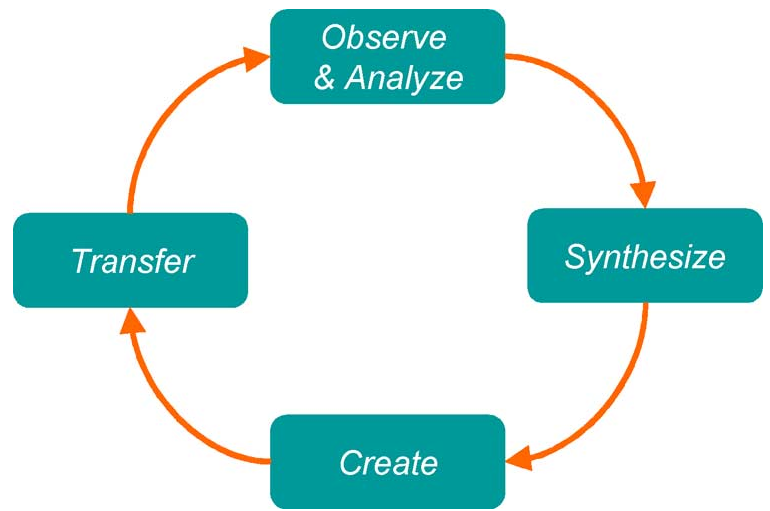
*The ILT Innovation Cycle: Observe -> Synthesize -> Create -> Transfer.*
## Managerial Takeaway: The "Zone Engineer"
The paper concludes with a practical recommendation: Create a parallel organizational structure. Don't just give the ILT teams more work; embed **Zone Engineers** within them. These individuals focus specifically on the "Brokerage" role, freeing up the technical experts to innovate while ensuring the network remains connected.
**Limitations**: The model assumes "perfect" data from interviews and does not account for the fact that information tends to lose accuracy as it passes through multiple human intermediaries.
## Future Outlook
As product development becomes increasingly virtual and AI-augmented, the ability to mathematically detect the "hidden" leaders of a project will be the difference between a successful launch and a catastrophic schedule slip.