
Beyond Human-Centricity: Building Heterogeneous Social Networks for the Data Age
Information organization on the internet based on heterogeneous social networks
The paper introduces a framework for Heterogeneous Social Networks based on Actor-Network Theory (ANT), where humans and non-human objects (educational resources, clinical data) are treated as equal "actors." By leveraging Semantic Web technologies like RDF and Linked Open Data (LOD), the authors demonstrate a system that organizes information through autonomous social interactions between data entities.
TL;DR
Information on the internet is typically organized by humans for humans. This paper proposes a radical shift: treating digital objects—from medical slides to research datasets—as "actors" with their own social lives. By merging Actor-Network Theory (ANT) with Semantic Web technologies, the authors create a ecosystem where data entities autonomously build relationships, inherit traits from "parent" resources, and interact with humans as equals.
Academic Positioning: This work moves beyond the first generation of social networks (connecting people) and second-generation object-centered sociality (connecting people around things) to a third generation: Heterogeneous Networks where the boundary between human and non-human agency is blurred.
The Problem: The Passive Data Trap
In current platforms like LinkedIn or ResearchGate, the "social" aspect is restricted to human aggregates. Information objects (papers, datasets) are treated as tokens—they don't "act"; they are merely "acted upon."
The authors argue this creates a bottleneck for information organization. If an educational resource is repurposed, translated, or cited, those connections are often fragmented across different repositories. To solve this, we need to stop viewing data as static metadata and start viewing it as a dynamic social actor.
Methodology: Giving "Life" to Digital Objects
The core innovation lies in the Symmetrical Analysis of human and non-human elements. The authors define three pillars to implement this:
1. Unified Actor Representation
Using the FOAF (Friend of a Friend) and SIOC (Semantically Interlinked Online Communities) ontologies, the system treats a "Person" and a "Leaning Object" under the same core class: agent.
2. The Four Dimensions of Object Sociality
How does a PDF or a medical image "socialize"? The paper defines four mechanisms:
- Tagging & Metadata: Conventional descriptive links.
- Collective Usage (Attention Metadata): Using APML to capture how users interact with objects, defining an object's profile by how it is perceived rather than just how it was created.
- Repurposing & Inheritance: Creating "Family Trees" where descendant resources point to ancestors.
- LOD Harvesting: Automatically linking resources to the Linked Open Data (LOD) cloud to discover deep semantic relationships without human intervention.
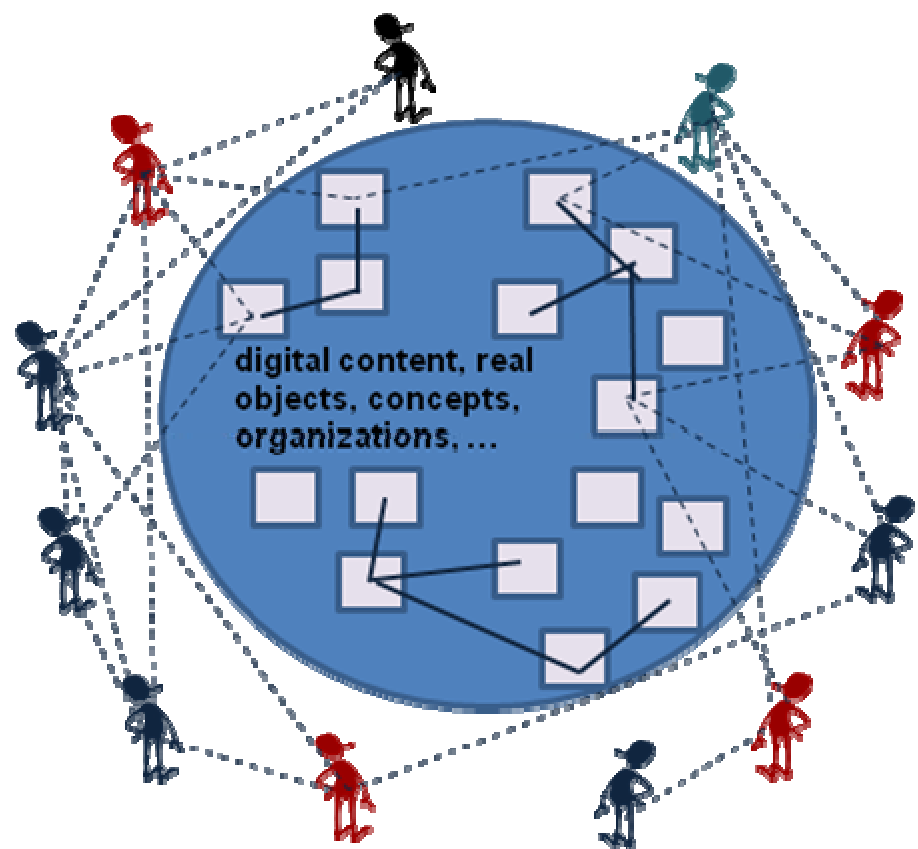 Figure: In a heterogeneous network, associations exist between human-human, human-object, and object-object pairs.
Case Study: MetaMorphosis+ in Medical Education
The authors implemented these concepts in MetaMorphosis+, a platform for sharing medical education resources. In this field, content is expensive and constantly evolving.
By using NCBO BioPortal's RESTful services, the system allows resources to be annotated with terms from over 260 medical ontologies (like SNOMED-CT or MeSH). A resource about "Telemedicine" doesn't just sit in a folder; it "knows" its semantic cousins in the LOD cloud and its "children" (repurposed versions in different languages).
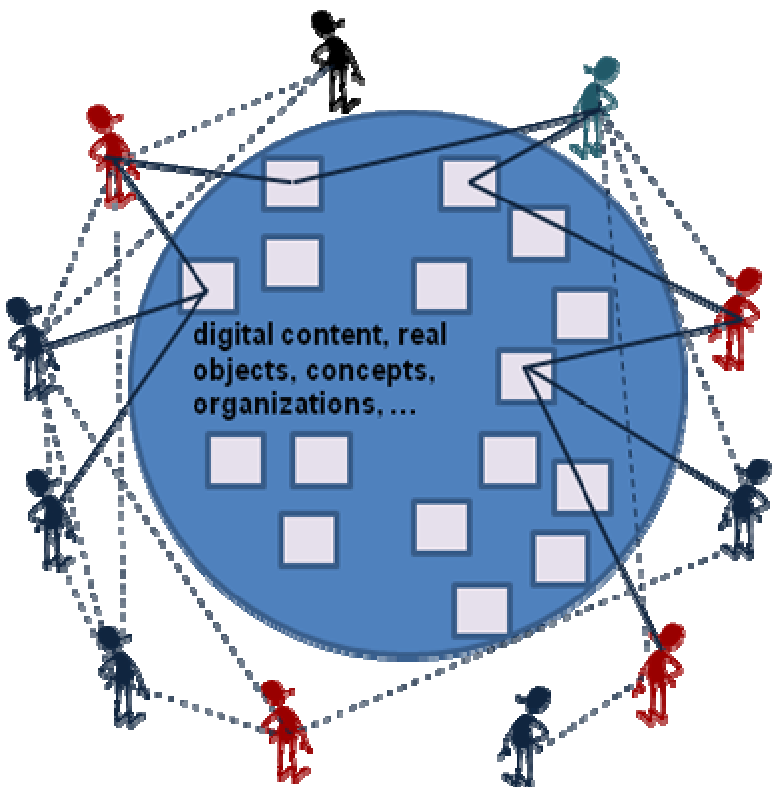 Figure: Contrast between traditional human-only networks and the proposed object-inclusive actor network.
Critical Insight: The Future of "Intelligent" Information
The paper doesn't just describe a better database; it describes a future where Patient Empowerment and Scientific Knowledge Management are transformed.
- In Healthcare: Instead of isolated silos, patients, diseases, medications, and clinical trials become interlinked actors in a single graph.
- In Science: Digital objects (raw data -> processing tools -> published paper) form a chain of agency that allows for perfect reproducibility and automated discovery.
Limitations & Outlook
While the theoretical framework is robust, the reliance on Semantic Web standards (RDF/Ontologies) poses a high barrier to entry for general users. However, as LLMs (Large Language Models) become better at generating structured RDF from unstructured text, the "heterogeneous social network" envisioned here may finally become the default architecture for the intelligent web.
Takeaway: Treating data as an active "social entity" is the key to breaking down information silos in complex professional domains.