
DYSTAL: Decoding Personal Favorites through Dynamic Spatio-Temporal Graph Modeling
Information Processing and Management
This paper introduces DYSTAL (Dynamic Spatio-temporal POI recommendation), a novel framework for point-of-interest suggeston in Location-Based Social Networks (LBSNs). It combines a geo-social network embedding method with a dynamic factor graph model (FGM) to capture evolving user patterns, achieving state-of-the-art performance on Foursquare and Yelp datasets.
TL;DR
Why do you choose a specific cafe on a Monday afternoon but a distant bar on a Saturday night? Traditional AI often misses this "dynamic" shift. DYSTAL is a new framework that masters this by combining network embedding (to understand your social/spatial circle) with a Dynamic Factor Graph Model (to compute your evolving "tendency"). It beats current SOTA models by up to 13% by prioritizing how you feel (textual sentiment) and when you move.
The "Dynamic" Blind Spot in Recommendation
Most POI (Point of Interest) systems treat you as a static entity. If you like Italian food, they suggest Italian food. But human behavior is a fluid coordination of space, time, and social context.
The authors identify a critical gap: Existing models fail to capture "Dynamic Spatio-Temporal Patterns." For instance, data sparsity (few check-ins) and unreliable quality make it hard to tell if a user's visit was a one-off fluke or a recurring lifestyle choice.
Methodology: The Core of DYSTAL
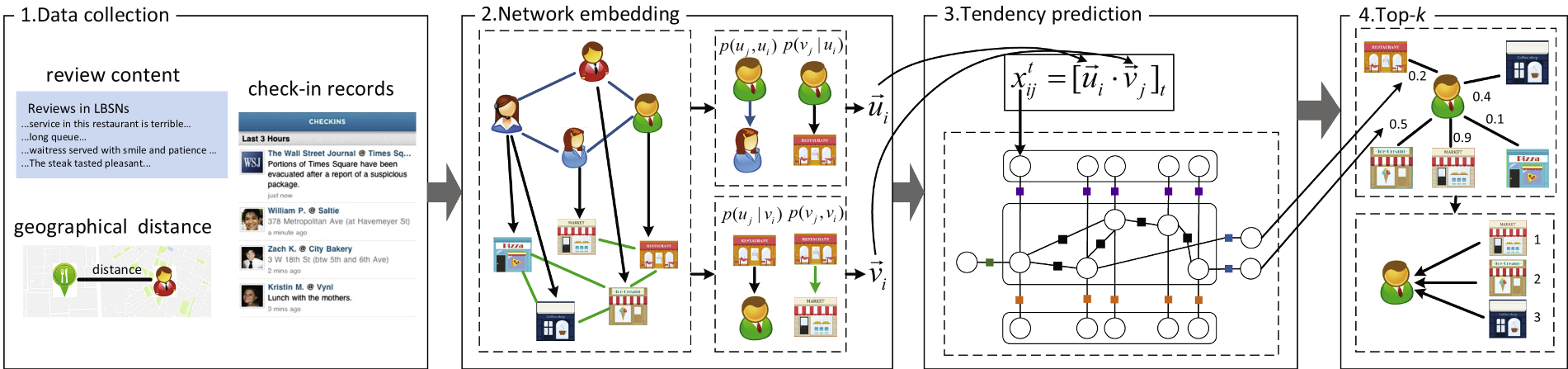
The framework operates in two distinct rhythmic phases to eliminate data noise and maximize predictive power.
1. Geo-Social Network Embedding
Unlike standard random walks (DeepWalk), DYSTAL uses a Breadth-First Search (BFS) strategy to represent nodes. It decomposes the massive LBSN into three subgraphs:
- POI-POI: Connects locations based on geographical proximity.
- User-User: Maps social intimacy.
- User-POI: Captures historical check-ins and reviews.
The goal is Joint Embedding Learning: transforming these complex relationships into low-dimensional vectors where "similarity" in the real world equals "closeness" in the vector space.
2. The Spatio-Temporal Factor Graph Model (ST-FGM)
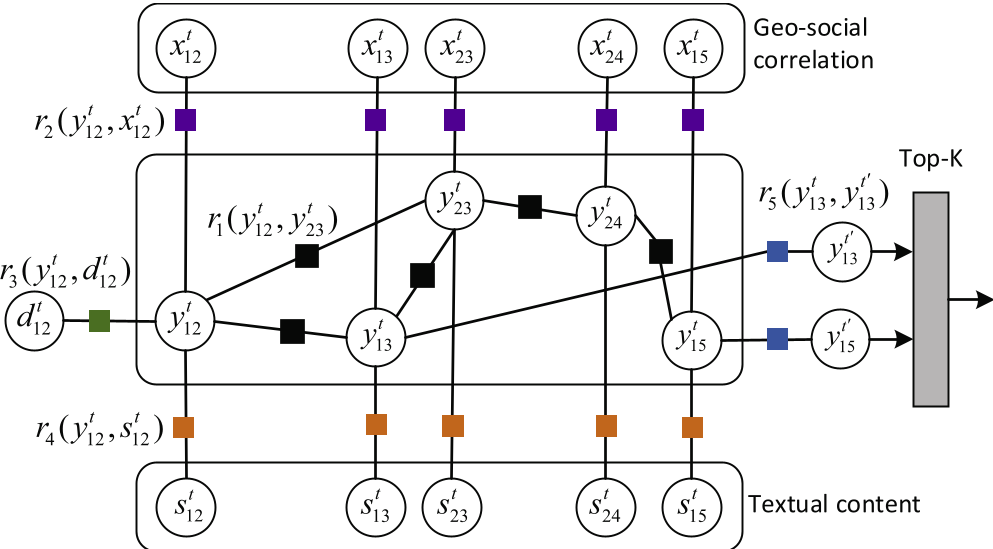
This is where the "intelligence" happens. Instead of a simple regression, DYSTAL uses a Factor Graph to model five dependencies:
- Tendency Correlation: Do your favorite spots share common features?
- Geo-social Correlation: Does the embedding vector match the venue?
- Geographical distance: the "cost" of moving (near vs. far).
- Sentimental Sentiment: Extracting emotion from textual reviews using SentiStrength.
- Temporal Correlation: How does your 3 PM Monday mood differ from your 9 PM Saturday mood?
Experimental Showdown
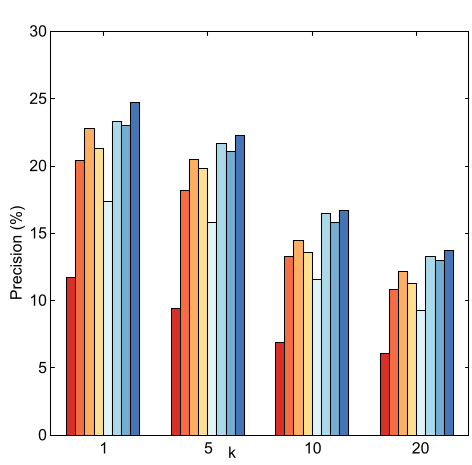
DYSTAL was tested against heavyweights like PINSAGE (Pinterest's Graph Sage) and KGCN (Knowledge Graph Convolutional Networks) on Foursquare (Singapore) and Yelp (Las Vegas) datasets.
Key Results:
- Superiority: DYSTAL consistently achieved higher Precision, Recall, and F1 scores.
- The Power of Sentiment: An ablation study (removing one factor at a time) proved that Textual Sentiment is the most vital signal. Removing it caused the largest drop in performance, suggesting that what we say about a place is a better predictor than where it is.
- Efficiency: Despite being a complex graph model, DYSTAL maintains a linear computational complexity relative to the number of edges, making it scalable for large cities.
Critical Insight: Why Factor Graphs?
A major takeaway from this research is the critique of "End-to-End" Neural Networks like GCN. While powerful, GCNs are often unexplainable black boxes that require massive amounts of dense data to converge. In contrast, the Factor Graph approach used in DYSTAL allows researchers to inject "Domain Knowledge" (like the physical intuition that people prefer shorter distances) into the model explicitly. It balances the "representation power" of embeddings with the "logical structure" of a probabilistic graphical model.
Conclusion & Future Outlook
DYSTAL successfully proves that by modeling the dynamics of time and sentiment, we can overcome the "sparsity" problem that plagues LBSNs.
Limitations: The authors acknowledge that user "static preferences" (like gender or age) aren't fully integrated yet due to complexity. The Future: Expect the next iteration to fuse these hyper-personalized static traits with the already successful dynamic spatio-temporal patterns, potentially creating a "Universal Context Engine" for mobile services.