
Onyx: Breaking the Silos of Emotional Intelligence with Linked Data
Information Processing and Management
This paper introduces Onyx, a semantic ontology designed for the unified representation of emotions through a Linked Data approach. It aligns with EmotionML, the Provenance Ontology (PROV-O), and the Lexicon Model for Ontologies (lemon) to bridge the gap between heterogeneous emotion theories and isolated data silos.
TL;DR
Onyx is a revolutionary semantic framework that treats emotions as Linked Data. By aligning psychological theories with standardized web ontologies, it allows different AI services—regardless of whether they use Ekman’s "Big 6" or Plutchik’s "Wheel"—to finally speak the same language. It’s not just about labeling a tweet as "happy"; it's about creating an interoperable, traceable, and multilingual emotional knowledge graph.
The Problem: An Emotional Tower of Babel
In the world of Affective Computing, we have a major problem: heterogeneity. One researcher uses a dimensional model (Valence, Arousal, Dominance), while another uses discrete categories (Joy, Sadness, Anger).
To make matters worse, these models are usually trapped in proprietary formats or isolated XML schemas like EmotionML. This creates "data silos" where a sentiment analysis tool trained on one dataset can't easily merge its insights with a lexicon from another. Onyx was born to solve this by applying the principles of the Semantic Web.
Methodology: The Architecture of Feeling
The authors didn't just create another emotion list. They built a meta-ontology.
1. The Core Triad
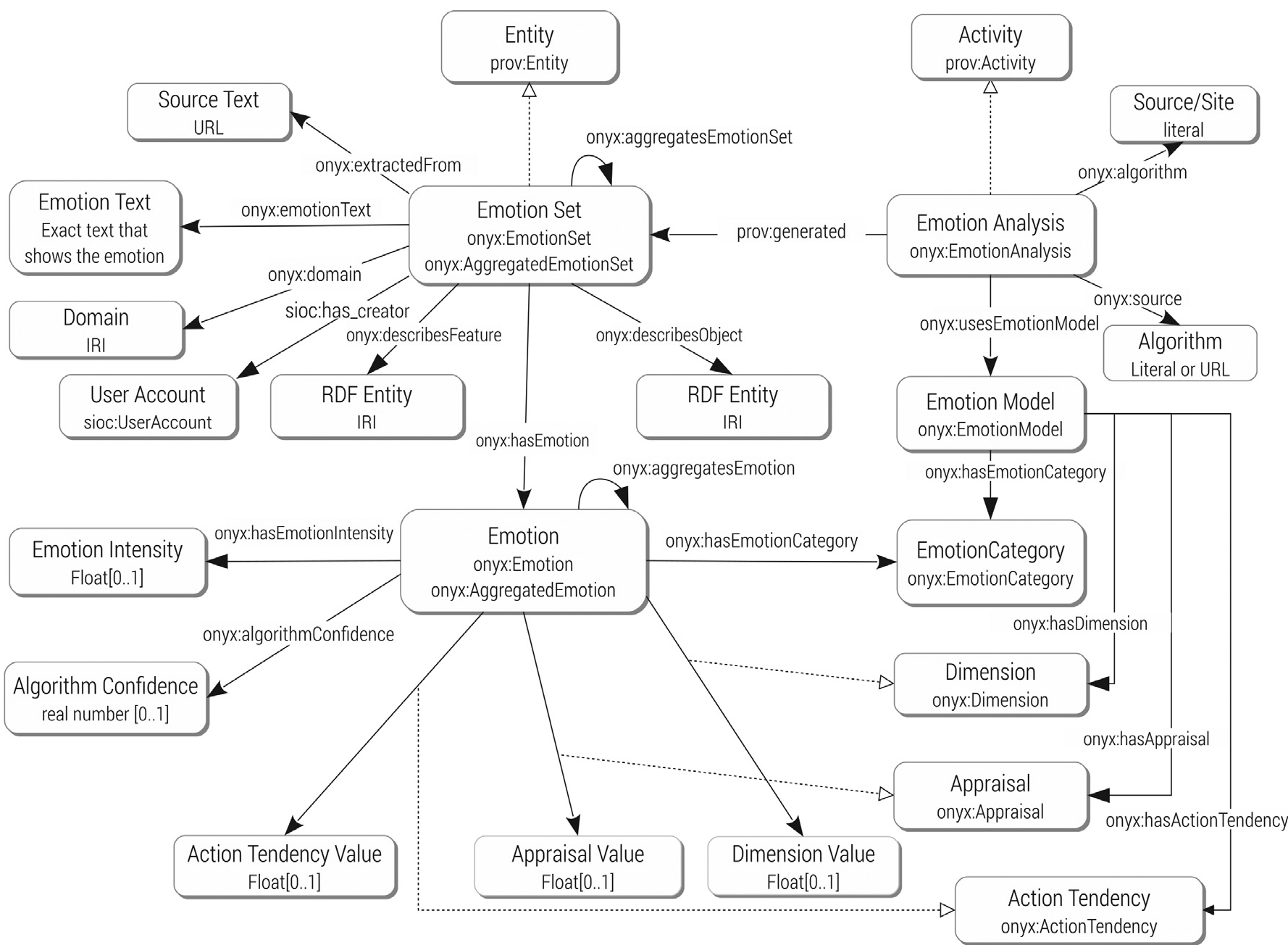
Onyx revolves around three main classes:
- EmotionAnalysis: The "Who/How" (Agent, Algorithm, Model).
- EmotionSet: The "Where" (The source text or snippet).
- Emotion: The "What" (Intensity, Category, Dimensions).
2. Deep Integration with LLOD
By integrating with the Linguistic Linked Open Data (LLOD) cloud, Onyx connects to:
- lemon: Allowing emotional labels to be attached to specific lexical entries (words) across different languages.
- PROV-O: Critical for transparency. It records which algorithm claimed a text was "fearful," allowing for credibility scores and conflict resolution between multi-agent systems.
From Theory to Practice: Experimental Validation
The authors didn't just theorize; they mapped existing giants into Onyx:
- WordNet-Affect: 291 emotion-related affects were converted into a SKOS taxonomy.
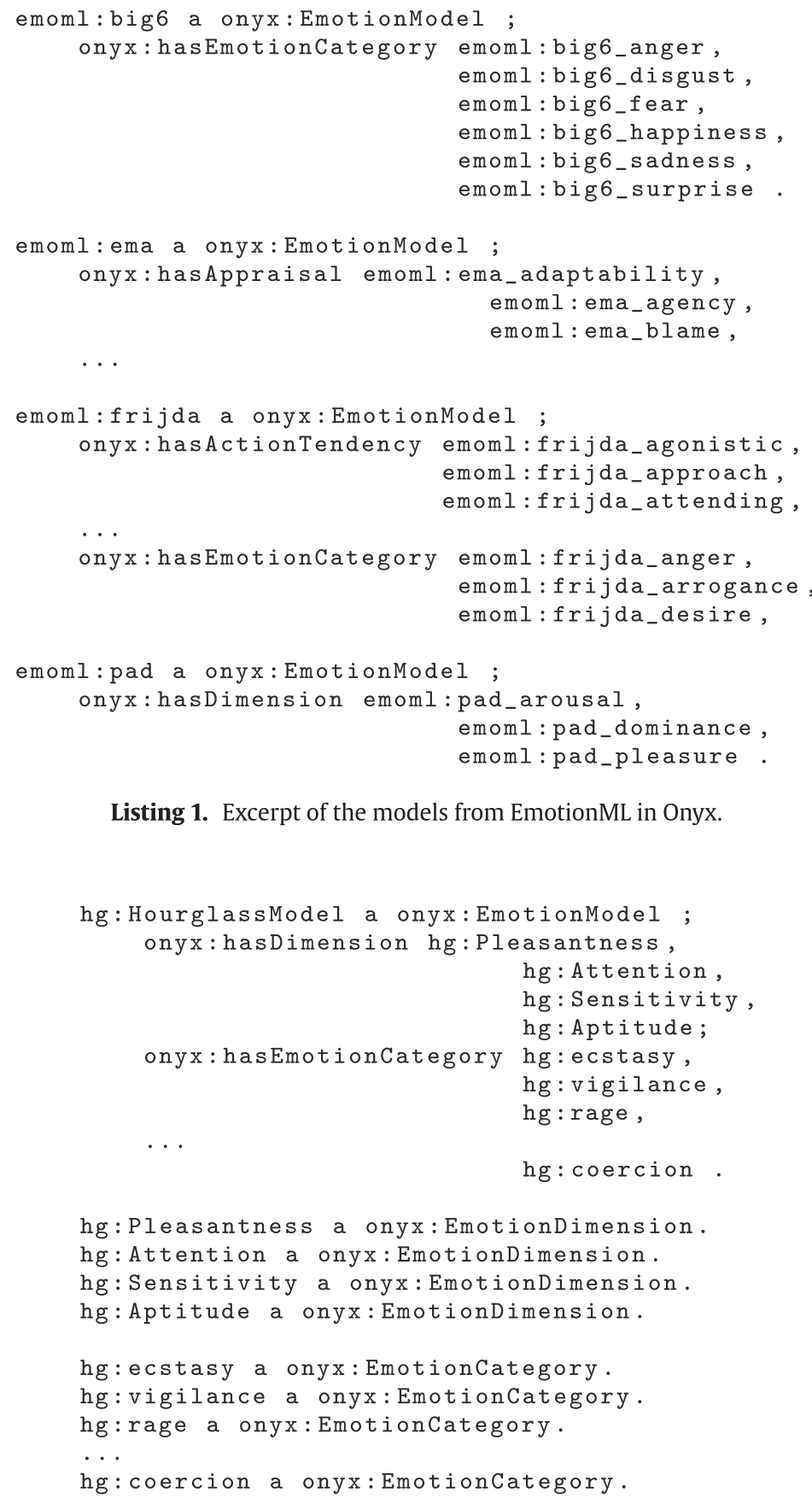
- EmotionML: All standard W3C emotion vocabularies were ported to Onyx-compatible RDF.
- The Hourglass of Emotions: Demonstrated how complex, multi-level models can be represented.
Case Study: The Eurosentiment Project
The real-world test came through Eurosentiment, where Onyx managed 14 lexicons and corpora in 6 different languages. This proved that Onyx could handle the nuance of domain-specific sentiment—for instance, how the word "terrifying" is positive for a horror book but negative for a safety report.
Advanced Reasoning: Emotion Composition
One of the most powerful features of Onyx is its use of SPIN (SPARQL Inference Notation) rules. This allows the system to "reason" about emotions.
- Example: If an algorithm detects Anticipation and Joy, a SPIN rule can automatically infer a new emotion: Optimism.
- Dimensional to Categorical: Rules can map high-valence, high-arousal states directly to specific emotion categories, bridging the gap between competing psychological theories.
Critical Insight: Why Onyx Matters
The genius of Onyx isn't in its math—it's in its interoperability. Most AI today is "narrow"; it classifies text and dies. Onyx enables "broad" AI. It allows an e-learning platform to take an emotion detected by a sensor, check it against a WordNet-Affect lexicon, verify the algorithm's provenance via PROV-O, and then trigger a contextally appropriate response from an embodied agent.
Limitations & Future Work
While Onyx is a massive step forward, it currently relies heavily on text-based NLP. The authors express a need to expand more aggressively into multimodal analysis (video/audio). Future work involves integrating these emotional models into conversational agents for e-learning to improve student engagement.
Conclusion
Onyx provides the missing "semantic glue" for the affective computing community. By moving away from static labels and toward a dynamic, linked, and reasoned approach, it paves the way for a web that doesn't just store data, but "understands" the human sentiment behind it.