
Beyond the Ripple: Enhancing Social Influence Estimation with TDF-C and TDF-CT
Information Processing and Management
This paper introduces two novel social influence diffusion models, TDF-C and TDF-CT, designed for Twitter networks. By integrating temporal, interaction, structural, and profile features via a Modified Topical Affinity Propagation (M-TAP) model, the authors achieve state-of-the-art results in predicting influence spread, improving accuracy by up to 39% over traditional Independent Cascade and Linear Threshold variants.
TL;DR
Understanding how information flows through social networks is the "holy grail" of viral marketing. This paper presents TDF-C and TDF-CT, two models that outperform traditional methods by 39% in accuracy. By acknowledging that users don't just stay "influenced" forever—they can become "neutral"—and by using a holistic set of interaction and temporal features, these models provide a much more realistic simulation of Twitter's chaotic information ecosystem.
Contextualizing the Problem: Why Basic Models Fail
Standard models like Independent Cascade (IC) and Linear Threshold (LT) are the workhorses of influence analysis, but they are fundamentally "stiff." They assume if you are influenced by a tweet, you stay influenced forever. In reality:
- Time Decays Everything: A retweet today is worth more than a retweet a month ago.
- Multi-Class Complexity: Users aren't just "active" or "inactive." They can move to a Neutral state where they neither influence others nor are influenced further.
- Holistic Influence: Most previous work looked at who a person is (Profile features). This work argues that when they act (Temporal) and how they act (Interaction) are just as critical.
Methodology: The M-TAP Core and PFE Synergy
The authors' contribution is two-fold: learning the strength of the connection, and then simulating the spread.
1. Learning Link Strength (M-TAP)
Using a Modified Topical Affinity Propagation (M-TAP) algorithm, the model calculates the probability of influence () between users. Unlike older models, it fuses:
- Profile Features: Who you follow.
- Structural Features: Your position in the cluster.
- Temporal Features: When you post.
- Interaction Features: Retweets, quotes, and likes.

2. The Hybrid Diffusion (Progressive Feedback Estimation)
The TDF-CT model introduces PFE, which is a "best of both worlds" approach. It allows for:
- Single Strong Influence (from IC model).
- Collaborative/Collective Influence (from LT model).
- The Neutral Transition: As users lose interest (modeled via time decay), they stop being "Infectious," mirroring the SIR (Susceptible-Infected-Recovered) models of epidemiology.

Experimental Results: Precision vs. Recall
The models were tested against two real-world datasets: Darwin (location-based) and MelCup17 (event-based).
- Accuracy Boost: Both TDF models achieved a roughly 30-39% improvement over pure IC models.
- Strategy Trade-off:
- TDF-CT is the "Precision specialist." By including the neutral state, it filters out false positives, making it ideal for high-cost campaigns (e.g., inviting specific influencers to an exclusive event).
- TDF-C is the "Recall specialist." It captures a broader set of potentially influenced users, suited for mass-awareness brand marketing where the cost of a "False Positive" is low.
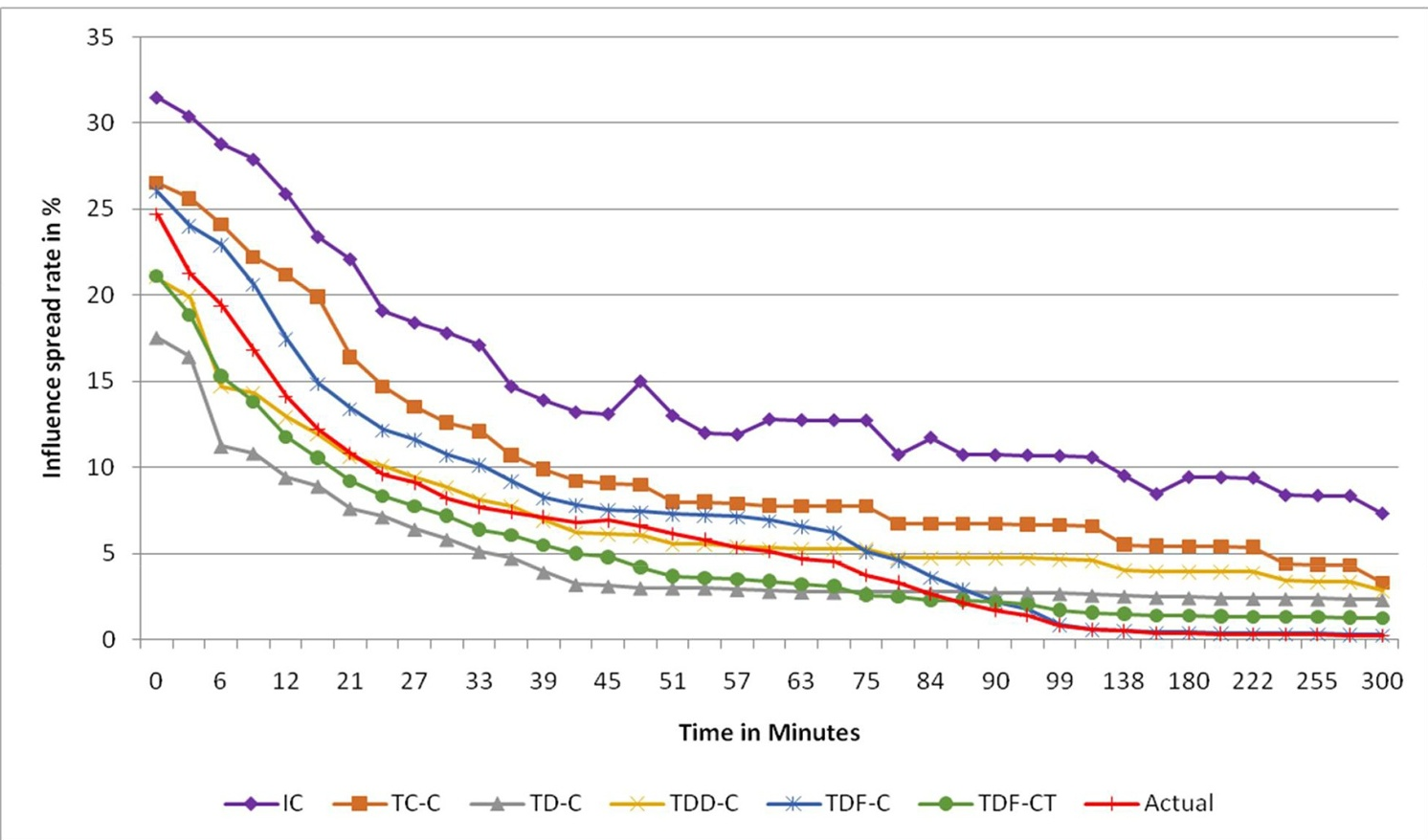
Deep Insight: Spread Shape
When visualizing the influence "cascade," traditional IC models often create "False Clusters"—areas where the model thinks everyone is talking, but in reality, the conversation has died out. As seen in the authors' depth-level analysis, TDF-CT remains consistent even at path lengths , whereas baselines fall apart.
Critical Insight & Conclusion
The true value of this work lies in its Inductive Bias toward temporal decay and user fatigue. By treating social influence more like a viral disease with a recovery period, the researchers have moved closer to a "Physics of Social Media."
While the model is highly effective for Twitter, its reliance on specific interaction types (retweets/quotes) suggests that future adaptations for platforms like TikTok or Instagram would need to redefine the "Interaction" feature set to include video-specific metrics. Nonetheless, the TDF-CT framework sets a new benchmark for precision in influence maximization.