
UP2VEC: Bridging the Gap Between Social Ties and Spatial Dynamics in LBSN
Information Processing and Management
The paper introduces UP2VEC, a comprehensive joint representation learning framework for users and Points of Interest (POIs) in Location-Based Social Networks (LBSNs). By constructing a heterogeneous LBSN graph and utilizing Node2Vec for embedding, the method achieves State-of-the-Art (SOTA) performance in POI recommendation and social link prediction tasks on Foursquare and Gowalla datasets.
TL;DR
UP2VEC is a novel framework that transforms Location-Based Social Network (LBSN) data into a unified heterogeneous graph. By jointly modeling social links, geographical power-laws, and temporal cycles, it learns rich latent representations for users and POIs. It significantly outperforms traditional matrix factorization and recent embedding baselines in POI recommendation and social link prediction, especially in challenging cold-start scenarios.
Problem & Motivation: The Partial View of LBSNs
In the world of LBSNs like Foursquare or Gowalla, user behavior is driven by a complex cocktail of "where my friends go," "what is nearby," and "what time of day it is."
Existing models often suffer from Contextual Myopia:
- Collaborative Filtering ignores geography.
- Spatial Filtering ignores social influence.
- Sequential Models (like JRLM++) often overlook fine-grained coordinates.
The authors argue that a "comprehensive understanding" requires a unified space where every contextual factor is modeled not as a separate feature, but as a component of the network's topological structure.
Methodology: The Heterogeneous LBSN Graph
The core innovation lies in the construction of the Heterogeneous LBSN Graph ().
1. Unified Node Space
The graph includes four types of nodes: active users (), existing POIs (), cold-start users (), and cold-start POIs (). By including cold-start entities and connecting them to their nearest neighbors geographically, the model ensures these nodes receive meaningful embeddings even without check-in history.
2. Context-Aware Transition Probabilities
Instead of simple binary edges, the authors derive transition probabilities that reflect physical and social reality:
- POI-POI: Combines sequential check-in frequency with a power-law distance decay function (), acknowledging that we are more likely to visit nearby locations.
- User-User: Weights social ties using the similarity of their check-in histories, capturing "social strength" beyond mere friendship status.
- Temporal Slotting: Nodes are augmented with 24-hour time windows to capture daily routines (e.g., attending a gym in the morning vs. a bar at night).
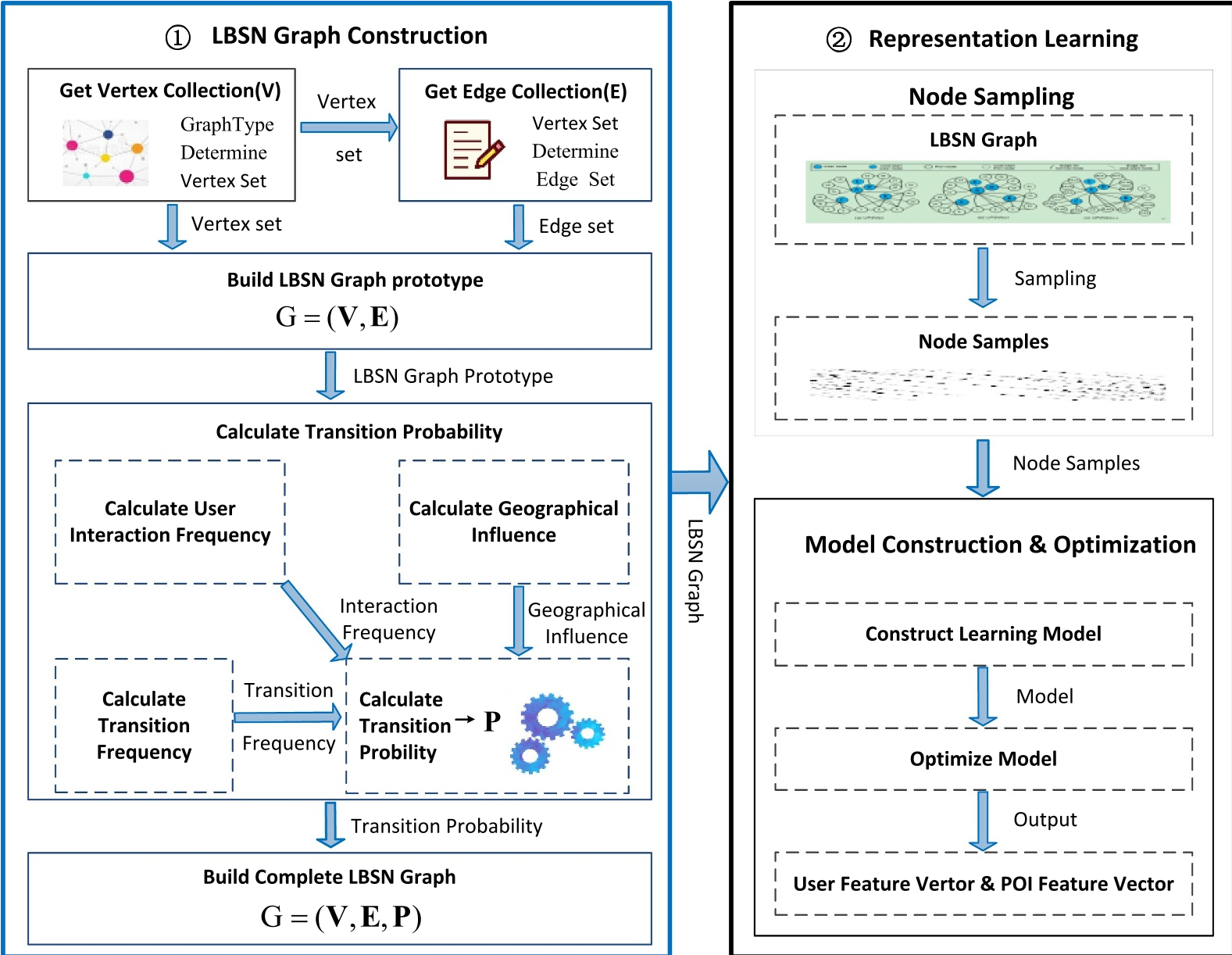 Figure 1: The UP2VEC Framework - From Raw LBSN Data to Joint Embeddings.
Experiments & Results: SOTA Performance
The researchers tested three variants: UP2Vec (Check-in only), UP2Vec+ (Social added), and UP2Vec++ (Temporal added).
Performance Boost
On the Foursquare dataset, UP2Vec++ achieved a massive lead in POI recommendation (Acc@k). The inclusion of social and temporal data (the "++" version) provided a clear incremental gain over the base version, proving that these factors are complementary.
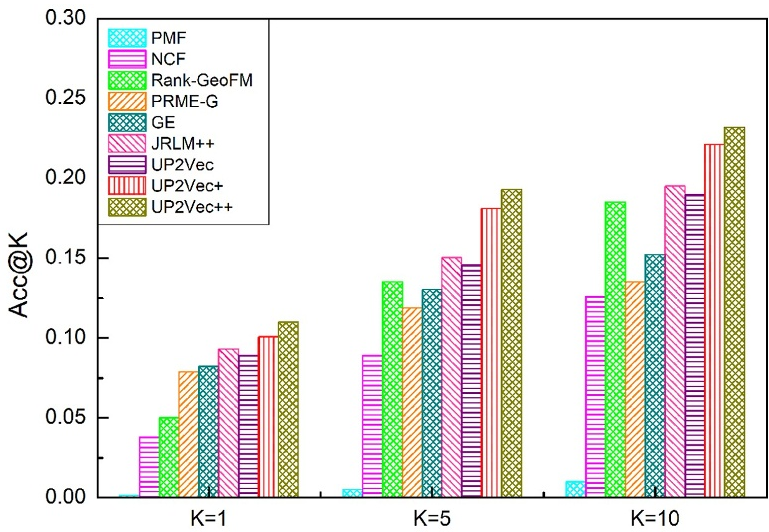 Figure 2: Performance Comparison under POI Recommendation (Foursquare vs. Gowalla).
Solving the Cold-Start Crisis
One of the most impressive feats is the performance on Cold-Start POIs. Traditional models fail here because they rely on check-in sequences. UP2VEC uses the fine-grained geographical proximity inherited from the graph structure to recommend new venues with surprising accuracy, outperforming the GE model significantly.
Critical Analysis & Conclusion
Takeaway
The success of UP2VEC lies in its Inductive Bias: it assumes that spatial behavior follows a power-law and that social ties are reflected in shared locations. By baking these "laws of geography" into the graph transition probabilities, the model learns a manifold that is much more representative of human mobility than raw data alone.
Limitations & Future Work
While robust, the model currently treats time as a series of 1-hour "buckets." Future iterations could benefit from Continuous Time Modeling or Attention Mechanisms (like GAT) to dynamically weight neighbors rather than relying on fixed transition probabilities.
UP2VEC stands as a powerful reminder that in spatial data science, the specific "physics" of the domain (Distance Decay, Circadian Rhythms) is just as important as the neural architecture itself.