
GENE: Rethinking Controversy Detection via Entity-Conditioned Graph Generation
Information Processing and Management
The paper introduces GENE (Graph generation conditioned on Named Entities), a novel framework for detecting polarization and controversy in social media environments. By modeling user networks based on their leanings toward specific named entities (politicians, brands, organizations), GENE achieves SOTA performance in early controversy detection using segmented multi-relational graphs.
TL;DR
Researchers have developed GENE, a framework that predicts social media "explosions" (controversy) before they fully manifest. By shifting the focus from abstract topics to Named Entities (the actual people and brands being discussed), GENE constructs polarized user graphs that outperform BERT-based models, achieving 90% sensitivity in the critical early hours of a news cycle.
The Core Insight: It’s Not Just What You Say, but Who You’re Talking About
Most social media analysis tools treat controversy as a linguistic problem. They look for "angry" words or high-volume interactions. However, the authors of GENE argue that controversy is structural. It is a collision between "Haters" and "Partisans" triggered by specific stimuli—Named Entities.
In platforms like news sites (e.g., Chile's Emol), there isn't a strong "follow" graph like Twitter. Instead, the "Graph" is ephemeral, formed by people congregating around a piece of news. GENE captures this by modeling the "leaning" of every user toward common entities (e.g., Sebastián Piñera vs. Michelle Bachelet).
Methodology: The GENE Pipeline
The framework operates through a sophisticated blending of NLP and Graph Representation Learning:
- User-Entity Latent Space: Using a feed-forward neural network, the model learns embeddings where users and entities are mapped based on historical sentiment.
- Multi-Relational Graph Generation: It doesn't just build one graph; it builds several based on latent factors. Using PyTorchBigGraph (PBG) and GraphGen, it creates proximity graphs where users are connected if they share similar biases toward specific entities.
- Controversy Metrics: The model introduces Relative Closeness Controversy (RCC), a metric that measures how "coupled" or "decoupled" polarized communities (Poles) are compared to a neutral center.
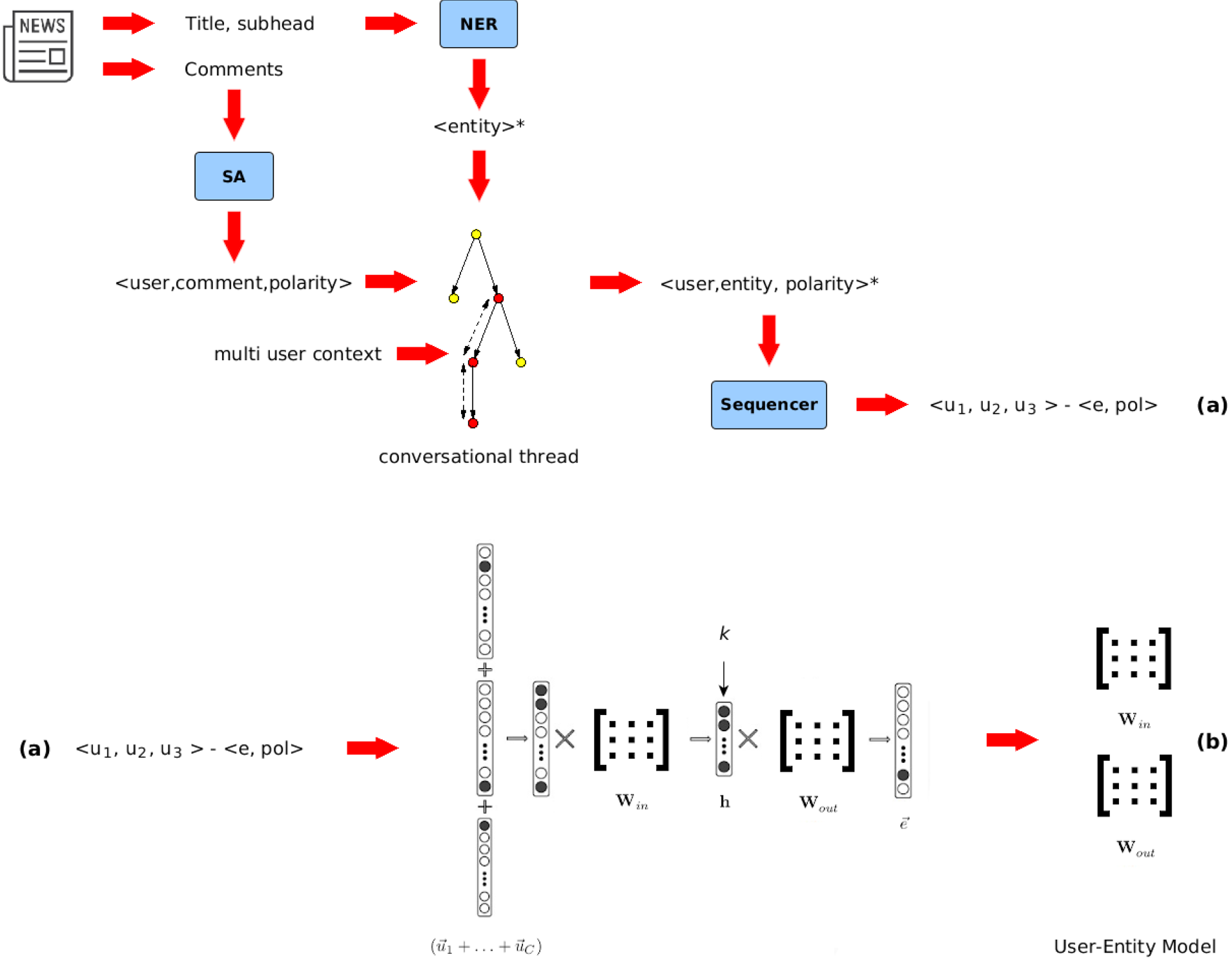 Figure 1: The GENE pipeline, showing the transition from raw comments to entity-polarized user networks.
Experiments: Beating the BERT Baseline
The authors tested GENE against heavyweights like BERT + bi-LSTM and traditional Lexicon methods.
- Ex-Post Performance: When the full conversation is available, GENE hits a precision of 0.85 on controversial news, while BERT-based sequential models lag significantly at 0.56.
- The "Early Bird" Advantage: The most impressive feat is the Ex-Ante (early) detection. The introduced RCC index is specifically designed for sparse, early-stage data.
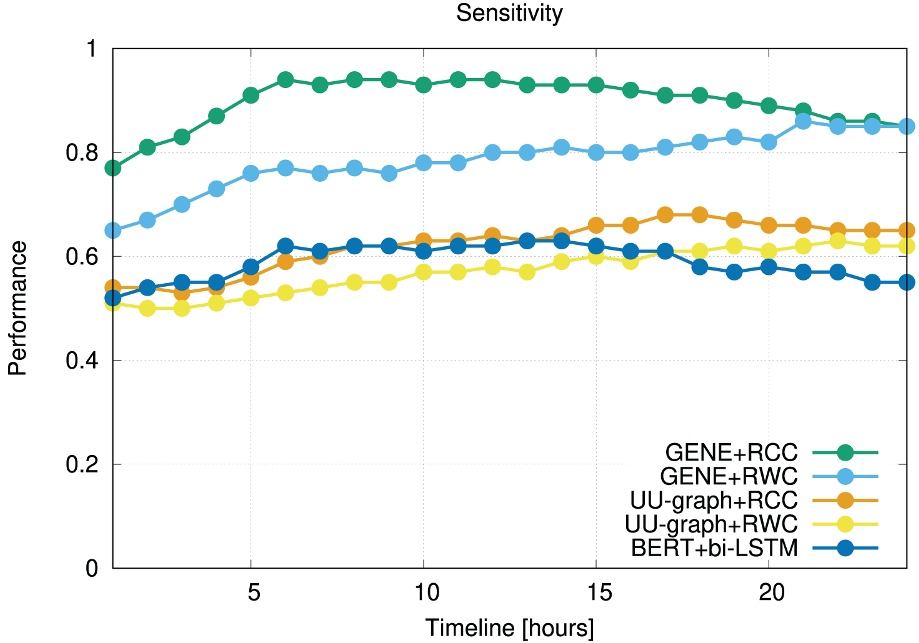 Figure 2: Sensitivity analysis over time. Note how GENE (blue/red lines) maintains high accuracy even in the first 0-6 hours, where other models fail.
Deep Dive: Why It Works
The "Ablation Study" in the paper reveals that the User-Entity model is the engine room. When they removed the entity-conditioning and used a standard User-User engagement graph, the performance in the target "Controversy" class plummeted.
This proves that in a polarized society, entities are the anchors of ideology. A user might be neutral about "The Economy" but highly polarized about "Sebastián Piñera." By tracking these specific entity-biases, GENE can predict if a comment section will turn into an "echo chamber" or a "battleground."
Critical Perspective & Limitations
- Cold Start Problem: GENE requires a history of user comments. It cannot easily model a brand-new user with no prior entity-sentiment footprint.
- Topic Drifts: The model assumes user bias is relatively static. In "Shock" events (e.g., a sudden political scandal), user leanings might flip faster than the model can retrain.
Conclusion
GENE represents a significant step forward for algorithmic moderation and social science. By moving beyond simple text analysis and into the realm of conditioned graph generation, it allows platform owners to identify "toxic" news cycles before they alienate the user base, potentially fostering a more deliberative digital democracy.