
Beyond the Graph: Characterizing Social Communities through Content Fingerprinting
Information Processing and Management
The paper proposes a content-based framework for online social community detection and characterization, primarily focusing on Twitter. By leveraging syntactic features (e.g., proper nouns) and semantic latent features (LDA topics), the authors develop classifiers that identify community membership with high precision using the vocabulary of shared tweets rather than traditional social link analysis.
TL;DR
While most social network analysis looks at who follows whom, this paper proves that what you say is often a more powerful and efficient identifier of community membership. By analyzing just the last 200 tweets of an account using Proper Nouns and Latent Topics, the researchers created a "content-based" detector that identifies community members (like chess players or political partisans) with remarkable precision—all without needing to map the complex web of social links.
The "Link" Problem: Why Graphs Aren't Enough
Traditionally, detecting a community (like "Chess Fans" or "Italian Conservatives") involved crawling the social graph. If Account A follows Account B, they are likely in the same group. However, this approach has three major flaws:
- Data Cost: Scraping follower lists for thousands of users is slow and restricted by API limits.
- The "Silent" Gap: Two people might share identical interests but never follow each other.
- Dynamics: Link-based structures are heavy and slow to update compared to the real-time flow of conversation.
The authors' insight is simple: Vocabulary is a distinctive feature of a community. A chess player's "linguistic fingerprint" (using words like raider, playoff, grandmaster) is so unique that it acts as a membership card.
Methodology: Building the Linguistic Centroid
The researchers moved beyond simple keyword matching to a multi-layered feature extraction process:
1. Syntactic Features
They focused on Proper Nouns (NNP). Why? Because specific people, places, and events are the "factual anchors" of a community. In Italian politics, mentioning specific cities like Bologna or Friuli was a stronger signal than general political terms.
2. Semantic Latent Features (Topics)
Using Latent Dirichlet Allocation (LDA), they compressed thousands of tweets into a probability distribution over "topics." To ensure these topics were meaningful, they used a Coherence Metric () to automatically find the "sweet spot" for the number of topics (e.g., 7 topics for chess players).
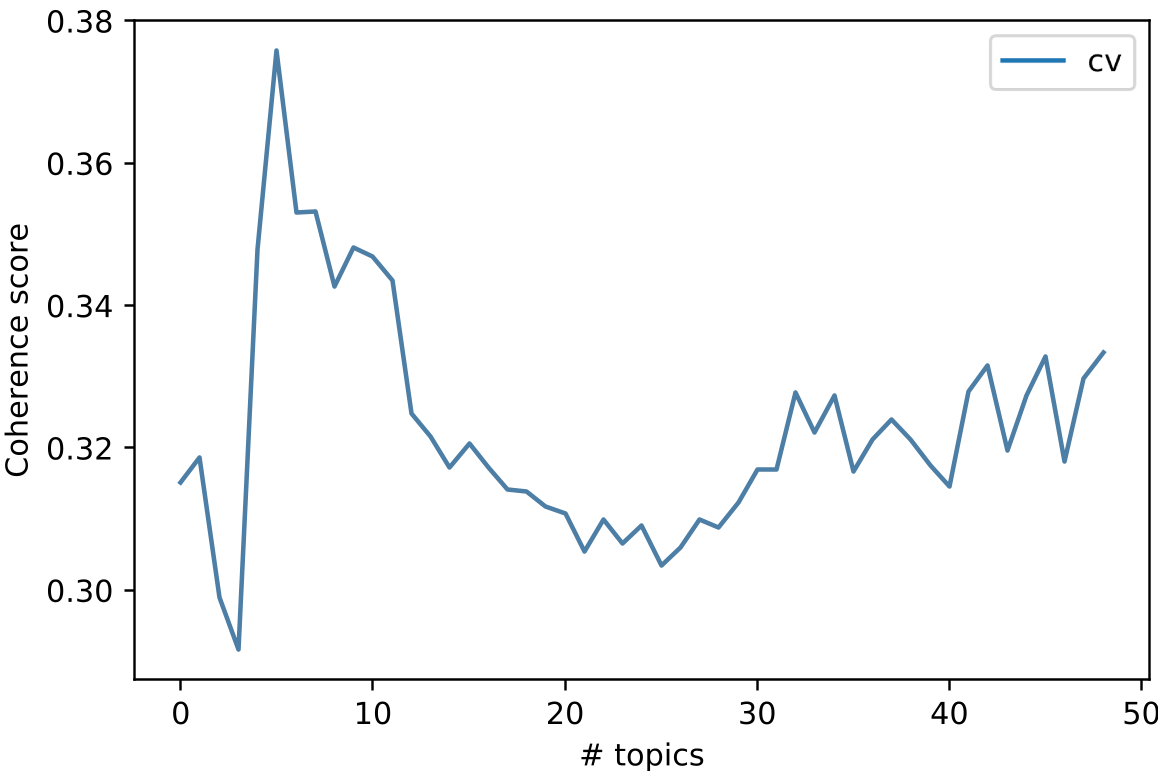 Figure 1: Using the Coherence Metric to find the optimal number of topics.
3. The Membership Test
They represented each community as a Centroid (an average vector). To see if a new user belongs, they measured the Cosine Distance or Kullback–Leibler Divergence (KLD) between the user’s tweets and that centroid.
Experimental Showdown: Politics and Sports
The team tested their method across diverse "Gold Standard" communities: Chess Players, Australian Writers, and Fashion Designers.
| Domain | Top Feature | Precision @ 10 |
|---|---|---|
| Chess | Proper Nouns | 0.80 |
| Fashion | Topics | 0.78 |
| Politics | Nouns/Proper Nouns | Variable |
Key Insight: The Political "Identity Crisis"
The application to Italian politics yielded a fascinating sociological finding. While Democratic and Right-wing party followers were easily identified by their vocabulary, the Cinque Stelle followers were often misclassified as supporters of the Democratic Party. Their Dispersion Index (a measure of how "scattered" a community's vocabulary is) was significantly higher, suggesting they lacked a cohesive, unique jargon compared to established parties.
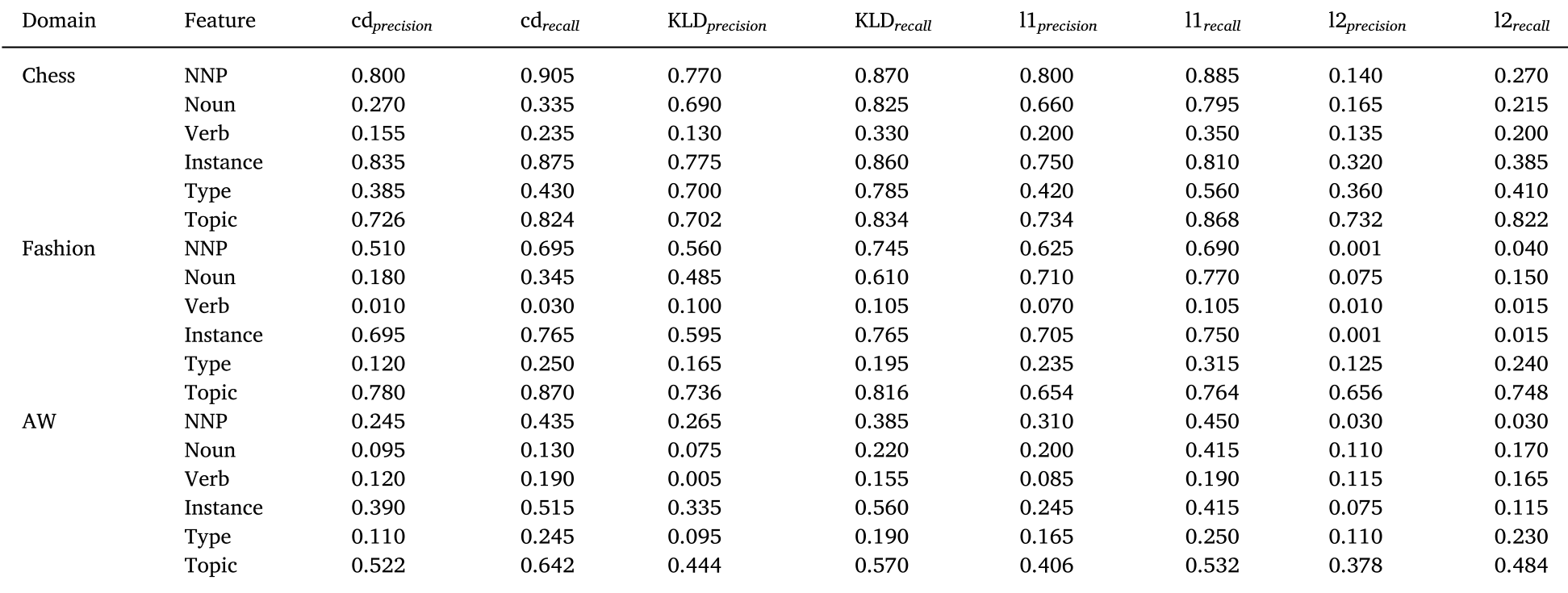 Table 2: Comparison of different linguistic features and distance metrics.
Critical Analysis & Takeaways
The brilliance of this work lies in its efficiency. By proving that a single API call for 200 tweets provides enough data for high-precision classification, the authors have lowered the barrier for targeted advertising and sociological research.
Limitations:
- Domain Sensitivity: The method works best for "narrow" communities (Chess). For broad interests (Writers), the vocabulary becomes too diluted ("dispersed"), and precision drops.
- Language: The study focuses on Italian and English; slang-heavy or highly emoji-reliant communities might require different feature extractors.
Future Outlook: This content-centered approach is perfectly suited for the "era of privacy," where social graphs are increasingly obscured, but public discourse remains accessible. Moving forward, applying this to visual content (Instagram/TikTok tags) could provide a truly multi-modal "community fingerprint."
Conclusion
This paper shifts the paradigm of community detection from who you know to how you speak. In the noisy world of Twitter, your vocabulary is your most honest identifier.