
VAE-Service: Revolutionizing API Discovery with Deep Generative Latent Spaces
Information Processing and Management
This paper introduces a deep learning-based approach for Web Service discovery using Variational Autoencoders (VAE) to represent service descriptions in a compressed latent space. By training on over 17,000 services from ProgrammableWeb, the method achieves SOTA status in keyword-based service retrieval, significantly outperforming traditional LSA, LDA, and modern Word Embedding techniques.
TL;DR
As Web API registries like ProgrammableWeb evolve into massive "social" repositories, finding the right service becomes a needle-in-a-haystack problem. This paper proposes using Variational Autoencoders (VAE) to map sparse service descriptions into dense, non-linear latent spaces. The result? A 36x faster search engine with a 35.7% boost in top-tier precision, effectively solving the age-old "vocabulary problem" in service-oriented computing.
Background: The Limits of Syntactic Search
For decades, Web Service discovery relied on the Vector Space Model (VSM) and TF-IDF. However, these methods are "blind" to semantics; if a user searches for "currency conversion" but an API describes itself as a "Forex tool," the system fails. While Latent Semantic Analysis (LSA) and Word Embeddings (like Word2Vec) attempted to bridge this gap, they either lack non-linear expressiveness or lack domain specificity when trained on general corpora like Google News.
Why Variational Autoencoders?
The authors' core "Aha!" moment was the realization that service descriptions are essentially noisy, high-dimensional observations of a few latent "functional goals." Variational Autoencoders are uniquely suited for this because:
- Dimensionality Reduction: They compress thousands of vocabulary terms into a small set of latent variables (e.g., 256 dimensions).
- Generative Robustness: Unlike "vanilla" autoencoders, VAEs model a probability distribution (mean and variance), preventing overfitting and ensuring the latent space is continuous and structured.
- Non-linearity: Deep layers capture complex relationships that linear models like LSA simply cannot see.
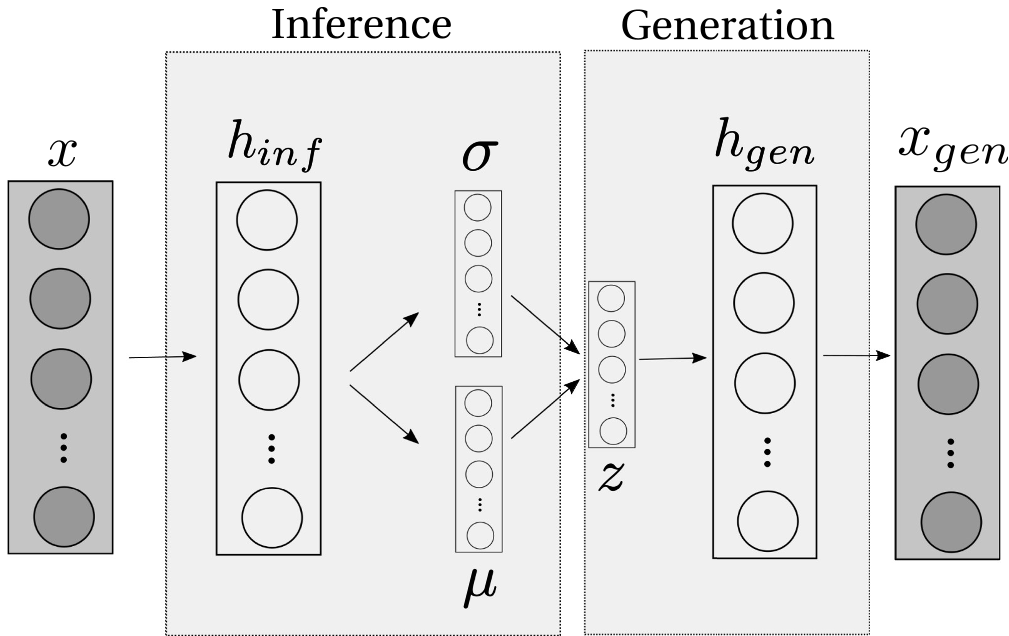 Figure 1: The VAE encoder map inputs to a Gaussian distribution (μ, σ), from which a latent vector z is sampled.
Methodology: Customizing the Cost Function
The standard VAE is often used for images with Mean Squared Error (MSE). However, text discovery is all about directional similarity. The authors modified the training process to use Cosine Similarity as the loss function:
By optimizing for cosine similarity, the VAE learns to align the "direction" of the reconstructed description with the original input, making it directly compatible with standard ranking algorithms.
Experimental Results: SOTA Performance
The researchers tested their approach against LSA, LDA, Word2Vec, GLoVe, and FastText using a dataset of 17,113 APIs.
- Precision & Recall: VAE consistently sat at the top of the curve. At the crucial "Position 1," it outperformed the nearest baseline (FastText) significantly.
- Efficiency: By compressing the vector space from ~1.5 GB down to 36 MB, search latency dropped from nearly 2 seconds to just 55 milliseconds.
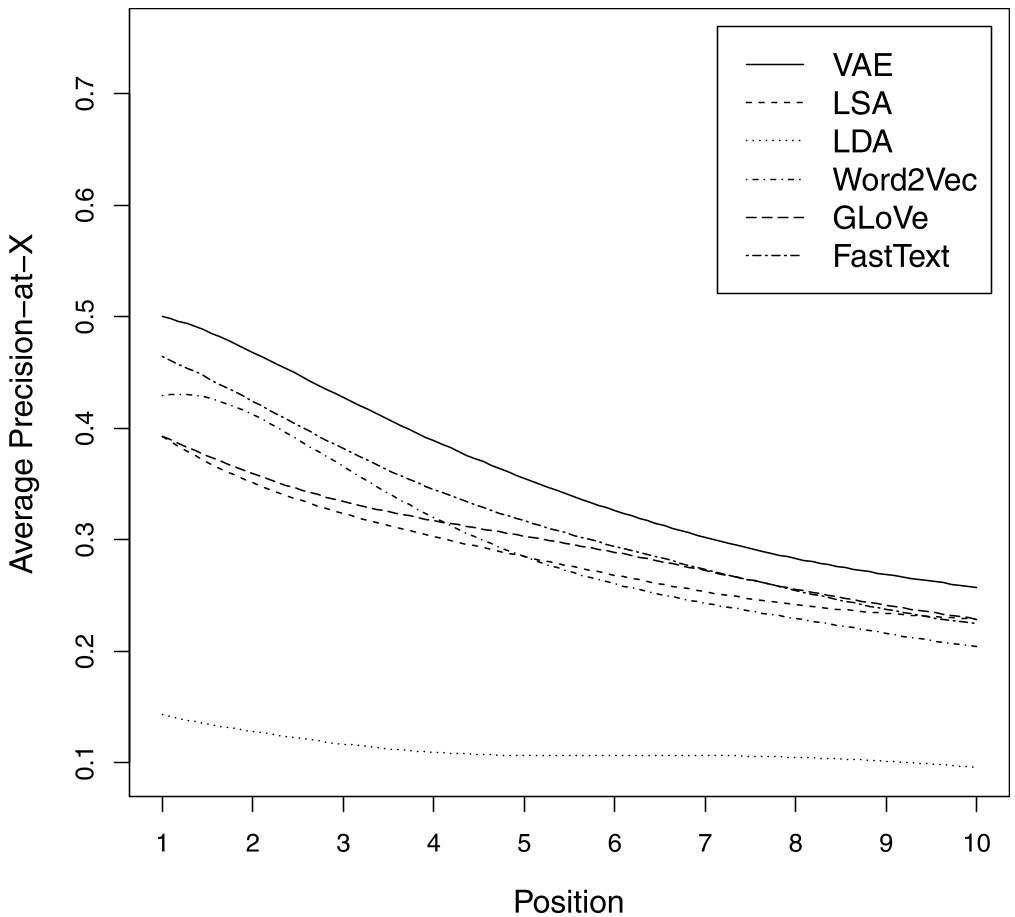 Figure 2: Precision-at-X comparison showing VAE's dominance in the top-10 result window.
Critical Insight: VAE vs. Word Embeddings
Interestingly, while Word Embeddings (like FastText) are powerful, they are often trained on Wikipedia or News. In contrast, the VAE in this study was trained directly on the service descriptions. This domain-specific "internal" learning allows the VAE to capture the specific jargon of software engineering and API documentation better than general-purpose embeddings.
Conclusion and Future Directions
The paper confirms that deep generative modeling is no longer just for images. In the realm of Web Services, it offers a dual benefit: higher accuracy in matching user intent and a massive reduction in infra requirements. Moving forward, the authors suggest replacing Cosine Similarity with Word Mover's Distance (WMD) and exploring even deeper network architectures to further refine the latent "DNA" of Web APIs.