
GLFM: Decoding the Dual Power of Groups in Social Event Recommendation
Information Processing and Management
The paper introduces a Dual-Perspective Latent Factor Model (GLFM) for event recommendation in Event-Based Social Networks (EBSNs). It explicitly models the dual role of groups—user-oriented (interests/topics) and event-oriented (organization/style)—using pairwise learning to achieve State-of-the-Art (SOTA) performance across multiple real-world datasets.
TL;DR
In Event-Based Social Networks (EBSNs) like Meetup, events are almost always "cold-start" because they happen in the future. This paper proposes a Dual-Perspective Latent Factor Model (GLFM) that treats groups as a bridge. By modeling groups as both "interest clusters" for users and "organizing entities" for events, the system can recommend events to new users or suggest new events with high accuracy, outperforming traditional Matrix Factorization.
Problem & Motivation: The Cold-Start Nightmare
Recommending events is fundamentally harder than recommending movies or books. Why?
- Temporal Decay: Most events are one-time occurrences. By the time you have enough data to model an event, it's already over.
- Implicit Feedback: Most users don't RSVP "No"; they simply ignore events they aren't interested in.
- Group Centrality: In EBSNs, users don't just exist in a vacuum; they belong to groups. Events aren't just items; they are hosted by these groups.
The authors observed that 80% of Meetup users belong to at least one group. This group membership is the "holy grail" for solving the cold-start problem.
Methodology: The Core Insight
The brilliance of this paper lies in the Dual-Perspective approach. Instead of a single "group embedding," the authors split the group's influence into two distinct latent factors:
- User-Oriented Perspective (): Represents the topics of interest shared by group members. If you join a "Python Developers" group, captures your interest in coding.
- Event-Oriented Perspective (): Represents the organization style and quality of the group. If a group is known for hosting high-quality tech talks, captures that "brand" consistency.
The Ranking Score Formula
The score for a user and event is calculated by combining standard latent factors () with these group factors:
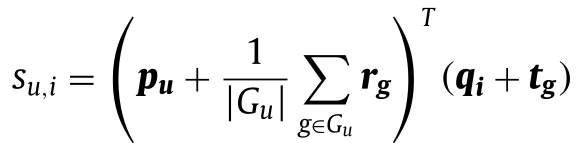
- The user's preference is "smoothed" by the average interest of the groups they belong to.
- The event's characteristics are "augmented" by the latent factor of its organizing group.
Exploiting the "Unseen"
The model uses Pairwise Ranking. Instead of predicting if a user will attend (0 or 1), it learns that a user prefers an "RSVP Yes" event over a "Missing" event, and a "Missing" event over an "RSVP No" event. They test two sigmoid functions for this: the standard Logistic (as in BPR) and the Probit function (Cumulative Distribution of a Gaussian).
Experiments and Results
The authors tested the model across four major U.S. cities (New York, San Francisco, DC, Chicago).
Key Findings:
- Group Info is King: Models with group factors (GLFM) crushed those without.
- Context Matters: Adding Venue (V), Popularity (P), Distance (D), and Time (T) further refined the results. Venue was found to be the most influential contextual factor because users often have preferred "hangout" spots.
- Cold-Start Victory: In the new-user/new-event scenario, where traditional MF fails, GLFM maintained strong performance because it could still rely on the and factors learned from the groups.
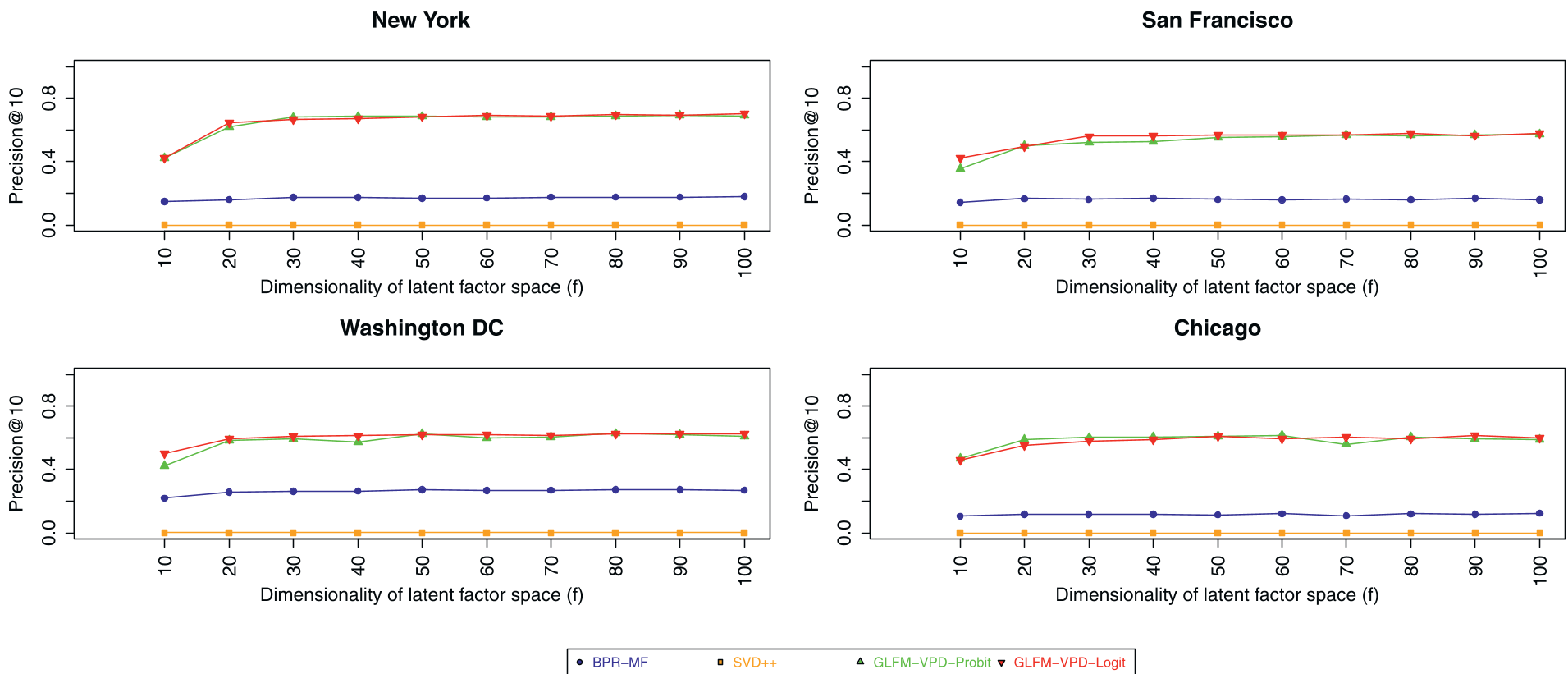 The chart above shows that as the dimensionality of latent factors increases, the group-aware models (GLFM) consistently maintain a massive lead over standard BPR-MF.
Critical Analysis & Conclusion
Why it works
The dual-perspective approach acts as a regularization mechanism. By tethering individual user/event latent factors to their respective groups, the model prevents over-fitting to sparse individual data and provides a sensible "default" for new entities.
Limitations
- Group Dynamics: The model assumes a user is equally influenced by all groups they belong to (simple average). In reality, a user might be active in one group and dormant in another. An Attention Mechanism (which became popular years after this paper) would be a natural upgrade.
- Social Network Neglect: While it uses "groups," it doesn't explicitly model friend-to-friend social links.
Future Outlook
This dual-perspective logic is highly transferable. Whether it's job recommendations (Skills vs. Company Culture) or music (Genre vs. Artist Brand), splitting entity influence into "interest" and "style" perspectives remains a robust strategy for tackling sparse, cold-start recommendation environments.