
In the Mood for Sharing: How Your Personality Dictates the News You Spread
Information Processing and Management
The paper investigates the impact of Twitter users' personality traits and communication styles on the diffusion of news articles associated with specific emotional moods. By analyzing over 2000 users sharing articles from the Italian newspaper Corriere, the study employs Random Forest and Logistic Regression to achieve a 61.7% F1-measure in predicting whether a user is a positive or negative mood sharer.
TL;DR
Why do some people always share "outrage" news while others spread "wholesome" content? This study reveals that the diffusion of mood-altering news on Twitter is deeply rooted in the sharer's Big Five personality traits and communication styles. By analyzing Italian news sharing patterns, researchers successfully predicted "Positive" vs. "Negative" sharers with a 61.7% F1-measure, proving that our psychological profiles act as emotional gatekeepers in the social ecosystem.
Background: Beyond the Content
Most research on "virality" focuses on the what—is the headline clickbaity? Is the sentiment extreme? However, this paper shifts the lens to the who. The authors argue that information diffusion is an act of identity performance. Using a unique dataset from Corriere.it (where readers self-annotate their mood after reading), the study maps the psychological landscape of the people who hit the "Tweet" button.
Problem & Motivation: The Missing Link in Contagion
Existing models of emotional contagion often treat users as passive nodes. The authors identified a gap: we know emotions spread like infectious diseases, but we don't know who the "super-spreaders" are for specific moods. The motivation was to move beyond generic sentiment analysis and see if stable human traits—like Extraversion or Neuroticism—could predict the emotional trajectory of a news cycle.
Methodology: Mapping the Digital Persona
The researchers built a sophisticated pipeline to connect psychological theory with social media data:
- Data Alignment: They sampled 2,500 Twitter users who shared news from Corriere.it, linking Twitter metadata to the "Gold Standard" mood labels (Amused, Satisfied, Disappointed, Worried, Indignated) provided by the news site.
- Personality Mapping: They used the Big Five model (Openness, Conscientiousness, Extraversion, Agreeableness, Neuroticism) and trained a Random Forest model to predict these traits.
- Communication Styles: They employed 11 dimensions from Analyzewords (based on LIWC), such as "Upbeat," "Depressed," and "Plugged-in," to categorize how users interact.
 Figure 1: The study synchronized Twitter interaction data with newspaper mood metadata.
Key Insights & Experimental Results
The correlation analysis yielded several "aha!" moments that defy simple intuition:
- The "Indignation" Paradox: There is a massive correlation between "Likes" and "Indignation." This suggests that on social media, a "Like" is often a signal of social support for a shared grievance rather than true "liking" of the content.
- Openness vs. Disappointment: Users high in Openness to Experience are significantly less likely to share disappointing news. They prefer content that fosters understanding rather than dissatisfaction.
- The Upbeat Filter: An "Upbeat" communication style is the strongest shield against sharing indignation, showing a direct link between linguistic habits and emotional gatekeeping.
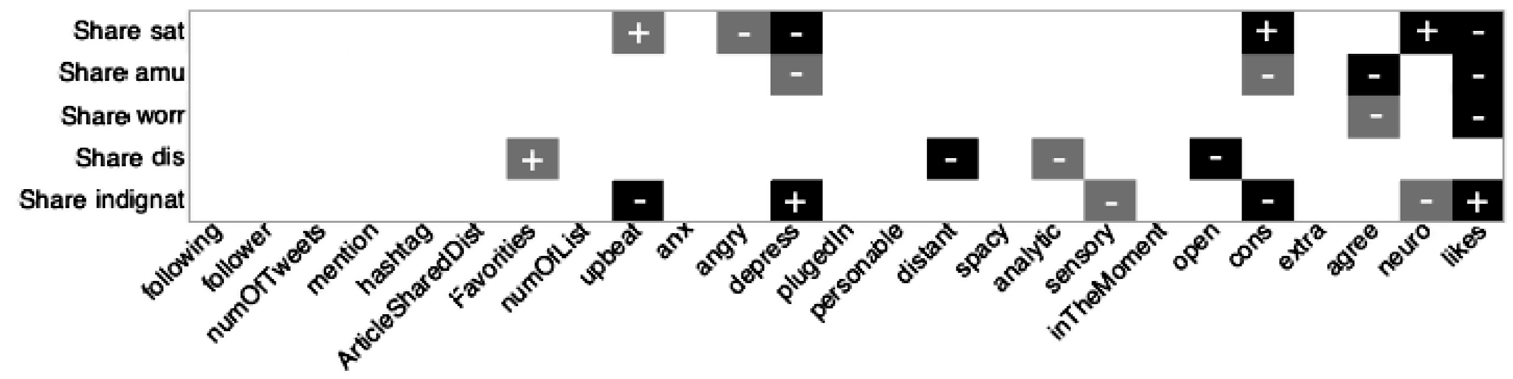 Figure 2: Heatmap showing the intricate correlations between personality traits (e.g., Consciousness), styles (e.g., Upbeat), and mood sharing.
In the classification task, Logistic Regression achieved a balanced F1-score of 61.7%. Notably, Conscientiousness emerged as one of the top predictors for positive mood sharing, suggesting that organized, disciplined individuals are more intentional about spreading "satisfied" or "amused" content.
Critical Analysis & Conclusion
Takeaway
The study proves that our online "mood" isn't just a reaction to the day's events—it's a reflection of our baseline personality. Platforms looking to foster healthier environments should look at the Inductive Bias of the users themselves, not just the text of the posts.
Limitations
- Language Specificity: The study was conducted on Italian users and news. Cultural nuances in expressing "indignation" or "satisfaction" might differ in other regions.
- Platform Dynamics: Since 2015, Twitter's (now X) algorithm has changed significantly, likely amplifying certain "negative" behaviors that were more organic during this study.
Future Outlook
As AI agents begin to curate our feeds, understanding these psychological drivers is crucial. Future work could apply these findings to Proactive Content Moderation, identifying potential spreaders of toxic "indignation" based on their long-term communication styles before a post even goes viral.