
Decoding the Crowd: A Systematic Review of Modern Crowdsourcing Workflows
Information Processing and Management
This systematic review analyzes the state-of-the-art in crowdsourcing project design, focusing on task execution, quality management, and platform utilization. It categorizes 76 core projects to establish a unified understanding of workflows and common practices in the human computation field.
TL;DR
Crowdsourcing has shifted from an experimental novelty to a vital engine for AI training and problem-solving. However, without a structured workflow, it remains a "black box" of varying quality. This review taxonomizes the industry, revealing that while monetary incentives and object processing dominate, the real breakthrough lies in integrating multi-stage quality management directly into the project lifecycle.
The "Black Box" Problem: Why Projects Fail
In many traditional crowdsourcing setups, workers are abstracted as mere algorithms. This leads to three critical pain points identified by Assis Neto and Santos:
- Pseudo-anonymity: Platforms like MTurk hide worker attributes, making it difficult to hire specialists for complex tasks.
- Inflexible Incentives: A reliance on micro-payments can attract "malicious" workers who prioritize speed over accuracy.
- Lack of Standardization: There isn't a "universal language" for designing crowdsourcing workflows, leading to fragmented research and non-reproducible results.
Methodology: The Four-Quadrant Task Model
The authors propose a refined way to look at what the crowd actually does. Instead of just "tasks," they categorize work into four distinct types based on the input and intended output:
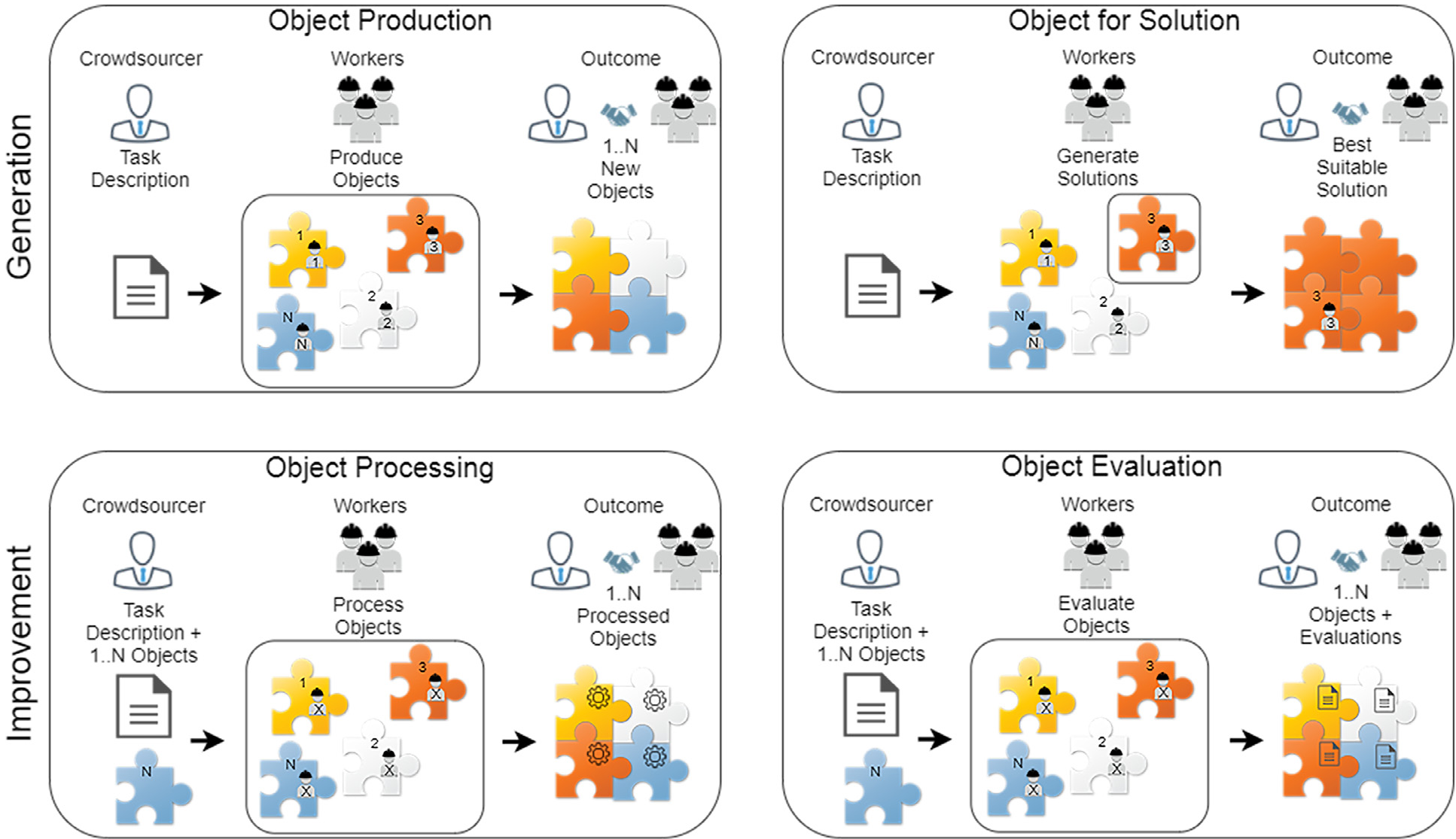
- Generation Dimension: Includes Object Production (creating new content) and Object for Solution (solving complex problems competitively).
- Improvement Dimension: Focuses on Object Processing (editing/segmenting) and Object Evaluation (voting/rating).
The Quality Management Pipeline
One of the paper's most significant insights is the breakdown of quality control. It’s no longer enough to just "check the work" at the end. The authors identify a three-pillar structure:
- Pre-task (Filtering): Qualification tests and training videos (used in 34/76 projects). If the worker isn't ready before they start, the data is already compromised.
- During-task (Verification): "Gold Standard" questions (hidden ground-truth questions) and task design constraints that monitor behavior in real-time.
- Post-task (Aggregation): The heavy lifter. Majority Voting remains the industry standard, but the paper highlights the rise of Review (manual checks) and Subtasks (using the crowd to check the crowd).
Key Results & Industry Trends
The data from 76 projects paints a clear picture of the current landscape:
- Platform Dominance: Amazon Mechanical Turk (32%) and CrowdFlower (14%) remain the leaders, but specific-purpose platforms are rising to handle "Specific Crowds" (specialists).
- Incentive Gap: While monetary rewards are the most common (92%), Entertainment (GWAP) is a powerful intrinsic motivator that often yields higher engagement for repetitive tasks like image labeling.
Critical Insight: The Workflow is the Infrastructure
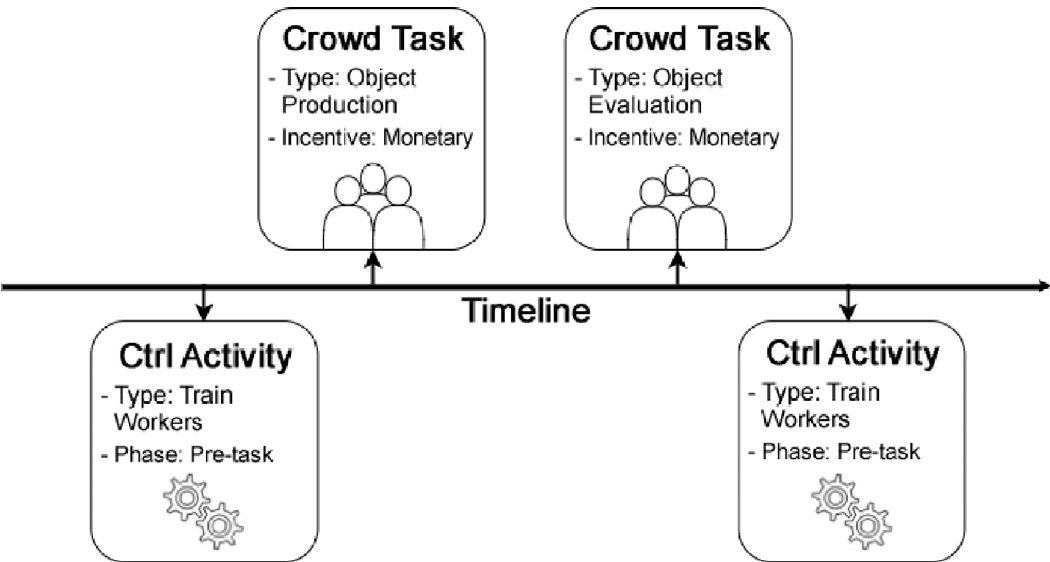
The authors argue that a crowdsourcing project is its workflow. As shown in the diagram above (adapted from the Chorus assistant project), a successful project sequences tasks and quality modules logically.
The transition from Microtasks to Complex Work requires moving away from static pipelines toward dynamic workflows where the output of one task (e.g., generating an answer) serves as the input for a quality task (e.g., voting on that answer).
Future Outlook: Beyond the Microtask
The review concludes that the industry’s greatest need is a conceptual model that formalizes these relationships. As we move into an era dominated by Large Language Models (LLMs), the "Human-in-the-Loop" (HITL) requirements will only increase. This paper provides the foundational coordinates for building those more sophisticated, reliable human-computation systems.
Takeaway: Stop treating the crowd as a black box. Design the workflow, verify the worker early, and aggregate with purpose.