
Status and Substance: A New Model for Information Propagation in Social Networks
Information Propagation Model for Social Network Based on Information Characteristic and Social Status
The paper introduces a novel information diffusion model for social networks that integrates individual psychological traits with network topology. By combining a Behavior Threshold Model and a Viewpoint Evolution Model, it effectively simulates how public opinion spreads based on information "amusement" and the social status (node degree) of individuals.
TL;DR
Why do some rumors die out while others paralyze a city? This paper argues it’s a mix of who you are and what you’re sharing. The researchers propose a model that ties an individual's social status to their psychological threshold for spreading info, while using Information Entropy to model our innate "urge to conform."
The Missing Link: Why Traditional Models Fail
Most classical models (like the Sznajd or Deffuant models) treat individuals as "opinion atoms"—particles that simply bump into each other and exchange views. But humans aren't atoms. We are social animals sensitive to Status (who is talking?) and Context (is this fun or serious?).
The authors identify a critical gap: existing models don't differentiate between an "ordinary" user seeking entertainment and a "leader" node who feels a sense of responsibility. Furthermore, they don't quantify the "noise" of the environment—how a confused crowd influences a single person's decision.
Methodology: The Math of Conformity and Status
The paper structures its approach into three distinct pillars:
1. Network Topology (The "Where")
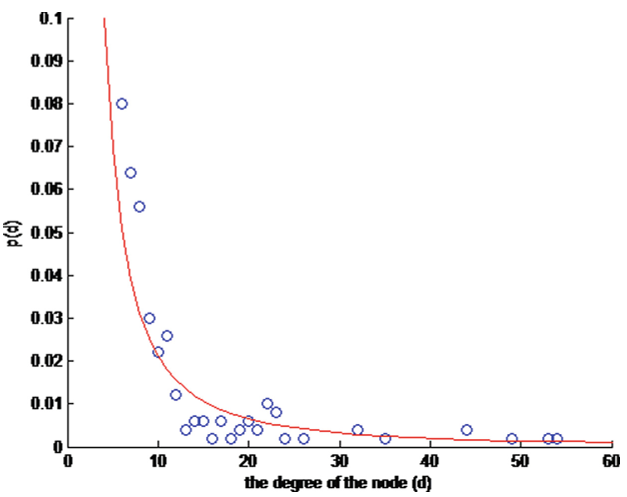
They utilize a modified BA (Barabási–Albert) Network. By simulating a growth process where new users prefer connecting to powerful (high-degree) nodes, they create a realistic "Power Law" distribution.
2. The Behavior Threshold ()
This is the "tipping point" for an individual to act. The model defines status () based on the number of neighbors:
- Ordinary nodes (): Driven by amusement. Low threshold for "fun" info.
- Elite/Leader nodes (): High sense of responsibility. They require more "substance" or proof before they risk their status to spread information.
3. Viewpoint Evolution and Entropy
How do you change your mind? The authors propose: Where:
- is the Overall State Influence, calculated using Information Entropy. If the neighbors are split 50/50, entropy is high (uncertainty), and the pressure to conform is low. If everyone agrees, entropy is low, and the pressure is massive.
- represents Authority Influence, the specific magnetic pull of high-status nodes.
Crucial Experiments: Amusement vs. Authority
The researchers ran simulations on a 500-node network. Two findings stand out:
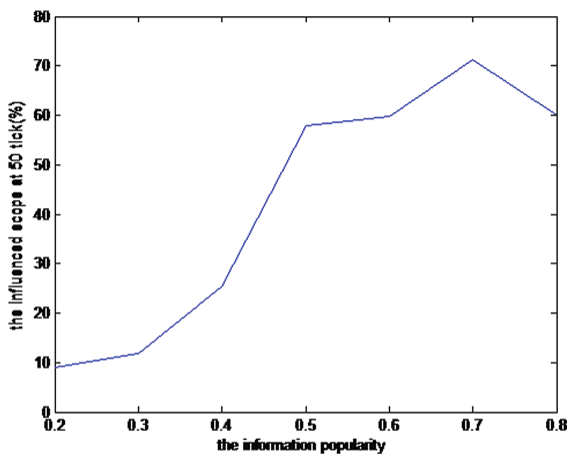
A. The Power of "Fun": As the information_amusement factor increases, the propagation scope widens. Interestingly, the model shows that "amusing" information bypasses the natural skepticism of ordinary nodes, causing rapid viral cascades.
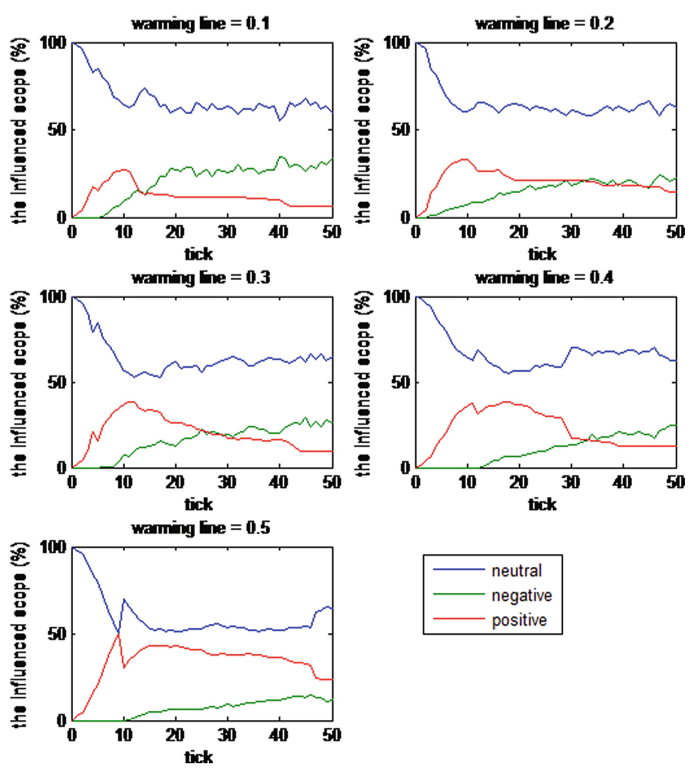
B. The Intervention Sweet Spot: The authors tested "Warning Lines" (). When the government or an authority intervenes early (e.g., when the propagation hits a 0.2 warning line), the spread of hazardous rumors is drastically neutralized.
Critical Insight & Conclusion
Takeaway
The core value of this work is the mathematical marriage of Information Theory (Entropy) and Sociological Status. It moves beyond "infection" metaphors used in epidemiology-based models and moves toward a "choice-based" model of human behavior.
Limitations
While the BA network is a good start, real social networks (like Twitter or WeChat) often feature "communities" or "echo chambers" more complex than a simple power-law degree distribution. The model also treats "amusement" as a static value, whereas in reality, information evolves as it is shared.
Future Outlook
This framework provides a blueprint for government agencies and social media platforms to design dynamic monitoring systems. By identifying the status of the "seed" nodes and the nature of the content early, we can predict—and potentially mitigate—the impact of harmful public opinion before it reaches the "tipping point."