
Beyond Strong Ties: Unveiling the Hidden Dynamics of Information Pushing in Social Networks
Information propagation in online social networks: a tie-strength perspective
This paper investigates the relationship between tie strength and information propagation in Online Social Networks (OSNs) by proposing the diffusion model. Using real-world Facebook data, it identifies that "information pushing" is the primary driver of rapid spread and that random selection often outperforms strong-tie-centric strategies.
TL;DR
Why does content go viral on Facebook or Twitter so much faster than in traditional social circles? This paper argues it isn't just about who you know, but the Information Pushing Mechanism inherent to OSNs. By proposing a new diffusion model, the authors prove that random selection often beats "strong-tie" strategies, and that "positive weak ties" act as the critical bridges preventing information from stalling in local clusters.
Problem: Why Traditional Models Fail OSNs
Traditional sociology emphasizes the "strength of weak ties" for finding jobs, but does this hold for a 24/7 digital feed? Most prior work ignored the Pushing Mechanism—where platforms actively force content onto your screen (e.g., Facebook’s News Feed). Furthermore, existing models like Independent Cascade (IC) don't fully capture the nuances of why someone republishes or how network topology (clustering) interacts with the strength of a friendship.
Methodology: The Diffusion Model
The authors introduce a flexible model to simulate high-velocity digital spread:
- Step 1 (Pushing): When a user posts, information is automatically pushed to all neighbors—a distinct OSN feature.
- Step 2 (Republishing): The probability of a neighbor passing it on () is governed by:
- (Navigating Parameter): Controls the preference for strong (), weak (), or random () ties.
- (Information Strength): Represents how catchy or viral the content is.
Key Insights and Experimental Results
1. The Pushing Power vs. Strategy
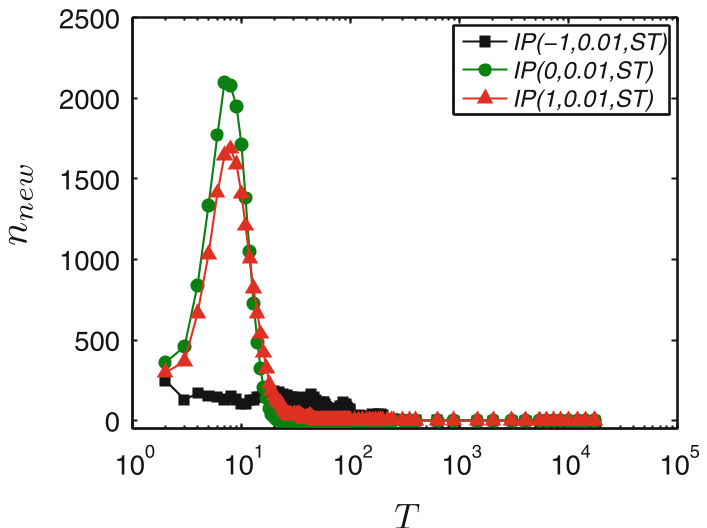
The study compared four strategies: High Betweenness Centrality (BCT), Strong-Tie-First, Weak-Tie-First, and Random Selection.
- Observation: High-BCT-First (a global, computationally expensive strategy) is the fastest, but Random Selection is surprisingly close in performance.
- Takeaway: OSNs are so efficient at pushing information that sophisticated (and expensive) global strategies are often overkill.
2. Social Synchrony
In most datasets, information reached nearly 100% coverage () within only 10 to 30 hops. The authors term this "Social Synchrony," where the network reaches a state of collective awareness almost instantly due to the pushing mechanism.
3. The Dual Nature of Weak Ties
The authors redefine weak ties into two categories:
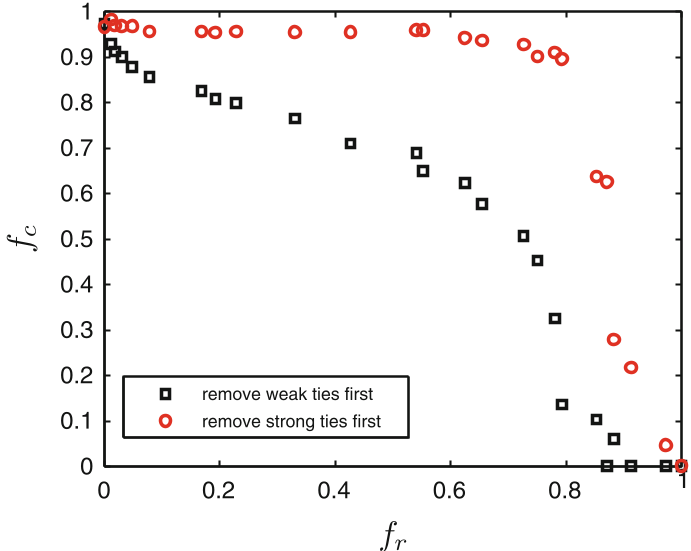
- Positive Weak Ties: Connections between high-degree "star" nodes in different clusters. These are the "bridges" that allow information to jump between isolated communities.
- Negative Weak Ties: Connections between low-degree nodes with no mutual friends. These are "dead ends" for propagation.
When weak ties were removed systematically, the information coverage plummeted once 40% of the weakest ties were gone, proving that while most weak ties are "negative," the "positive" ones are essential global connectors.
Critical Analysis & Conclusion
The Clustering Correlation
The paper establishes a mathematical link: Lower Clustering Coefficient = More Weak Ties. In networks like the Facebook Caltech dataset (high clustering), weak ties are rare, making the "Bridge Effect" of the few remaining weak ties even more powerful.
Business Implications
- Viral Marketing: Don't just target the "strongest" friends; target the "bridges."
- Security: To stop a digital virus, the most cost-effective method is identifying and "breaking" the positive weak ties (bridges) rather than individual high-degree nodes.
Limitations
The model assumes a static information strength () across all users. In reality, is subjective—what is "interesting" to one user may be "spam" to another. Future research should integrate personal preference vectors into the republishing probability.
Takeaway: In the era of OSNs, the platform's mechanism is as important as the network's topology.