
Modeling the Human Factor: Information Propagation in Mobile Social Networks
Information Propagation through Opportunistic Communication in Mobile Social Networks
This paper proposes an Ordinary Differential Equation (ODE) based theoretical framework to evaluate information propagation in Mobile Social Networks (MSNs) modeled as Delay Tolerant Networks (DTNs). The framework uniquely incorporates human social behaviors, specifically individual and social selfishness, interest evolution, and message discarding, achieving a high prediction accuracy with an average deviation of less than 5.09%.
TL;DR
Researchers have developed a robust mathematical framework using Ordinary Differential Equations (ODE) to predict how information spreads across mobile devices. Unlike previous models, this framework accounts for the "human element"—selfishness, loss of interest, and the tendency to delete data—achieving over 95% accuracy against real-world movement data.
Positioning: This work bridges the gap between theoretical epidemic modeling and practical social network analysis in Delay Tolerant Networks (DTNs).
Problem & Motivation: The Selfish Node
In a world of smartphones, we often rely on "Store-Carry-Forward" communication (Bluetooth/WiFi) when cellular networks are unavailable. However, humans aren't perfect relays. Prior work often assumed nodes were "altruistic," always willing to help. In reality:
- Individual Selfishness: Users want to save battery and may refuse to forward messages.
- Social Selfishness: People are more likely to help those within their own social community than strangers.
- Buffer Dynamics: Messages aren't kept forever; users discard information once it's consumed.
Previous attempts to model this using Markov Chains became mathematically trapped as the number of social communities grew. This paper breaks that bottleneck.
Methodology: The Four-State ODE Framework
The core innovation lies in categorizing every person in the network into one of four states and defining the "flow" between them using ODEs:
- Uninterested (): Not yet caring about the message.
- Unsatisfied (): Interested but hasn't received it.
- Satisfied (): Has the message and is potentially sharing it.
- Discarded (): Had the message but deleted it.
The Architecture of Interaction
The authors assume contacts follow a Poisson distribution (exponential inter-contact times), allowing them to define the rate of change for each group.
 The equation above (Eq. 13) represents the growth of 'Satisfied' nodes, factoring in cooperation probabilities () across different communities.
Experiments & Results: The "Tipping Point"
The model was tested against the ONE Simulator using two datasets:
- Synthetic Random Waypoint (RWP) movement.
- Real GPS traces from 2,100 taxis in Shanghai.
Key Findings:
- Accuracy: The ODE model matched simulation results with a tiny 5.09% deviation.
- The Phase Transition: The researchers discovered a critical threshold. If the message discard rate () increases even slightly past a certain point, the number of people reached by the message drops from hundreds to nearly zero.
- Community Impact: Increasing the number of social communities makes propagation harder, as inter-community trust is typically lower.
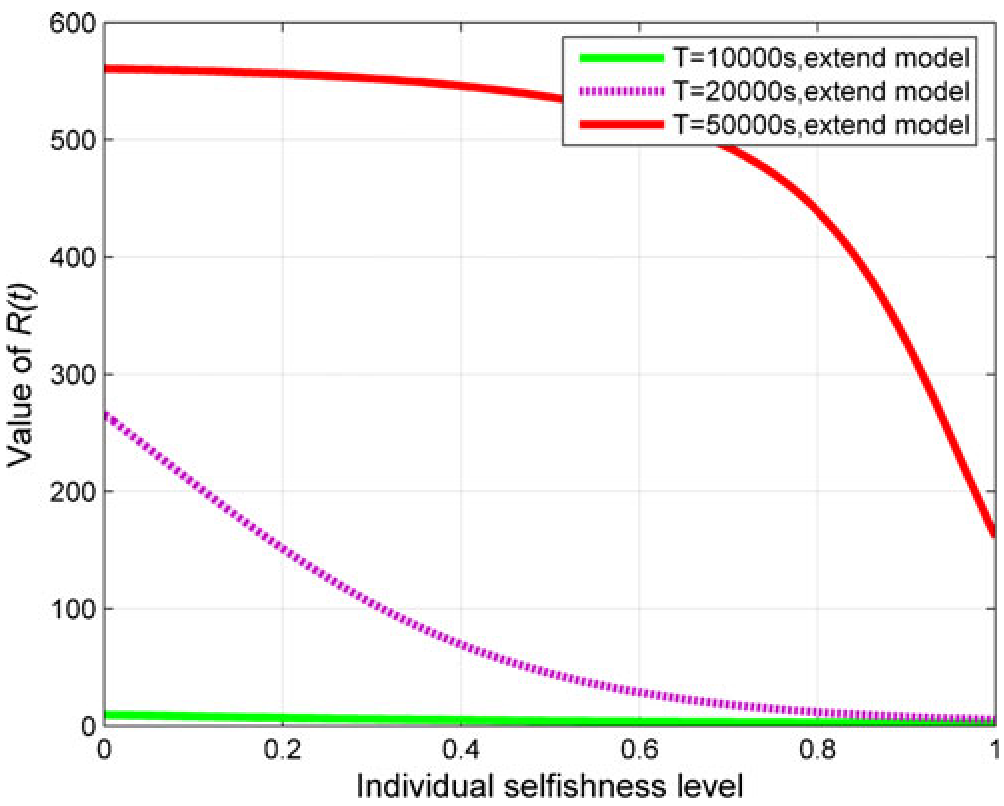 Fig 3: As individual selfishness increases, message reach (R(t)) collapses, especially when the message lifetime (T) is short.
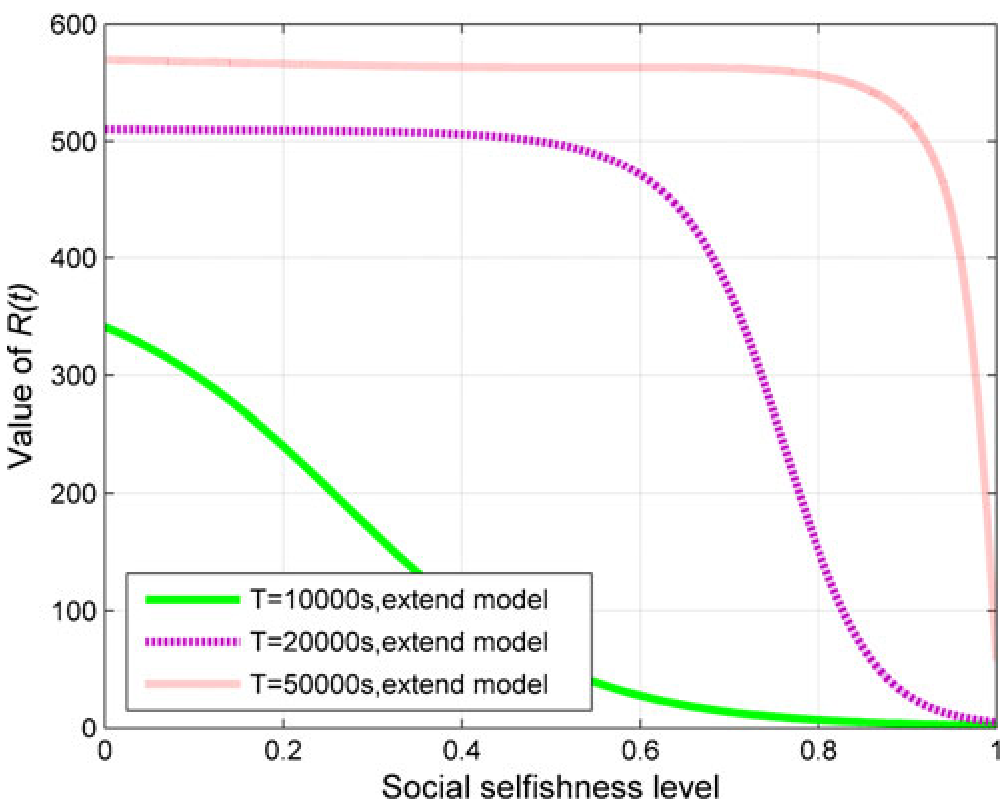 Fig 2: Alignment between the theoretical ODE model and real Shanghai taxi mobility traces.
Critical Analysis & Conclusion
Takeaway
This framework is a powerful tool for predicting the reach of mobile advertisements or emergency alerts in challenged environments. It proves that network performance is not just a hardware problem, but a psychological one.
Limitations
- Poisson Assumption: While the paper argues that long-term contact traces exhibit exponential decay, many modern mobility studies suggest "heavy-tailed" distributions (Power Law) are more realistic for short-term human movement.
- Homogeneous Mixing: The model assumes nodes within a community meet each other with equal probability, which ignores the existence of "social hubs" or popular locations.
Future Outlook
The "Phase Transition" phenomenon identified here suggests that future MSN protocols must include incentive mechanisms (like virtual credits or reputation systems) to prevent the network from reaching an "absorption state" where information simply dies out.