
Facebook and the Privacy Paradox: Why We Reveal While We Worry
Information revelation and internet privacy concerns on social network sites: A case study of Facebook
This study investigates the tension between personal information disclosure and privacy concerns among university students on Facebook. Using a mixed-methods approach of surveys and interviews, the authors identify key predictors of information revelation and categorize student-led privacy protection strategies, such as profile visibility adjustments and self-censorship.
TL;DR
This classic study by Young and Quan-Haase deconstructs why university students reveal massive amounts of personal data on Facebook despite expressing significant privacy concerns. It reveals that information disclosure is a calculated social trade-off, where the "cost" of privacy is weighed against the "benefit" of social visibility and network growth.
Contextualizing the "Privacy Paradox"
In the late 2000s, Facebook shifted from a closed campus directory to a global social powerhouse. Researchers were baffled: why were students—aware of "creepy" surveillance and potential employer monitoring—still sharing their birth dates, sexual orientations, and social lives? This paper argues that users are not merely passive victims of a platform; they are active architects of their digital identities who use specific "buffer" strategies to navigate risk.
Methodology: The Live Profile Analysis
One of the paper's unique contributions is the Live Profile Analysis. Instead of relying solely on memory-based surveys, the authors sat with students as they logged into Facebook. This revealed a "knowledge gap": many students had forgotten exactly what they had shared until they saw it on screen, emphasizing that privacy is often a "set-and-forget" burden rather than a constant active state.
Key Findings: The Drivers of Revelation
The researchers tested five hypotheses to see what actually drives someone to post more info:
- Network Size is King: There is a strong positive correlation between how many friends you have and how much you share. To sustain a large network, you must remain "searchable" and "relatable."
- General vs. Specific Concern: General fear of "the Internet" reduces sharing. However, specific fear of "unwanted audiences" (like employers) didn't necessarily stop sharing—it just changed how students shared (e.g., using private messages).
- Physical vs. Digital Chasm: There is a hard line at physical safety. While students share "digital" info (music, birthday), they strictly withhold "physical" info (home address, cell phone).
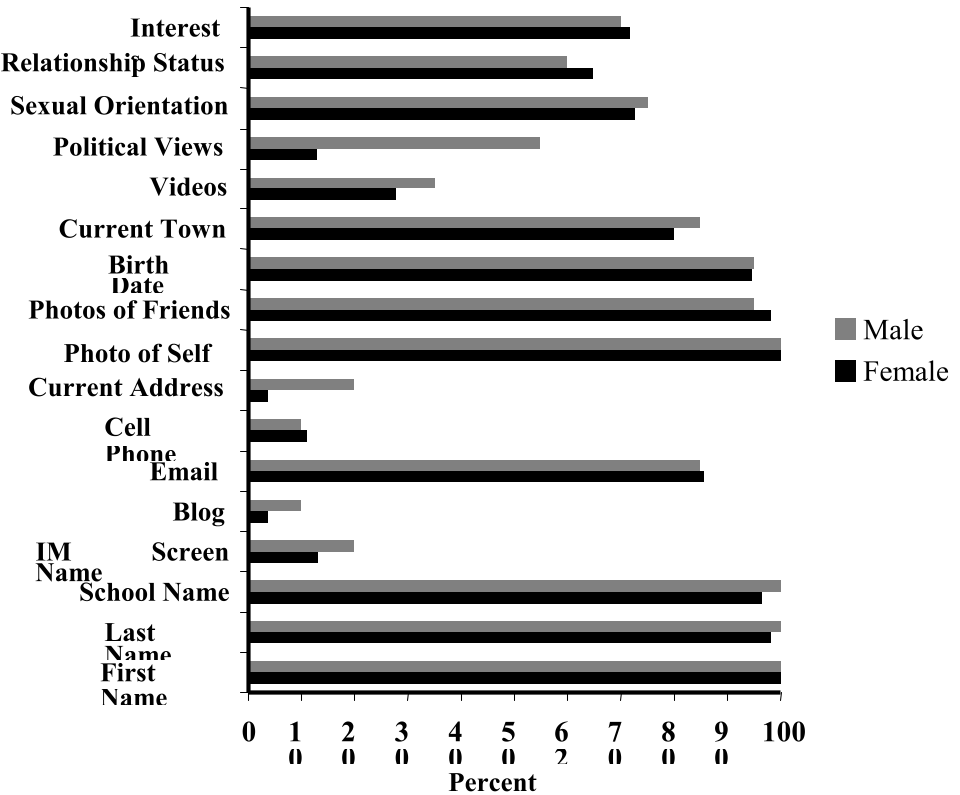 Figure 1: Comparison of disclosure levels between male and female users shows high uniformity in sharing school names and emails, but divergence in political views.
The Defense Mechanisms: How Students Fight Back
The study categorizes strategies into two buckets based on the type of privacy threatened:
- Expressive Privacy (Managing the Image): This is about "saving face." Strategies include untagging photos and deleting wall posts to prevent family members or "known others" from seeing "bad news" (e.g., party photos).
- Informational Privacy (Security): To prevent stalking or data mining, students restricted profile visibility to "friends only" and falsified minor details (like hometowns) while keeping their names real to remain findable.
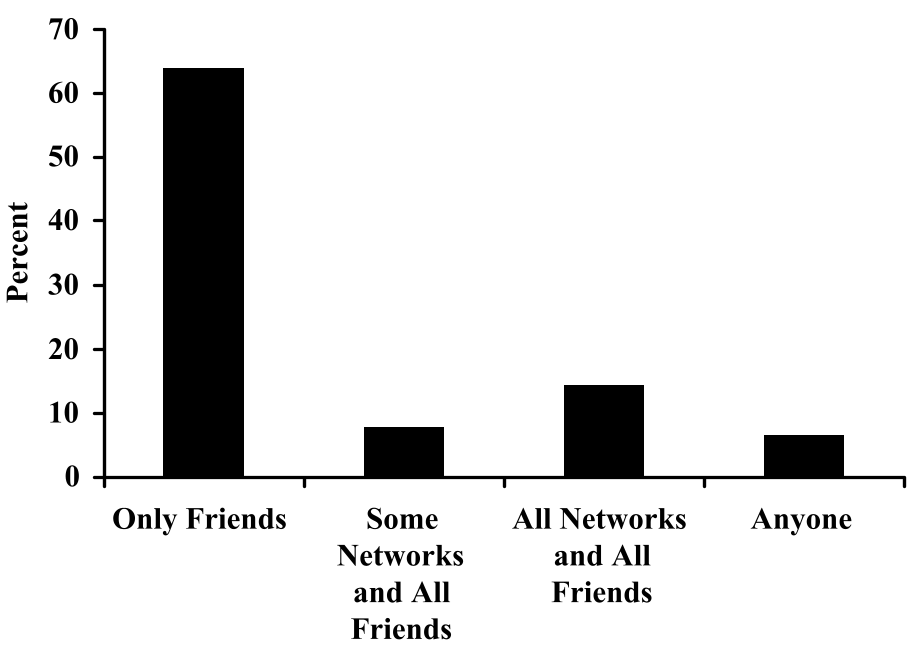 Table 2: The OLS regression demonstrates that network size and general privacy concerns are the most significant predictors of sharing behavior.
Critical Insight: The Social Necessity of "Being"
The paper echoes Jenny Sundén’s idea: to exist online, you must "write yourself into being." Silence on a social network is social death. Therefore, students don't use fake names (which would make them invisible to friends); they use accurate info but try to gatekeep the doors.
Conclusion and Limitations
While this study was conducted in 2009, its findings remain the bedrock for understanding why we can't "just quit" social media despite the privacy risks. The primary limitation is its small, Canadian-specific sample. Today’s landscape—dominated by algorithmic feeds and permanent data trails—makes the "strategies" of 2009 (like untagging) seem almost quaint, yet the underlying motivation remains the same: we share because we want to belong.
Takeaway for Researchers
Privacy is not a binary (hidden/revealed). It is a negotiation. Future product design should focus on helping users manage these "expressive" risks more intuitively, as users clearly value social connectivity over absolute data anonymity.