
The Facebook Privacy Time Capsule: Why We Ignored the Warnings in 2005
Information revelation and privacy in online social networks
This seminal 2005 paper investigates personal information revelation and privacy risks on "The Facebook" (now Facebook) during its early explosive growth. By analyzing over 4,000 Carnegie Mellon University (CMU) profiles, the authors highlight a massive disconnect between users' high-disclosure behavior and their minimal engagement with privacy settings.
TL;DR
In 2005, before Facebook became a global titan, researchers Ralph Gross and Alessandro Acquisti conducted a clinical "autopsy" of privacy at Carnegie Mellon University. They discovered that while users shared intimate details—address, phone numbers, and class schedules—less than 1.2% bothered to change their default privacy settings. This paper serves as the "Ground Zero" for understanding the Privacy Paradox we live in today.
Background: The Birth of the "Imagined Community"
In the mid-2000s, social networking was transitioning from niche tools to mass adoption. Unlike the pseudonymity of early chat rooms, "The Facebook" demanded real identities. Gross and Acquisti realized that this created a paradox: the platform felt like a safe, "bounded" campus community (an Imagined Community), but in reality, it was a wide-open database accessible to anyone with a university email.
Methodology: Peering into the Digital Fishbowl
The authors analyzed 4,540 CMU profiles, looking at:
- Data Validity: Are these real people? (Spoiler: 89% used real names).
- Identifiability: Can we recognize them? (61% used high-quality, identifiable headshots).
- Privacy Engagement: Do they use the tools provided?
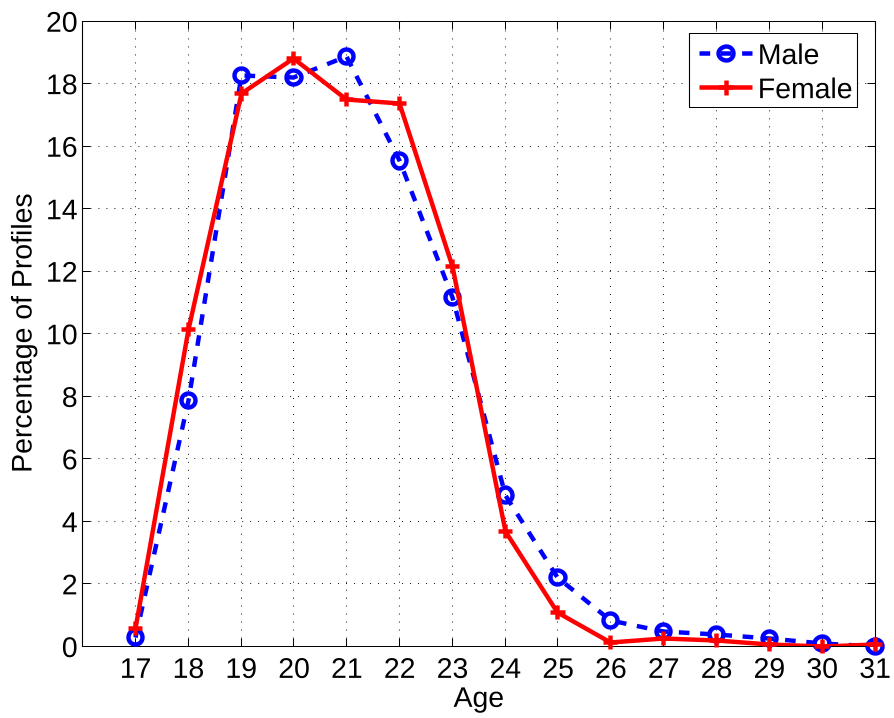 The study focused on the 18-24 demographic, a group that was then—and arguably still is—the most active in digital self-disclosure.
The Core Insight: The Illusion of Control
The most striking finding wasn't that people shared data, but how they shared it.
- Default Bias: Despite a "granular and relatively sophisticated interface" for privacy, almost no one used it. The "Recommended" default settings allowed anyone in the network to see everything.
- The Signaling Motive: Users were more concerned with "signaling" (finding dates, building social capital) than with long-term risks like identity theft.
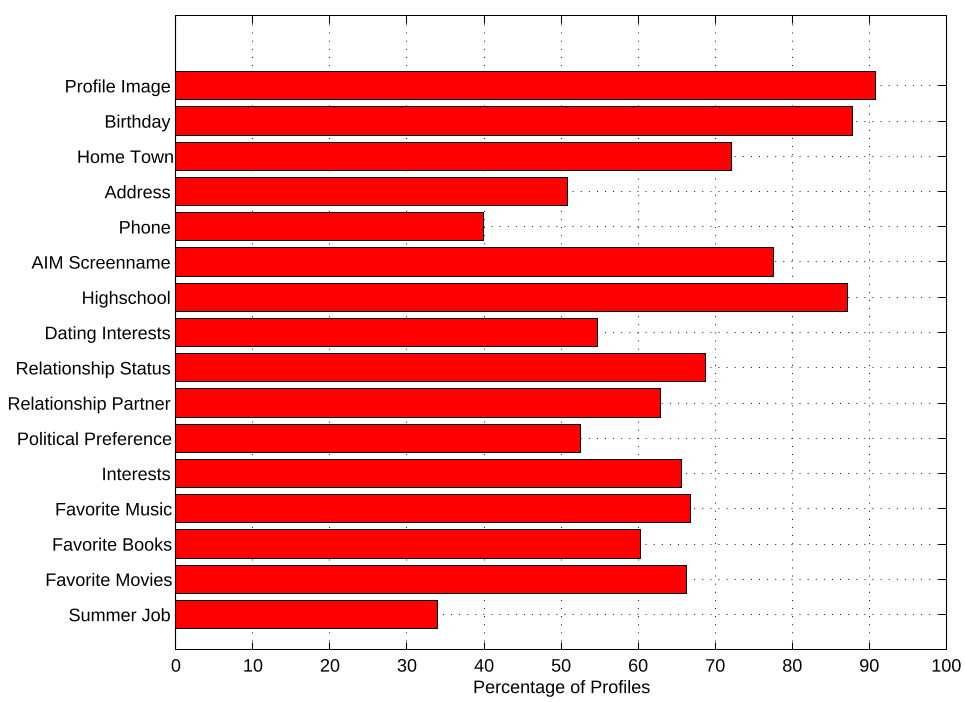 Most users revealed their birthdate, relationship status, and current residence, often without considering the implications of combining these data points.
Quantifying the Danger: Stalking and Identity Theft
The researchers didn't just point out vulnerabilities; they quantified prospective attacks:
- Stalking: 21% of males and 15% of females revealed enough info (residence + class schedule) to be physically located in real-time.
- Demographics Re-identification: 44.3% of users were uniquely identifiable just by combining their gender and birthdate—data that can be linked to "de-identified" hospital or voter records.
- The Digital Dossier: The authors presciently noted that while a student might not care about their party photos today, the durability of digital data means those photos could be used for price discrimination or employment screening a decade later.
Critical Analysis: Why It Still Matters
This paper debunked the myth that "if you give people privacy controls, they will protect themselves." It proved that UI/UX design is more powerful than policy. By making permissive settings the default, Facebook ensured maximum data flow, even if it compromised user safety.
Limitations
The study was limited to a single elite university (CMU) and measured behavior at a time when "privacy" wasn't yet a mainstream buzzword. However, the psychological drivers they identified—peer pressure and myopic evaluation of risk—remain core to human nature.
Summary Table: Risk Exposure

Conclusion: A Warning Ignored
Gross and Acquisti concluded that the Facebook community was "more imagined than real." Users trusted a "physical" community that didn't actually have walls. Twenty years later, as we grapple with global data breaches and AI scraping, this paper reminds us that the fundamental vulnerability of social media isn't a bug—it’s a feature of how we choose to signal our presence to the world.