
ACANTO: Balancing Privacy and Social Interaction in Robotic Assistants for the Elderly
Information Security, Privacy, and Trust in Social Robotic Assistants for Older Adults
The paper introduces the ACANTO project, which develops the "FriWalk" robotic assistant to foster social and therapeutic activities for mobility-impaired older adults. It proposes a socio-technical framework combining group motion planning and social networking while addressing critical Information Security, Privacy, and Trust (ISPT) challenges.
TL;DR
The ACANTO project introduces the FriWalk, a robotic walker designed to transition older adults from isolation to social mobility. By combining social networking with group motion planning, it tackles the "vicious cycle" of deteriorating health, while solving the paradox of sharing sensitive medical information in a collaborative environment through technical obfuscation and statistical validation.
Background: The Socially Conscious Robot
Current assistive technologies often treat the user as an isolated agent. However, human mobility is inherently social. The ACANTO project (built on the earlier DALi work) shifts the paradigm by treating elderly users as part of a social network. The challenge? To move a group of people together, the system needs to know their physical limits, medical needs, and real-time locations—all of which are highly sensitive data points.
Problem: The "Observable Constraint" Leak
The authors identify a unique privacy threat: Plan-based Inference.
- The Logic: If a group path is forced to stay near a bathroom or avoid stairs, other group members can easily infer the medical conditions of their peers just by looking at the "unnatural" route chosen by the FriWalk.
- The Server Dilemma: Using a central server to share sensor data improves safety (e.g., seeing around corners) but risks leaking the precise location of users to anyone on the same network.
Methodology: Sophisticated Motion Intelligence
To solve these issues, ACANTO uses a hierarchical framework:
1. Social Force Model (SFM) & Group Abstraction
Instead of calculating every single user's path (which leads to exponential complexity), the system clusters users into moving groups. It applies "psychological forces" (attractive for goals, repulsive for obstacles) to simulate future trajectories.
2. Statistical Model Checking (SMC)
Because human behavior is unpredictable, the FriWalk uses SMC to run thousands of "what-if" simulations in real-time. It chooses the path that has the highest statistical probability of being safe and comfortable.
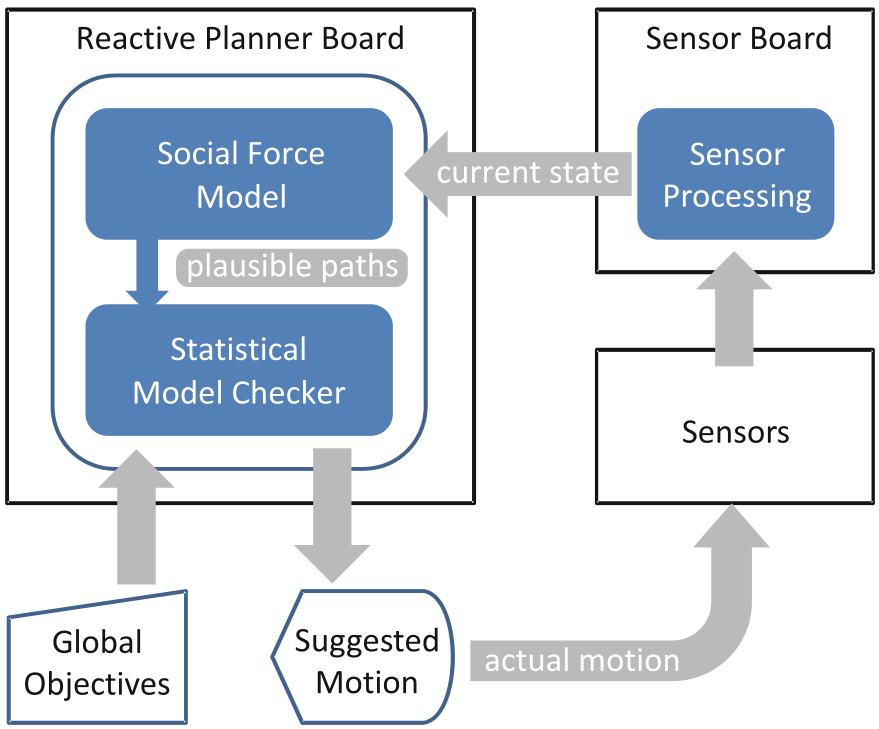 Figure 1: The reactive planning loop showing the integration of SFM and Statistical Model Checking.
Privacy and Trust: The Proposed Solutions
The paper doesn't just present the problem; it offers a roadmap for mitigation:
- Complexity as Obfuscation: By mixing multiple constraints (traffics, caloric burn goals, environmental noise), it becomes mathematically harder for a peer to reverse-engineer a specific medical requirement from a chosen path.
- Non-Deterministic Suggestion: By adding "noise" to the SFM, the robot’s suggestions aren't perfectly predictable, which prevents precise location inference of agents "around the corner."
- User Agency: Trust is built by allowing the user to ignore the robot. Like a car GPS, the FriWalk must "re-calculate" rather than "override" the human, preserving the user's sense of control.
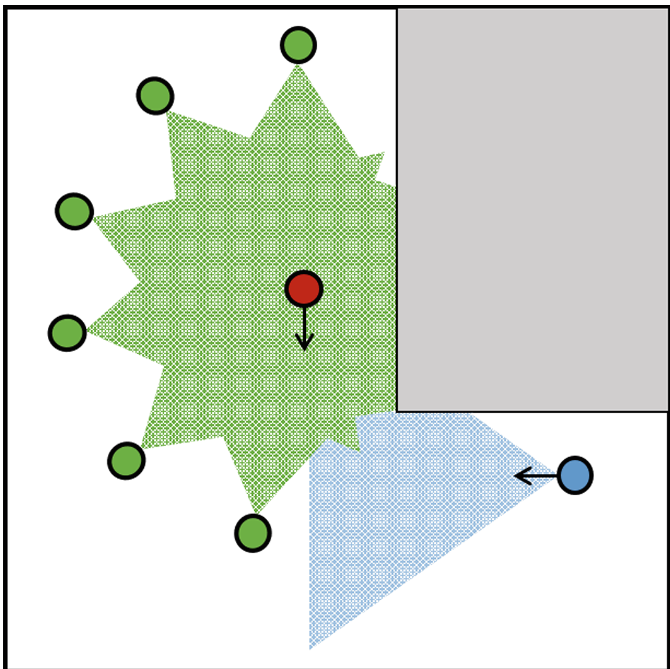 Figure 2: Example of how server-shared information (blue user perceiving a red agent via a green user) can lead to location leakage if not properly obfuscated.
Critical Insight: The Future of Assistive Robotics
The most profound takeaway from the ACANTO project is that trust is the ultimate currency. If an elderly user feels "tracked" or "exposed" by their walker, they will return to isolation. The authors argue that legal compliance is the minimum bar; the real challenge is creating a robot that feels like a "friend" (FriWalk) that respects secrets while ensuring safety.
Conclusion
As we move toward an aging society, social robots like the FriWalk will become common. This paper provides the necessary technical and ethical framework to ensure that our pursuit of mobility doesn't come at the cost of the user's dignity and privacy.
Reference Highlights
- The use of Sequential Probability Ratio Tests for efficient on-board verification.
- Integration of Differential Privacy concepts for medical data obfuscation.
- Adaptation of Social Force Models for elderly group correlation.