
When Technology Doesn't Fit: The Social Logic of the "Silent" Rural Internet
When technology doesn't fit: information sharing practices among farmers in rural China
This ethnographic study investigates the "informatization" gap in rural China, examining why farmers rarely use mobile phones and the Internet for agriculture despite widespread availability. Drawing on the "Community of Practice" framework, it highlights that farming remains a distributed social activity rooted in oral traditions and collective trust.
TL;DR
Despite China's massive investment in rural "informatization," farmers in the countryside are using their smartphones for everything except farming. This paper reveals that the failure of ag-tech isn't a lack of access, but a fundamental mismatch between the individualistic logic of digital tools and the socially distributed reality of village life. Farming in rural China is a "Community of Practice" where trust is built through face-to-face conversation, not a website.
The "Informatization" Paradox
In the mid-2000s, the Chinese State launched aggressive plans to "informatize" the countryside. The logic was simple: give farmers mobile phones and internet access, provide them with real-time market prices, and they will become more efficient, rational economic actors.
However, the ethnographic reality discovered by Elisa Oreglia is startlingly different. While the electrical grid is reliable and internet access is cheaper than in most developed countries, the computers in seed shops are often unplugged, and the agricultural television channels are only watched for their game shows.
Why the Digital Model Fails: Three Core Mismatches
1. Farming as a Social, Not Individual, Practice
The Western/Neoclassical view sees a farmer as an independent CEO making data-driven decisions. In reality, Chinese farming is a Community of Practice.
- How they learn: Not through manuals, but through "legitimate peripheral participation"—children helping in the fields, imitating elders.
- The "Everybody Knows" Effect: When asked where they get prices, farmers say "everybody knows." This refers to a collective validation process where a price is whispered at a gathering, checked against a neighbor's sale, and confirmed by a passing trader.
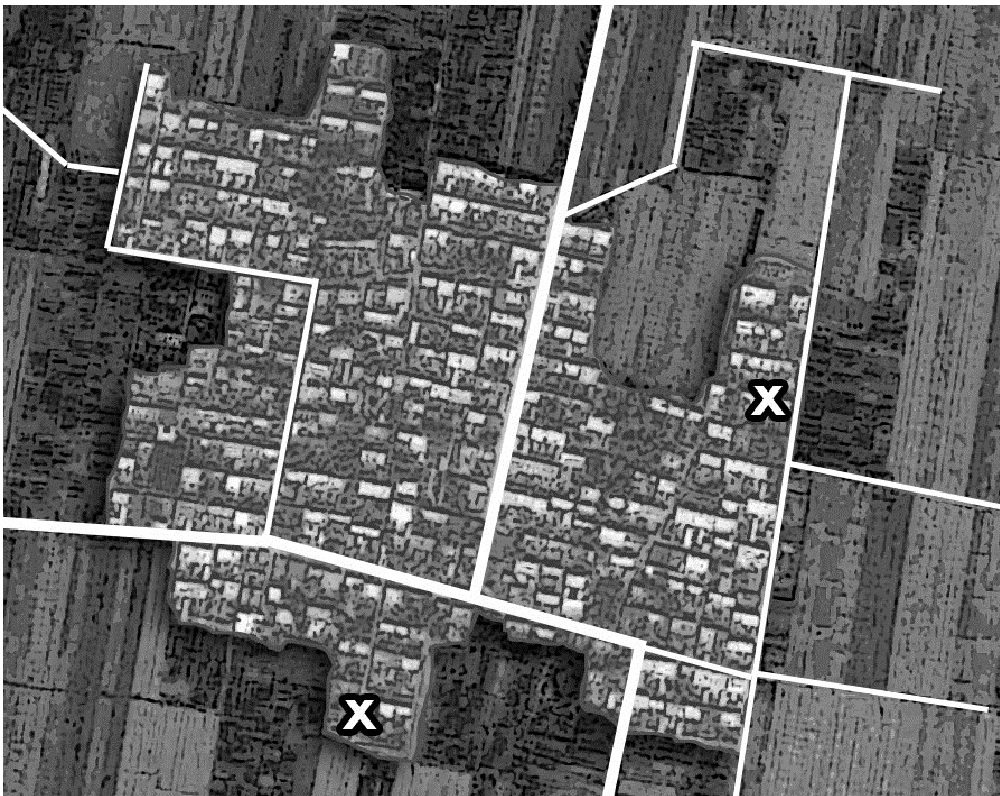 Figure 1: Social interaction happens at critical physical junctions (marked X), not in the isolation of a digital screen.
2. Orality vs. Textual Documentation
The government builds websites (text-based, immediate, abstract). The village operates on orality (tradition-oriented, continuous, contextual).
- Trust: Farmers trust an agricultural extension worker not because of their degree, but because of a long-term relationship.
- Context: A digital "national price index" is seen as irrelevant because it doesn't account for the "fit"—the quality of a specific corn handful or the convenience of a trader coming directly to the farm gate.
3. Risk Aversion vs. Profit Maximization
Informatization assumes farmers want to maximize income. However, most rural residents are older, with children sending remittances from cities. Their goal is predictability.
- The Case of Mr. Cui: He tried growing garlic when prices were high but got burned when the market crashed. He returned to wheat and corn—not because he lacked information, but because "at least it's safe."
The "Convenience" Factor
The word "convenience" (fangbian) appears constantly in the interviews. It serves as a catch-all for a choice that minimizes friction. Selling to a local trader for a slightly lower price is "convenient" because it requires no transport and avoids the risk of a volatile city market. Current ICT tools often increase friction by requiring farmers to filter through unreliable digital ads or manage complex logistics.
Institutional Insight: The Human-Machine Gap
The paper argues that technology is currently situated in the household for leisure (talking to grandchildren, online shopping), while farming is situated in the community. Because the two domains don't overlap, the smartphone remains a tool for consumption, not production.
Conclusion: Beyond Digital Literacy
The takeaway for policymakers and tech developers is clear: Access is not Adoption.
- The Design-Actuality Gap: Systems designed by urban elites assume a "rational" market that doesn't exist at the village level.
- Future Path: If technology is to "fit," it must support the oral, social, and collective ways that farmers already share information. Until digital tools can replicate the trust of a neighborly chat at a village crossroads, they will remain "unplugged" in the fields.
Critical Analysis
While the paper provide a brilliant critique of top-down policy, it also notes the rise of "professional" large-scale farms where university-educated managers do use ICT. This suggests a future where the digital divide isn't about age or literacy, but about the scale of production. For the smallholder, the community remains the strongest "network" they have.